Download Mendeley
Secreted nuclease effector neutralization by active site mimicry in Bacillota.
Abbasian, R., Parajuli, B., Yu, L., Durocher, B., Gardner, E., Chodur, E., Dwelley, M.K., Ellermeier, C.D., Ho, T.D., Bosch, D.E.(2026) mBio 17: e0151626-e0151626
- PubMed: 42606298 Search on PubMedSearch on PubMed Central
- DOI: https://doi.org/10.1128/mbio.01516-26
- Primary Citation Related Structures:
11UX, 11UZ, 11VD, 11VF, 11VH, 11VJ, 11VK, 11VL, 11VM - PubMed Abstract:
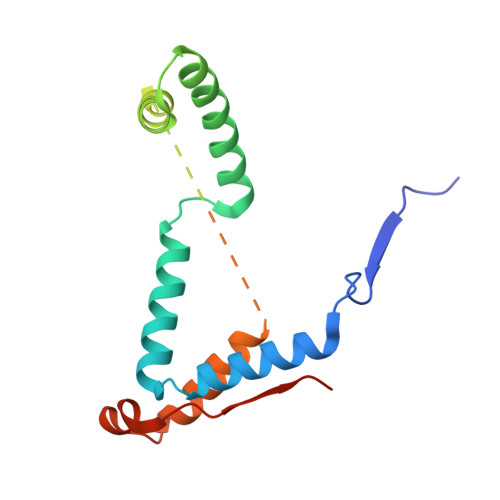
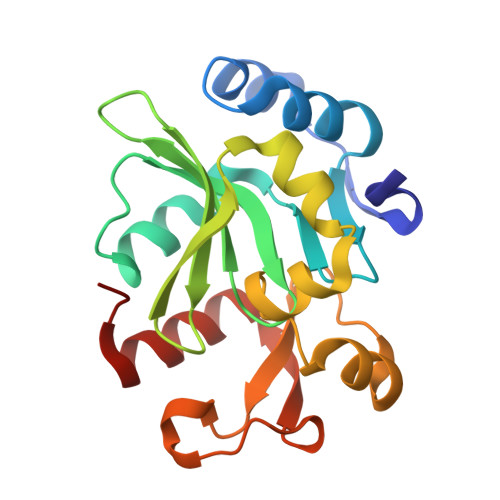
Polymorphic toxins mediate interbacterial antagonism among competitors in the gut microbiome. Nuclease effectors, distantly related to the type VI-secreted Bacteroidales Tde, are enriched in human gut Bacillota. Tde mediates antagonism among Bacillota, and expression of the cognate immunity, Tdi, in recipients is protective. Crystal structures of Tde/Tdi complexes from two Bacillus spp. and Enterococcus quebecensis highlight a conserved mechanism of immunity. Tdi engages Tde with high-affinity, specific binding at an interface that features predominantly polar amino acids. A separate Tdi interface has a very highly conserved P(Φ) 4 GG motif that structurally mimics and displaces a short helix in Tde's active site, which contains the critical catalytic residues. An isolated P(Φ) 4 GG motif peptide is sufficient for Tde nuclease activity inhibition at high concentrations. However, key residues at both the polar interface and P(Φ) 4 GG are required for complete inhibition of nuclease activity and protection against toxicity. We propose a multivalent Tde/Tdi neutralization mechanism where an initial high-affinity interface increases the local concentration of Tdi's P(Φ) 4 GG motif, enabling it to displace the Tde active site through structural mimicry. The resulting conformational rearrangement of Tde increases its flexibility in solution and susceptibility to proteolysis, which may aid in eliminating the toxic effector.IMPORTANCEBacteria in the gut microbiome compete using toxin secretion systems. Prior research has emphasized the importance of secretion systems in gram-negative bacteria. We describe a class of secreted nuclease effectors (toxins) and protective immunity proteins that are enriched in gram-positive Bacillota in human gut microbiomes. These effector/immunity pairs mediate antagonism among Bacillus and Enterococcus spp. The immunity proteins neutralize the nuclease effector through a unique mechanism of enzymatic active site mimicry. The immunity proteins bind effectors with very high-affinity at an interface with polar residues. The effector undergoes a large conformational change. A very highly conserved motif on the immunity surface competitively displaces an active site short helix and loop that contains the key catalytic residues. This rearrangement of the effector renders it inactive and susceptible to elimination by proteolysis.
- Pathology Department, University of Iowa, Iowa City, Iowa, USA.
Organizational Affiliation: