1CT5 | pdb_00001ct5

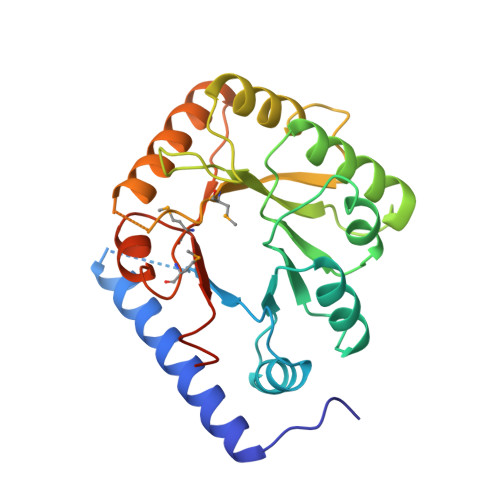
CRYSTAL STRUCTURE OF YEAST HYPOTHETICAL PROTEIN YBL036C-SELENOMET CRYSTAL


Experimental Data Snapshot

  • Method: X-RAY DIFFRACTION
  • Resolution: 2.00 Å
  • R-Value Free: 
    0.245 (Depositor), 0.247 (DCC) 
  • R-Value Work: 
    0.196 (Depositor), 0.212 (DCC) 

wwPDB Validation 3D Report Full Report

Validation slider image for 1CT5

Ligand Structure Quality Assessment 


This is version 1.4 of the entry. See complete history

Literature

Structure of a yeast hypothetical protein selected by a structural genomics approach.

Eswaramoorthy, S.Gerchman, S.Graziano, V.Kycia, H.Studier, F.W.Swaminathan, S.

(2003) Acta Crystallogr D Biol Crystallogr 59: 127-135

  • DOI: https://doi.org/10.1107/s0907444902018012
  • Primary Citation Related Structures: 
    1B54, 1CT5

  • PubMed Abstract: 

    Yeast hypothetical protein YBL036C (SWISS-PROT P38197), initially thought to be a member of an 11-protein family, was selected for crystal structure determination since no structural or functional information was available. The structure has been determined independently by MIR and MAD methods to 2.0 A resolution. The MAD structure was determined largely through automated model building. The protein folds as a TIM barrel beginning with a long N-terminal helix, in contrast to the classic triose phosphate isomerase (TIM) structure, which begins with a beta-strand. A cofactor, pyridoxal 5'-phosphate, is covalently bound near the C-terminal end of the barrel, the usual active site in TIM-barrel folds. A single-domain monomeric molecule, this yeast protein resembles the N-terminal domain of alanine racemase or ornithine decarboxylase, both of which are two-domain dimeric proteins. The yeast protein has been shown to have amino-acid racemase activity. Although selected as a member of a protein family having no obvious relationship to proteins of known structure, the protein fold turned out to be a well known and widely distributed fold. This points to the need for a more comprehensive base of structural information and better structure-modeling tools before the goal of structure prediction from amino-acid sequences can be realised. In this case, similarity to a known structure allowed inferences to be made about the structure and function of a widely distributed protein family.


  • Organizational Affiliation
    • Biology Department, Brookhaven National Laboratory, Upton, NY 11973, USA.

Macromolecule Content 

  • Total Structure Weight: 29.42 kDa 
  • Atom Count: 2,031 
  • Modeled Residue Count: 228 
  • Deposited Residue Count: 256 
  • Unique protein chains: 1

Macromolecules

Find similar proteins by:|  3D Structure
Entity ID: 1
MoleculeChains  Sequence LengthOrganismDetailsImage
PROTEIN (YEAST HYPOTHETICAL PROTEIN, SELENOMET)256Saccharomyces cerevisiaeMutation(s): 0 
UniProt
Find proteins for P38197 (Saccharomyces cerevisiae (strain ATCC 204508 / S288c))
Explore P38197 
Go to UniProtKB:  P38197
Entity Groups
Sequence Clusters30% Identity50% Identity70% Identity90% Identity95% Identity100% Identity
UniProt GroupP38197
Sequence Annotations
Expand
Reference Sequence

Small Molecules

Ligands 1 Unique
IDChains Name / Formula / InChI Key2D Diagram3D Interactions
PLP

Query on PLP


Download:Ideal Coordinates CCD File
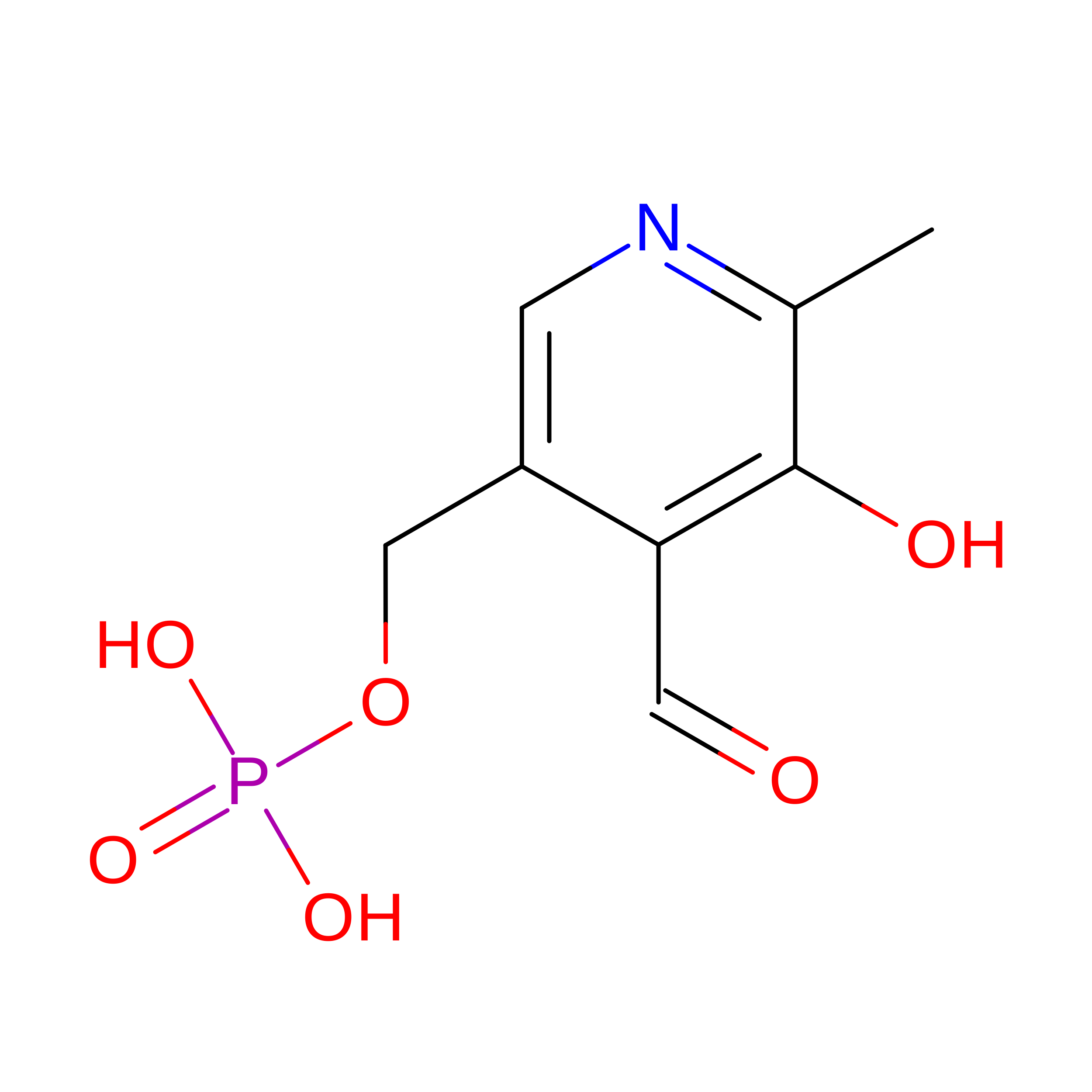
B [auth A]PYRIDOXAL-5'-PHOSPHATE
C8 H10 N O6 P
NGVDGCNFYWLIFO-UHFFFAOYSA-N
Modified Residues  1 Unique
IDChains TypeFormula2D DiagramParent
MSE
Query on MSE
A
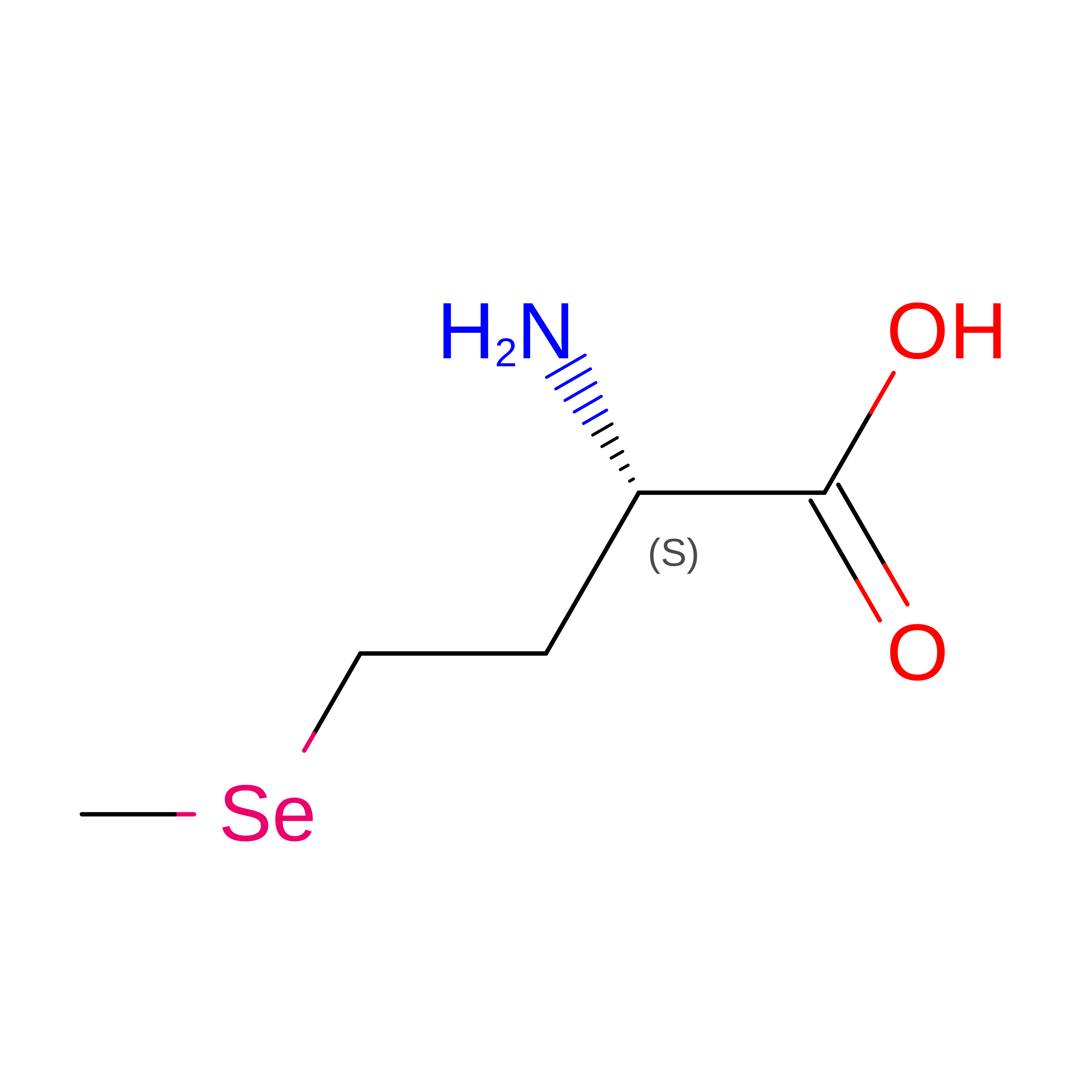
L-PEPTIDE LINKINGC5 H11 N O2 SeMET

Experimental Data & Validation

Experimental Data

  • Method: X-RAY DIFFRACTION
  • Resolution: 2.00 Å
  • R-Value Free:  0.245 (Depositor), 0.247 (DCC) 
  • R-Value Work:  0.196 (Depositor), 0.212 (DCC) 
Space Group: P 21 21 21
Unit Cell:
Length ( Å )Angle ( ˚ )
a = 49.052α = 90
b = 65.823β = 90
c = 93.052γ = 90
Software Package:
Software NamePurpose
DENZOdata reduction
SCALEPACKdata scaling
PHASESphasing
SHARPphasing
REFMACrefinement

Structure Validation

View Full Validation Report


Ligand Structure Quality Assessment 


Entry History 

Deposition Data

Revision History  (Full details and data files)

  • Version 1.0: 1999-09-02
    Type: Initial release
  • Version 1.1: 2007-10-16
    Changes: Version format compliance
  • Version 1.2: 2011-07-13
    Changes: Non-polymer description, Version format compliance
  • Version 1.3: 2021-02-03
    Changes: Derived calculations, Structure summary
  • Version 1.4: 2025-03-26
    Changes: Data collection, Database references, Structure summary