1TVO | pdb_00001tvo

The structure of ERK2 in complex with a small molecule inhibitor


Experimental Data Snapshot

  • Method: X-RAY DIFFRACTION
  • Resolution: 2.50 Å
  • R-Value Free: 
    0.272 (Depositor) 
  • R-Value Work: 
    0.263 (Depositor), 0.236 (DCC) 
  • R-Value Observed: 
    0.265 (Depositor) 

wwPDB Validation 3D Report Full Report

Validation slider image for 1TVO

Ligand Structure Quality Assessment 


This is version 1.4 of the entry. See complete history. 

Literature

Identification of a selective ERK inhibitor and structural determination of the inhibitor-ERK2 complex

Ohori, M., Kinoshita, T., Okubo, M., Sato, K., Yamazaki, A., Arakawa, H., Nishimura, S., Inamura, N., Nakajima, H., Neya, M., Miyake, H., Fujii, T.

(2005) Biochem Biophys Res Commun 336: 357-363

  • DOI: https://doi.org/10.1016/j.bbrc.2005.08.082
  • Primary Citation Related Structures: 
    1TVO

  • PubMed Abstract: 

    Selective inhibition of extracellular signal-regulated kinase (ERK) represents a potential approach for the treatment of cancer and other diseases; however, no selective inhibitors are currently available. Here, we describe an ERK-selective inhibitor, FR180204, and determine the structural basis of its selectivity. FR180204 inhibited the kinase activity of ERK1 and ERK2, with K(i) values 0.31 and 0.14microM, respectively. Lineweaver-Burk analysis of the binding interaction revealed that FR180204 acted as competitive inhibitor of ATP. In mink lung epithelial Mv1Lu cells, FR180204 inhibited TGFbeta-induced luciferase-expression. X-ray crystal structure analysis of the human ERK2/FR180204 complex revealed that Q105, D106, L156, and C166, which form the ATP-binding pocket on ERK, play important roles in the drug/protein interaction. These results suggest that FR180204 is an ERK-selective and cell-permeable inhibitor, and could be useful for elucidating the roles of ERK as well as for drug development.


  • Organizational Affiliation: 
    • Lead Discovery Research Laboratories, Astellas Pharma Inc., Miyukigaoka 21, Tsukuba, Ibaraki 305-8585, Japan. makoto.ohori@jp.astellas.com

Macromolecule Content 

  • Total Structure Weight: 42.56 kDa 
  • Atom Count: 3,020 
  • Modeled Residue Count: 350 
  • Deposited Residue Count: 368 
  • Unique protein chains: 1

Macromolecules

Find similar proteins by:|  3D Structure
Entity ID: 1
MoleculeChains  Sequence LengthOrganismDetailsImage
Mitogen-activated protein kinase 1368Homo sapiensMutation(s): 0 
EC: 2.7.1.37 (PDB Primary Data), 2.7.11.24 (UniProt)
UniProt & NIH Common Fund Data Resources
Find proteins for P28482 (Homo sapiens)
Explore P28482 
Go to UniProtKB:  P28482
PHAROS:  P28482
GTEx:  ENSG00000100030 
Entity Groups
Sequence Clusters30% Identity50% Identity70% Identity90% Identity95% Identity100% Identity
UniProt GroupP28482
Sequence Annotations
Expand
Reference Sequence

Small Molecules

Ligands 1 Unique
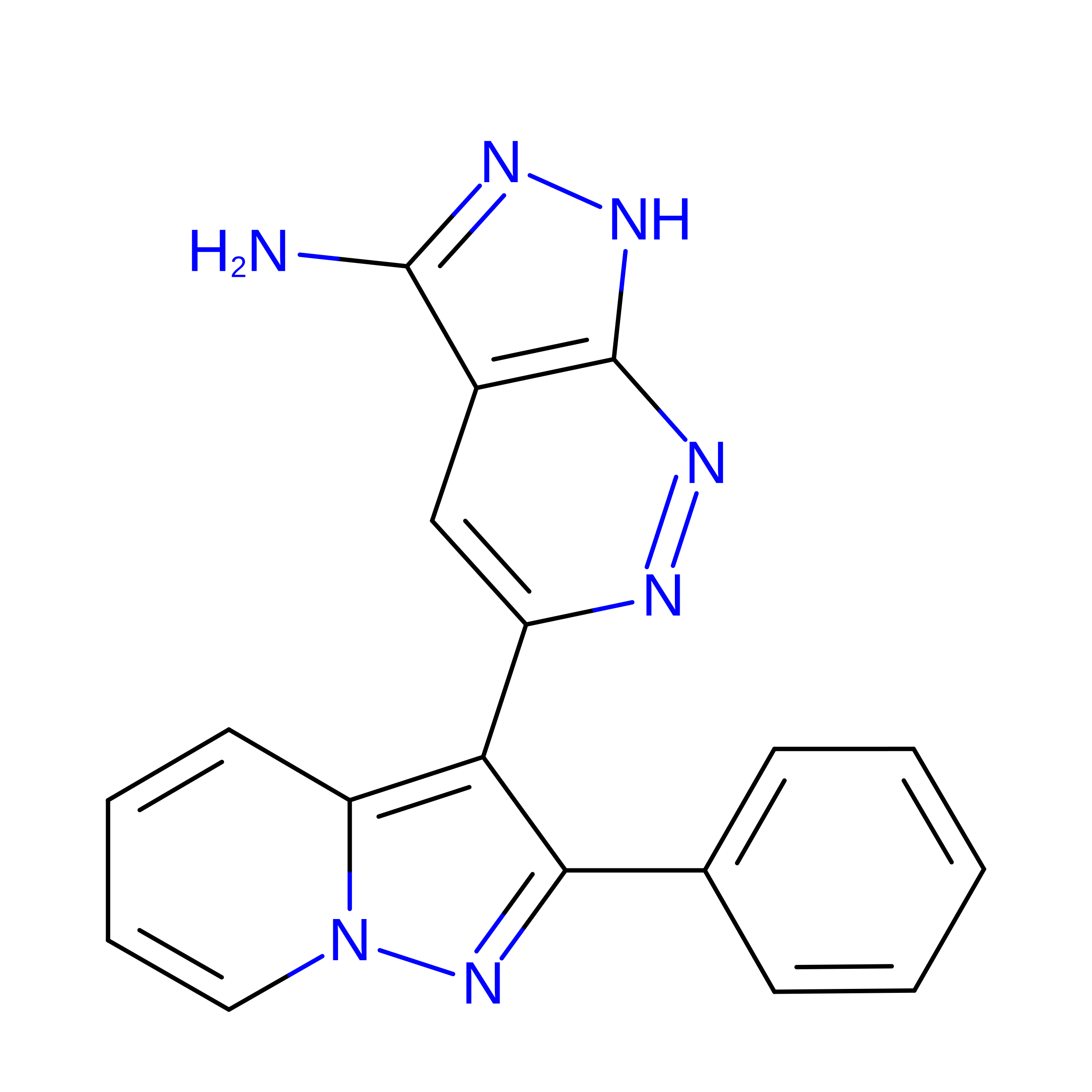
IDChains Name / Formula / InChI Key2D Diagram3D Interactions
FRZ

Query on FRZ


Download:Ideal Coordinates CCD File
B [auth A]5-(2-PHENYLPYRAZOLO[1,5-A]PYRIDIN-3-YL)-1H-PYRAZOLO[3,4-C]PYRIDAZIN-3-AMINE
C18 H13 N7
XVECMUKVOMUNLE-UHFFFAOYSA-N

Experimental Data & Validation

Experimental Data

  • Method: X-RAY DIFFRACTION
  • Resolution: 2.50 Å
  • R-Value Free:  0.272 (Depositor) 
  • R-Value Work:  0.263 (Depositor), 0.236 (DCC) 
  • R-Value Observed: 0.265 (Depositor) 
Space Group: P 1 21 1
Unit Cell:
Length ( Å )Angle ( ˚ )
a = 48.86α = 90
b = 69.99β = 116.5
c = 63.3γ = 90
Software Package:
Software NamePurpose
CNXrefinement
CrystalCleardata scaling
AMoREphasing

Structure Validation

View Full Validation Report


Ligand Structure Quality Assessment 


Entry History 

Deposition Data

Revision History  (Full details and data files)

  • Version 1.0: 2005-09-13
    Type: Initial release
  • Version 1.1: 2008-04-30
    Changes: Version format compliance
  • Version 1.2: 2011-07-13
    Changes: Version format compliance
  • Version 1.3: 2017-10-11
    Changes: Refinement description
  • Version 1.4: 2024-03-13
    Changes: Data collection, Database references, Derived calculations