2I4O | pdb_00002i4o

Rhodopseudomonas palustris prolyl-tRNA synthetase in complex with ATP


Experimental Data Snapshot

  • Method: X-RAY DIFFRACTION
  • Resolution: 2.40 Å
  • R-Value Free: 
    0.261 (Depositor), 0.255 (DCC) 
  • R-Value Work: 
    0.197 (Depositor), 0.192 (DCC) 
  • R-Value Observed: 
    0.201 (Depositor) 

Starting Model: experimental
View more details

wwPDB Validation 3D Report Full Report

Validation slider image for 2I4O

Ligand Structure Quality Assessment 


This is version 1.4 of the entry. See complete history

Literature

Structures of Two Bacterial Prolyl-tRNA Synthetases with and without a cis-Editing Domain.

Crepin, T.Yaremchuk, A.Tukalo, M.Cusack, S.

(2006) Structure 14: 1511-1525

  • DOI: https://doi.org/10.1016/j.str.2006.08.007
  • Primary Citation Related Structures: 
    2I4L, 2I4M, 2I4N, 2I4O, 2J3L, 2J3M

  • PubMed Abstract: 

    Prolyl-tRNA synthetases (ProRSs) are unique among synthetases in that they have diverse architectures, notably the variable presence of a cis-editing domain homologous to the freestanding deacylase proteins YbaK and ProX. Here, we describe crystal structures of two bacterial ProRSs from the pathogen Enterococcus faecalis, which possesses an editing domain, and from Rhodopseudomonas palustris, which does not. We compare the overall structure and binding mode of ATP and prolyl-adenylate with those of the archael/eukaryote-type ProRS from Thermus thermophilus. Although structurally more homologous to YbaK, which preferentially hydrolyzes Cys-tRNA(Pro), the editing domain of E. faecalis ProRS possesses key elements similar to ProX, with which it shares the activity of hydrolyzing Ala-tRNA(Pro). The structures give insight into the complex evolution of ProRSs, the mechanism of editing, and structural differences between prokaryotic- and eukaryotic-type ProRSs that can be exploited for antibiotic design.


  • Organizational Affiliation
    • European Molecular Biology Laboratory, Grenoble Outstation, 6 rue Jules Horowitz, BP 181, F-38042 Grenoble Cedex 9, France.

Macromolecule Content 

  • Total Structure Weight: 156.35 kDa 
  • Atom Count: 10,865 
  • Modeled Residue Count: 1,323 
  • Deposited Residue Count: 1,374 
  • Unique protein chains: 1

Macromolecules

Find similar proteins by:|  3D Structure
Entity ID: 1
MoleculeChains  Sequence LengthOrganismDetailsImage
Proline-tRNA ligase
A, B, C
458Rhodopseudomonas palustrisMutation(s): 0 
Gene Names: proSRPA2928
EC: 6.1.1.15
UniProt
Find proteins for Q6N5P6 (Rhodopseudomonas palustris (strain ATCC BAA-98 / CGA009))
Explore Q6N5P6 
Go to UniProtKB:  Q6N5P6
Entity Groups
Sequence Clusters30% Identity50% Identity70% Identity90% Identity95% Identity100% Identity
UniProt GroupQ6N5P6
Sequence Annotations
Expand
Reference Sequence

Small Molecules

Ligands 2 Unique
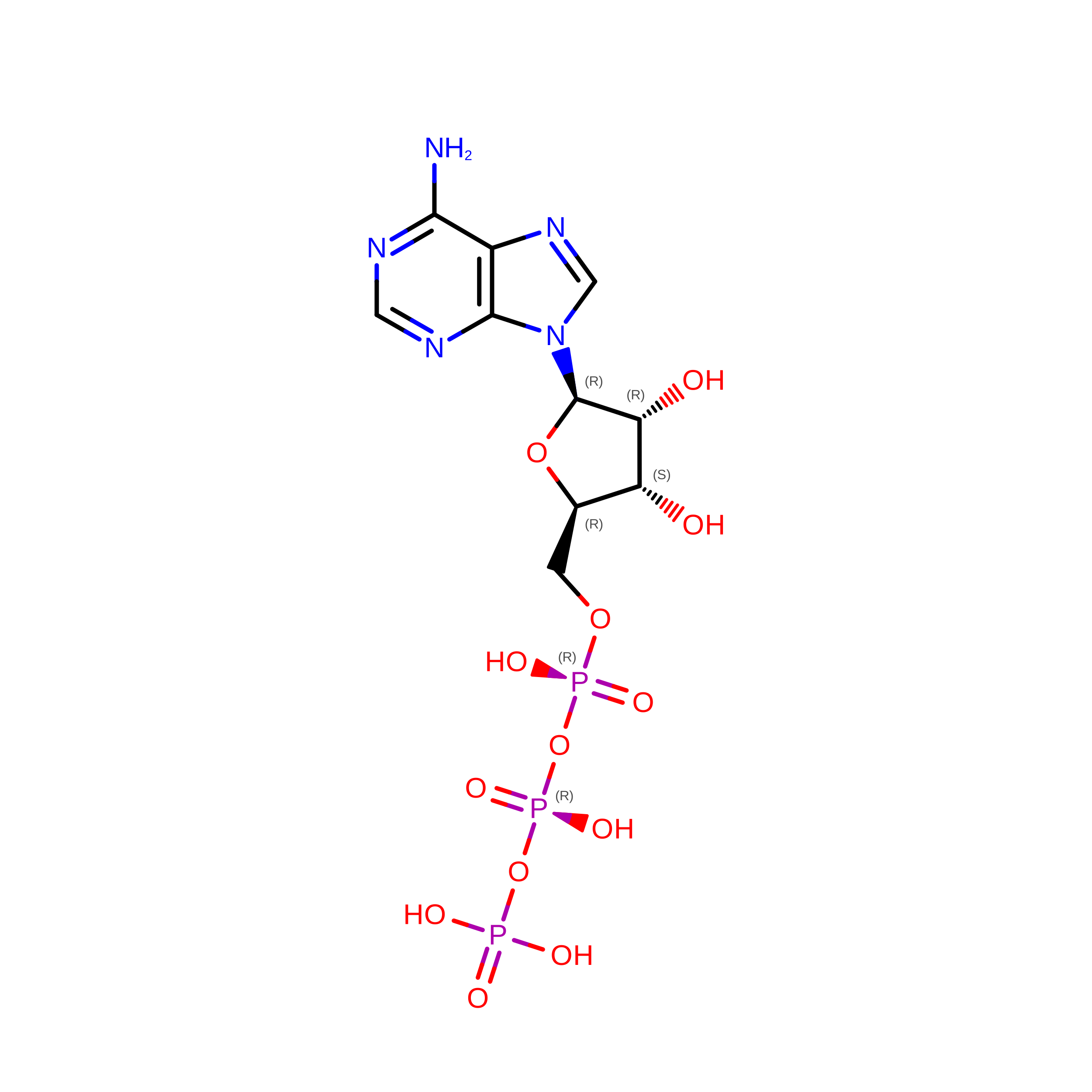
IDChains Name / Formula / InChI Key2D Diagram3D Interactions
ATP

Query on ATP


Download:Ideal Coordinates CCD File
G [auth A],
K [auth B],
N [auth C]
ADENOSINE-5'-TRIPHOSPHATE
C10 H16 N5 O13 P3
ZKHQWZAMYRWXGA-KQYNXXCUSA-N
MG

Query on MG


Download:Ideal Coordinates CCD File
D [auth A]
E [auth A]
F [auth A]
H [auth B]
I [auth B]
D [auth A],
E [auth A],
F [auth A],
H [auth B],
I [auth B],
J [auth B],
L [auth C],
M [auth C]
MAGNESIUM ION
Mg
JLVVSXFLKOJNIY-UHFFFAOYSA-N

Experimental Data & Validation

Experimental Data

  • Method: X-RAY DIFFRACTION
  • Resolution: 2.40 Å
  • R-Value Free:  0.261 (Depositor), 0.255 (DCC) 
  • R-Value Work:  0.197 (Depositor), 0.192 (DCC) 
  • R-Value Observed: 0.201 (Depositor) 
Space Group: C 2 2 21
Unit Cell:
Length ( Å )Angle ( ˚ )
a = 114.2α = 90
b = 211.21β = 90
c = 148.21γ = 90
Software Package:
Software NamePurpose
REFMACrefinement
MxCuBEdata collection
XDSdata reduction
XSCALEdata scaling
MOLREPphasing

Structure Validation

View Full Validation Report


Ligand Structure Quality Assessment 


Entry History 

Deposition Data

Revision History  (Full details and data files)

  • Version 1.0: 2006-10-24
    Type: Initial release
  • Version 1.1: 2008-05-01
    Changes: Version format compliance
  • Version 1.2: 2011-07-13
    Changes: Advisory, Refinement description, Version format compliance
  • Version 1.3: 2024-02-21
    Changes: Data collection, Database references, Derived calculations
  • Version 1.4: 2024-04-03
    Changes: Refinement description