2Q50 | pdb_00002q50

Ensemble refinement of the protein crystal structure of a glyoxylate/hydroxypyruvate reductase from Homo sapiens


Experimental Data Snapshot

  • Method: X-RAY DIFFRACTION
  • Resolution: 2.45 Å
  • R-Value Free: 
    0.286 (Depositor), 0.285 (DCC) 
  • R-Value Work: 
    0.200 (Depositor), 0.204 (DCC) 
  • R-Value Observed: 
    0.200 (Depositor) 

Starting Model: experimental
View more details

wwPDB Validation 3D Report Full Report

Validation slider image for 2Q50

This is version 1.6 of the entry. See complete history

Re-refinement Note

This entry reflects an alternative modeling of the original data in: 2H1S

Literature

Ensemble refinement of protein crystal structures: validation and application.

Levin, E.J.Kondrashov, D.A.Wesenberg, G.E.Phillips, G.N.

(2007) Structure 15: 1040-1052

  • DOI: https://doi.org/10.1016/j.str.2007.06.019
  • Primary Citation Related Structures: 
    2Q3M, 2Q3O, 2Q3P, 2Q3Q, 2Q3R, 2Q3S, 2Q3T, 2Q3U, 2Q3V, 2Q3W, 2Q40, 2Q41, 2Q42, 2Q43, 2Q44, 2Q45, 2Q46, 2Q47, 2Q48, 2Q49, 2Q4A, 2Q4B, 2Q4C, 2Q4D, 2Q4E, 2Q4F, 2Q4H, 2Q4I, 2Q4J, 2Q4K, 2Q4L, 2Q4M, 2Q4N, 2Q4O, 2Q4P, 2Q4Q, 2Q4R, 2Q4S, 2Q4T, 2Q4U, 2Q4V, 2Q4X, 2Q4Y, 2Q4Z, 2Q50, 2Q51, 2Q52

  • PubMed Abstract: 

    X-ray crystallography typically uses a single set of coordinates and B factors to describe macromolecular conformations. Refinement of multiple copies of the entire structure has been previously used in specific cases as an alternative means of representing structural flexibility. Here, we systematically validate this method by using simulated diffraction data, and we find that ensemble refinement produces better representations of the distributions of atomic positions in the simulated structures than single-conformer refinements. Comparison of principal components calculated from the refined ensembles and simulations shows that concerted motions are captured locally, but that correlations dissipate over long distances. Ensemble refinement is also used on 50 experimental structures of varying resolution and leads to decreases in R(free) values, implying that improvements in the representation of flexibility observed for the simulated structures may apply to real structures. These gains are essentially independent of resolution or data-to-parameter ratio, suggesting that even structures at moderate resolution can benefit from ensemble refinement.


  • Organizational Affiliation
    • Department of Biochemistry, University of Wisconsin-Madison, Madison, WI 53706, USA.

Macromolecule Content 

  • Total Structure Weight: 143.61 kDa 
  • Atom Count: 10,218 
  • Modeled Residue Count: 1,284 
  • Deposited Residue Count: 1,312 
  • Unique protein chains: 1

Macromolecules

Find similar proteins by:|  3D Structure
Entity ID: 1
MoleculeChains  Sequence LengthOrganismDetailsImage
Glyoxylate reductase/hydroxypyruvate reductase
A, B, C, D
328Homo sapiensMutation(s): 5 
Gene Names: GRHPRGLXRMSTP035
EC: 1.1.1.79 (PDB Primary Data), 1.1.1.81 (UniProt)
UniProt & NIH Common Fund Data Resources
Find proteins for Q9UBQ7 (Homo sapiens)
Explore Q9UBQ7 
Go to UniProtKB:  Q9UBQ7
PHAROS:  Q9UBQ7
GTEx:  ENSG00000137106 
Entity Groups
Sequence Clusters30% Identity50% Identity70% Identity90% Identity95% Identity100% Identity
UniProt GroupQ9UBQ7
Sequence Annotations
Expand
Reference Sequence

Small Molecules

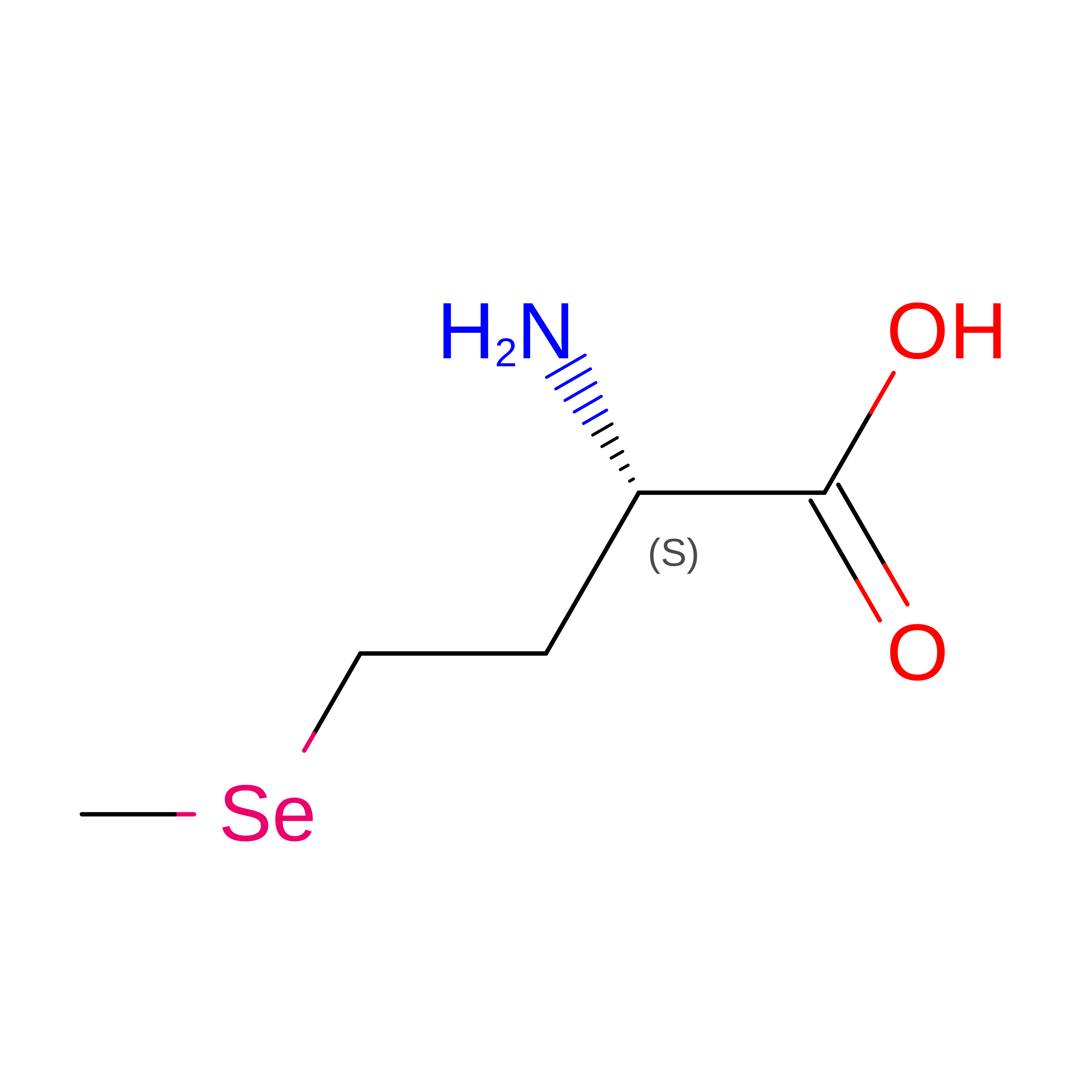
Modified Residues  1 Unique
IDChains TypeFormula2D DiagramParent
MSE
Query on MSE
A, B, C, D
L-PEPTIDE LINKINGC5 H11 N O2 SeMET

Experimental Data & Validation

Experimental Data

  • Method: X-RAY DIFFRACTION
  • Resolution: 2.45 Å
  • R-Value Free:  0.286 (Depositor), 0.285 (DCC) 
  • R-Value Work:  0.200 (Depositor), 0.204 (DCC) 
  • R-Value Observed: 0.200 (Depositor) 
Space Group: P 1 21 1
Unit Cell:
Length ( Å )Angle ( ˚ )
a = 75.996α = 90
b = 66.436β = 98.59
c = 148.774γ = 90
Software Package:
Software NamePurpose
CNSrefinement
PDB_EXTRACTdata extraction
CNSphasing

Structure Validation

View Full Validation Report


Entry History 

Deposition Data

Revision History  (Full details and data files)

  • Version 1.0: 2007-06-19
    Type: Initial release
  • Version 1.1: 2007-09-25
    Changes: Version format compliance
  • Version 1.2: 2011-07-13
    Changes: Derived calculations, Version format compliance
  • Version 1.3: 2011-08-10
    Changes: Other
  • Version 1.4: 2023-08-30
    Changes: Data collection, Database references, Derived calculations, Refinement description
  • Version 1.5: 2023-11-15
    Changes: Data collection
  • Version 1.6: 2024-11-06
    Changes: Structure summary