2V5R | pdb_00002v5r

Structural basis for Dscam isoform specificity


Experimental Data Snapshot

  • Method: X-RAY DIFFRACTION
  • Resolution: 3.00 Å
  • R-Value Free: 
    0.303 (Depositor), 0.302 (DCC) 
  • R-Value Work: 
    0.271 (Depositor), 0.270 (DCC) 

Starting Model: experimental
View more details

wwPDB Validation 3D Report Full Report

Validation slider image for 2V5R

Ligand Structure Quality Assessment 


This is version 1.6 of the entry. See complete history

Literature

Structural Basis of Dscam Isoform Specificity

Meijers, R.Puettmann-Holgado, R.Skiniotis, G.Liu, J.-H.Walz, T.Wang, J.-H.Schmucker, D.

(2007) Nature 449: 487

  • DOI: https://doi.org/10.1038/nature06147
  • Primary Citation Related Structures: 
    2V5M, 2V5R, 2V5S

  • PubMed Abstract: 

    The Dscam gene gives rise to thousands of diverse cell surface receptors thought to provide homophilic and heterophilic recognition specificity for neuronal wiring and immune responses. Mutually exclusive splicing allows for the generation of sequence variability in three immunoglobulin ecto-domains, D2, D3 and D7. We report X-ray structures of the amino-terminal four immunoglobulin domains (D1-D4) of two distinct Dscam isoforms. The structures reveal a horseshoe configuration, with variable residues of D2 and D3 constituting two independent surface epitopes on either side of the receptor. Both isoforms engage in homo-dimerization coupling variable domain D2 with D2, and D3 with D3. These interactions involve symmetric, antiparallel pairing of identical peptide segments from epitope I that are unique to each isoform. Structure-guided mutagenesis and swapping of peptide segments confirm that epitope I, but not epitope II, confers homophilic binding specificity of full-length Dscam receptors. Phylogenetic analysis shows strong selection of matching peptide sequences only for epitope I. We propose that peptide complementarity of variable residues in epitope I of Dscam is essential for homophilic binding specificity.


  • Organizational Affiliation
    • Department of Medical Oncology, Dana-Farber Cancer Institute, Boston, Massachusetts 02115, USA.

Macromolecule Content 

  • Total Structure Weight: 88.91 kDa 
  • Atom Count: 6,232 
  • Modeled Residue Count: 782 
  • Deposited Residue Count: 782 
  • Unique protein chains: 1

Macromolecules

Find similar proteins by:|  3D Structure
Entity ID: 1
MoleculeChains  Sequence LengthOrganismDetailsImage
DSCAM
A, B
391Drosophila melanogasterMutation(s): 43 
UniProt
Find proteins for Q0E9H9 (Drosophila melanogaster)
Explore Q0E9H9 
Go to UniProtKB:  Q0E9H9
Entity Groups
Sequence Clusters30% Identity50% Identity70% Identity90% Identity95% Identity100% Identity
UniProt GroupQ0E9H9
Sequence Annotations
Expand
Reference Sequence

Small Molecules

Ligands 2 Unique
IDChains Name / Formula / InChI Key2D Diagram3D Interactions
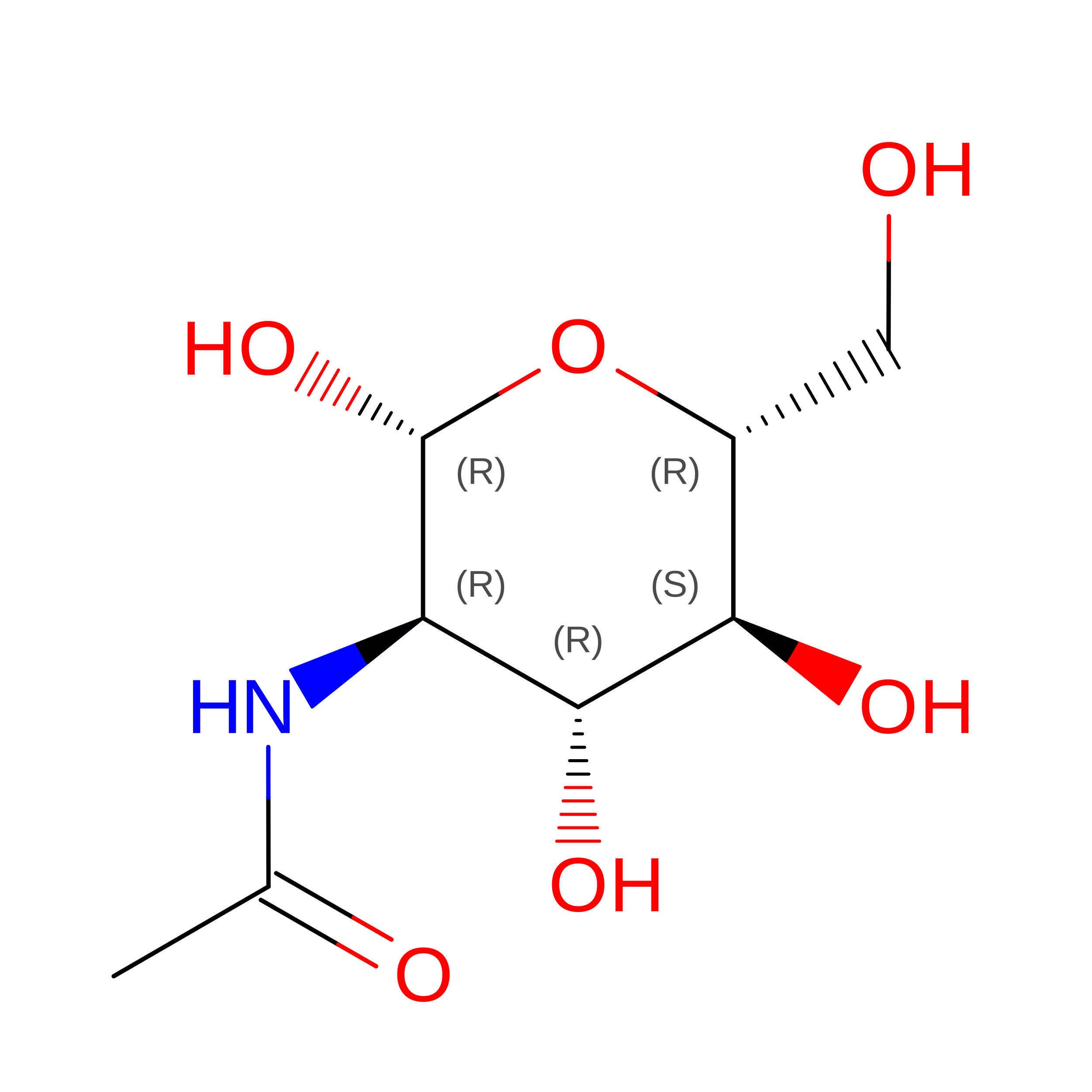
NAG

Query on NAG


Download:Ideal Coordinates CCD File
C [auth A]
D [auth A]
E [auth A]
F [auth A]
H [auth B]
C [auth A],
D [auth A],
E [auth A],
F [auth A],
H [auth B],
I [auth B],
J [auth B],
K [auth B]
2-acetamido-2-deoxy-beta-D-glucopyranose
C8 H15 N O6
OVRNDRQMDRJTHS-FMDGEEDCSA-N
GOL

Query on GOL


Download:Ideal Coordinates CCD File
G [auth B],
L [auth B]
GLYCEROL
C3 H8 O3
PEDCQBHIVMGVHV-UHFFFAOYSA-N

Experimental Data & Validation

Experimental Data

  • Method: X-RAY DIFFRACTION
  • Resolution: 3.00 Å
  • R-Value Free:  0.303 (Depositor), 0.302 (DCC) 
  • R-Value Work:  0.271 (Depositor), 0.270 (DCC) 
Space Group: C 1 2 1
Unit Cell:
Length ( Å )Angle ( ˚ )
a = 277.781α = 90
b = 70.548β = 105.13
c = 72.771γ = 90
Software Package:
Software NamePurpose
PHENIXrefinement
DENZOdata reduction
SCALEPACKdata scaling
MOLREPphasing

Structure Validation

View Full Validation Report


Ligand Structure Quality Assessment 


Entry History 

Deposition Data

Revision History  (Full details and data files)

  • Version 1.0: 2007-09-11
    Type: Initial release
  • Version 1.1: 2011-05-08
    Changes: Version format compliance
  • Version 1.2: 2011-07-13
    Changes: Version format compliance
  • Version 1.3: 2019-10-23
    Changes: Data collection, Database references, Other
  • Version 1.4: 2020-07-29
    Type: Remediation
    Reason: Carbohydrate remediation
    Changes: Data collection, Derived calculations, Structure summary
  • Version 1.5: 2023-12-13
    Changes: Data collection, Database references, Refinement description, Structure summary
  • Version 1.6: 2024-11-20
    Changes: Structure summary