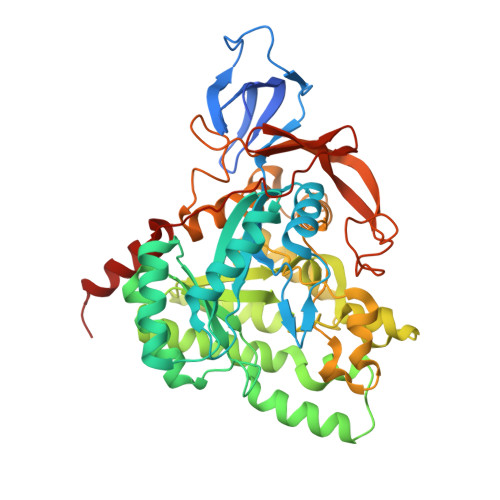
2VM8 | pdb_00002vm8

Human CRMP-2 crystallised in the presence of Mg


Experimental Data Snapshot

  • Method: X-RAY DIFFRACTION
  • Resolution: 1.90 Å
  • R-Value Free: 
    0.325 (Depositor), 0.315 (DCC) 
  • R-Value Work: 
    0.256 (Depositor) 
  • R-Value Observed: 
    0.259 (Depositor) 

Starting Model: experimental
View more details

wwPDB Validation 3D Report Full Report

Validation slider image for 2VM8

This is version 1.4 of the entry. See complete history

Literature

Crystal and Solution Structure, Stability and Post- Translational Modifications of Collapsin Response Mediator Protein 2.

Majava, V.Loytynoja, N.Chen, W.Q.Lubec, G.Kursula, P.

(2008) FEBS J 275: 4583

  • DOI: https://doi.org/10.1111/j.1742-4658.2008.06601.x
  • Primary Citation Related Structures: 
    2VM8

  • PubMed Abstract: 

    The collapsin response mediator protein 2 (CRMP-2) is a central molecule regulating axonal growth cone guidance. It interacts with the cytoskeleton and mediates signals related to myelin-induced axonal growth inhibition. CRMP-2 has also been characterized as a constituent of neurofibrillary tangles in Alzheimer's disease. CD spectroscopy and thermal stability assays using the Thermofluor method indicated that Ca2+ and Mg2+ affect the stability of CRMP-2 and prevent the formation of beta-aggregates upon heating. Gel filtration showed that the presence of Ca2+ or Mg2+ promoted the formation of CRMP-2 homotetramers, and this was further proven by small-angle X-ray scattering experiments, where a 3D solution structure for CRMP-2 was obtained. Previously, we described a crystal structure of human CRMP-2 complexed with calcium. In the present study, we determined the structure of CRMP-2 in the absence of calcium at 1.9 A resolution. When Ca2+ was omitted, crystals could only be grown in the presence of Mg2+ ions. By a proteomic approach, we further identified a number of post-translational modifications in CRMP-2 from rat brain hippocampus and mapped them onto the crystal structure.


  • Organizational Affiliation
    • Department of Biochemistry, University of Oulu, Finland.

Macromolecule Content 

  • Total Structure Weight: 220.46 kDa 
  • Atom Count: 16,539 
  • Modeled Residue Count: 1,905 
  • Deposited Residue Count: 2,004 
  • Unique protein chains: 1

Macromolecules

Find similar proteins by:|  3D Structure
Entity ID: 1
MoleculeChains  Sequence LengthOrganismDetailsImage
DIHYDROPYRIMIDINASE-RELATED PROTEIN 2
A, B, C, D
501Homo sapiensMutation(s): 0 
UniProt & NIH Common Fund Data Resources
Find proteins for Q16555 (Homo sapiens)
Explore Q16555 
Go to UniProtKB:  Q16555
PHAROS:  Q16555
GTEx:  ENSG00000092964 
Entity Groups
Sequence Clusters30% Identity50% Identity70% Identity90% Identity95% Identity100% Identity
UniProt GroupQ16555
Sequence Annotations
Expand
Reference Sequence

Experimental Data & Validation

Experimental Data

  • Method: X-RAY DIFFRACTION
  • Resolution: 1.90 Å
  • R-Value Free:  0.325 (Depositor), 0.315 (DCC) 
  • R-Value Work:  0.256 (Depositor) 
  • R-Value Observed: 0.259 (Depositor) 
Space Group: P 21 21 21
Unit Cell:
Length ( Å )Angle ( ˚ )
a = 86.51α = 90
b = 126.24β = 90
c = 209.75γ = 90
Software Package:
Software NamePurpose
REFMACrefinement
XDSdata reduction
XSCALEdata scaling
MOLREPphasing

Structure Validation

View Full Validation Report


Entry History 

Deposition Data

  • Released Date: 2008-08-26 
  • Deposition Author(s): Kursula, P.

Revision History  (Full details and data files)

  • Version 1.0: 2008-08-26
    Type: Initial release
  • Version 1.1: 2011-05-08
    Changes: Version format compliance
  • Version 1.2: 2011-07-13
    Changes: Version format compliance
  • Version 1.3: 2018-01-17
    Changes: Data collection
  • Version 1.4: 2023-12-13
    Changes: Data collection, Database references, Derived calculations, Other, Refinement description