3O8N | pdb_00003o8n

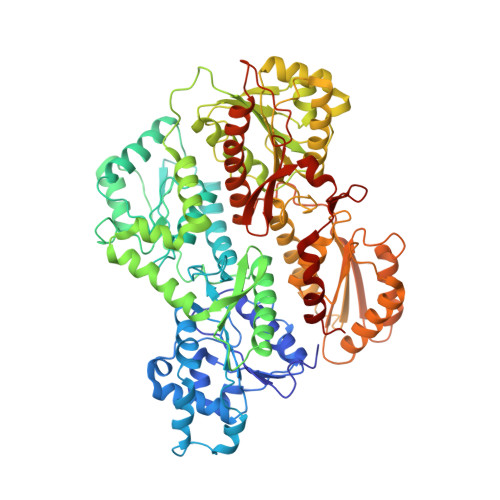
Structure of phosphofructokinase from rabbit skeletal muscle


Experimental Data Snapshot

  • Method: X-RAY DIFFRACTION
  • Resolution: 3.20 Å
  • R-Value Free: 
    0.302 (Depositor), 0.298 (DCC) 
  • R-Value Work: 
    0.229 (Depositor), 0.228 (DCC) 
  • R-Value Observed: 
    0.229 (Depositor) 

Starting Model: experimental
View more details

wwPDB Validation 3D Report Full Report

Validation slider image for 3O8N

Ligand Structure Quality Assessment 


This is version 1.2 of the entry. See complete history

Literature

The Crystal Structures of Eukaryotic Phosphofructokinases from Baker's Yeast and Rabbit Skeletal Muscle.

Banaszak, K.Mechin, I.Obmolova, G.Oldham, M.Chang, S.H.Ruiz, T.Radermacher, M.Kopperschlager, G.Rypniewski, W.

(2011) J Mol Biology 407: 284-297

  • DOI: https://doi.org/10.1016/j.jmb.2011.01.019
  • Primary Citation Related Structures: 
    3O8L, 3O8N, 3O8O

  • PubMed Abstract: 

    Phosphofructokinase 1 (PFK) is a multisubunit allosteric enzyme that catalyzes the principal regulatory step in glycolysis-the phosphorylation of fructose 6-phosphate to fructose 1,6-bisphosphate by ATP. The activity of eukaryotic PFK is modulated by a number of effectors in response to the cell's needs for energy and building blocks for biosynthesis. The crystal structures of eukaryotic PFKs-from Saccharomyces cerevisiae and rabbit skeletal muscle-demonstrate how successive gene duplications and fusion are reflected in the protein structure and how they allowed the evolution of new functionalities. The basic framework inherited from prokaryotes is conserved, and additional levels of structural and functional complexity have evolved around it. Analysis of protein-ligand complexes has shown how PFK is activated by fructose 2,6-bisphosphate (a powerful PFK effector found only in eukaryotes) and reveals a novel nucleotide binding site. Crystallographic results have been used as the basis for structure-based effector design.


  • Organizational Affiliation
    • Institute of Bioorganic Chemistry, Polish Academy of Sciences, Poznan, Poland.

Macromolecule Content 

  • Total Structure Weight: 169.67 kDa 
  • Atom Count: 11,630 
  • Modeled Residue Count: 1,496 
  • Deposited Residue Count: 1,524 
  • Unique protein chains: 1

Macromolecules

Find similar proteins by:|  3D Structure
Entity ID: 1
MoleculeChains  Sequence LengthOrganismDetailsImage
6-phosphofructokinase, muscle type
A, B
762Oryctolagus cuniculusMutation(s): 0 
Gene Names: PFKM
EC: 2.7.1.11
UniProt
Find proteins for P00511 (Oryctolagus cuniculus)
Explore P00511 
Go to UniProtKB:  P00511
Entity Groups
Sequence Clusters30% Identity50% Identity70% Identity90% Identity95% Identity100% Identity
UniProt GroupP00511
Sequence Annotations
Expand
Reference Sequence

Small Molecules

Ligands 2 Unique
IDChains Name / Formula / InChI Key2D Diagram3D Interactions
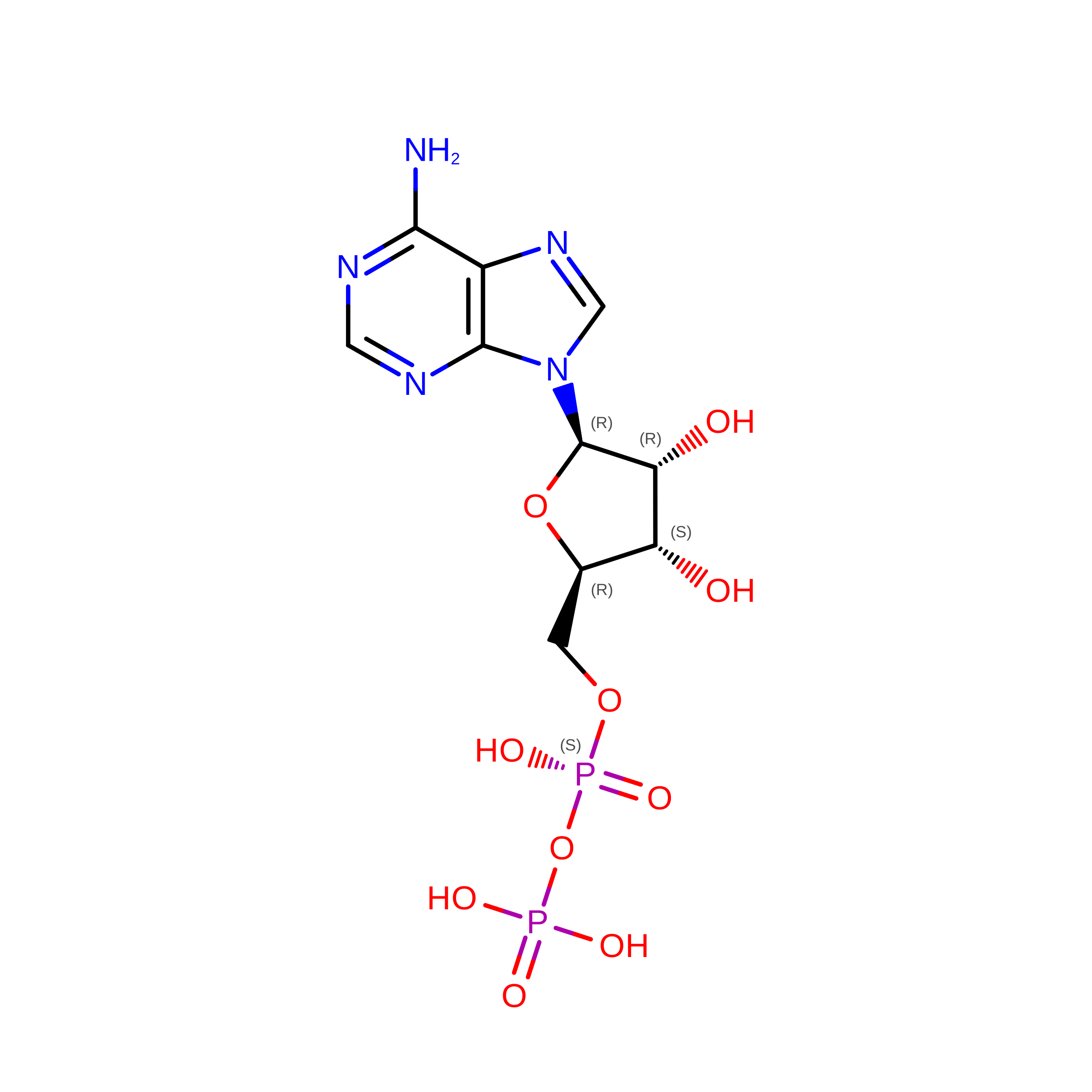
ADP

Query on ADP


Download:Ideal Coordinates CCD File
C [auth A]
D [auth A]
E [auth A]
I [auth B]
J [auth B]
C [auth A],
D [auth A],
E [auth A],
I [auth B],
J [auth B],
K [auth B]
ADENOSINE-5'-DIPHOSPHATE
C10 H15 N5 O10 P2
XTWYTFMLZFPYCI-KQYNXXCUSA-N
PO4

Query on PO4


Download:Ideal Coordinates CCD File
F [auth A]
G [auth A]
H [auth A]
L [auth B]
M [auth B]
F [auth A],
G [auth A],
H [auth A],
L [auth B],
M [auth B],
N [auth B]
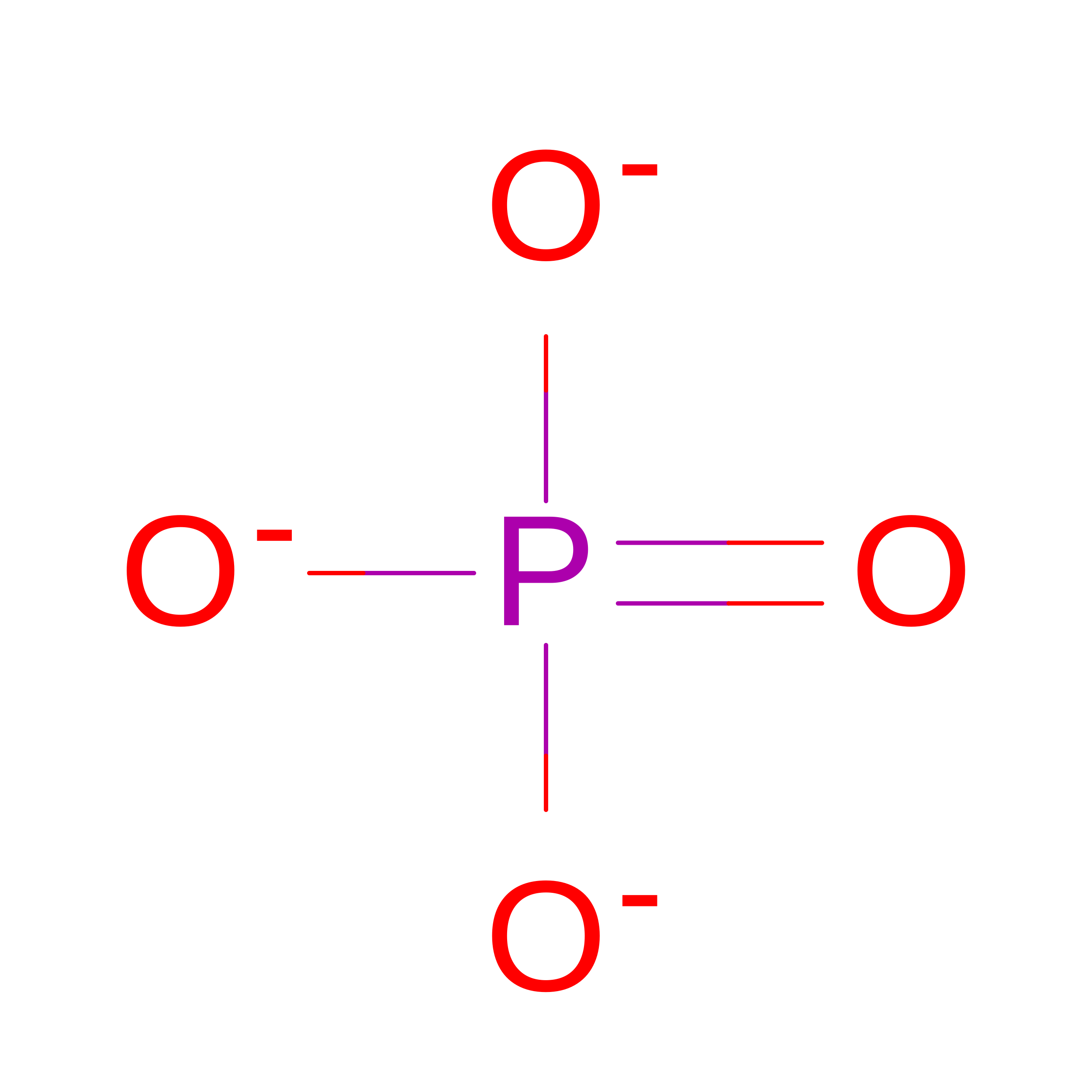
PHOSPHATE ION
O4 P
NBIIXXVUZAFLBC-UHFFFAOYSA-K

Experimental Data & Validation

Experimental Data

  • Method: X-RAY DIFFRACTION
  • Resolution: 3.20 Å
  • R-Value Free:  0.302 (Depositor), 0.298 (DCC) 
  • R-Value Work:  0.229 (Depositor), 0.228 (DCC) 
  • R-Value Observed: 0.229 (Depositor) 
Space Group: P 61 2 2
Unit Cell:
Length ( Å )Angle ( ˚ )
a = 163.292α = 90
b = 163.292β = 90
c = 356.939γ = 120
Software Package:
Software NamePurpose
MAR345dtbdata collection
PHASERphasing
CNSrefinement
DENZOdata reduction
SCALEPACKdata scaling

Structure Validation

View Full Validation Report


Ligand Structure Quality Assessment 


Entry History 

Deposition Data

Revision History  (Full details and data files)

  • Version 1.0: 2011-02-02
    Type: Initial release
  • Version 1.1: 2011-07-13
    Changes: Version format compliance
  • Version 1.2: 2023-09-06
    Changes: Data collection, Database references, Derived calculations, Refinement description