3WFG | pdb_00003wfg

Mineralocorticoid receptor ligand-binding domain with compuond 2e


Experimental Data Snapshot

  • Method: X-RAY DIFFRACTION
  • Resolution: 1.40 Å
  • R-Value Free: 
    0.179 (Depositor), 0.177 (DCC) 
  • R-Value Work: 
    0.164 (Depositor), 0.163 (DCC) 
  • R-Value Observed: 
    0.165 (Depositor) 

Starting Model: experimental
View more details

wwPDB Validation 3D Report Full Report

Validation slider image for 3WFG

Ligand Structure Quality Assessment 


This is version 1.2 of the entry. See complete history

Literature

Design, synthesis, and structure-activity relationships of dihydrofuran-2-one and dihydropyrrol-2-one derivatives as novel benzoxazin-3-one-based mineralocorticoid receptor antagonists.

Hasui, T.Ohra, T.Ohyabu, N.Asano, K.Matsui, H.Mizukami, A.Habuka, N.Sogabe, S.Endo, S.Siedem, C.S.Tang, T.P.Gauthier, C.De Meese, L.A.Boyd, S.A.Fukumoto, S.

(2013) Bioorg Med Chem 21: 5983-5994

  • DOI: https://doi.org/10.1016/j.bmc.2013.07.043
  • Primary Citation Related Structures: 
    3WFF, 3WFG

  • PubMed Abstract: 

    Dihydrofuran-2-one and dihydropyrrol-2-one derivatives were identified as novel, potent and selective mineralocorticoid receptor (MR) antagonists by the structure-based drug design approach utilizing the crystal structure of MR/compound complex. Introduction of lipophilic substituents directed toward the unfilled spaces of the MR and identification of a new scaffold, dihydropyrrol-2-one ring, led to potent in vitro activity. Among the synthesized compounds, dihydropyrrol-2-one 11i showed an excellent in vitro activity (MR binding IC50=43nM) and high selectivity over closely related steroid receptors such as the androgen receptor (AR), progesterone receptor (PR) and glucocorticoid receptor (GR) (>200-fold for AR and PR, 100-fold for GR).


  • Organizational Affiliation
    • Pharmaceutical Research Division, Takeda Pharmaceutical Company Limited, 26-1, Muraoka-higashi, 2-Chome, Fujisawa, Kanagawa 251-8555, Japan. tomoaki.hasui@takeda.com

Macromolecule Content 

  • Total Structure Weight: 32.81 kDa 
  • Atom Count: 2,366 
  • Modeled Residue Count: 249 
  • Deposited Residue Count: 275 
  • Unique protein chains: 1

Macromolecules

Find similar proteins by:|  3D Structure
Entity ID: 1
MoleculeChains  Sequence LengthOrganismDetailsImage
Mineralocorticoid receptor275Homo sapiensMutation(s): 3 
Gene Names: NR3C2MCRMLR
UniProt & NIH Common Fund Data Resources
Find proteins for P08235 (Homo sapiens)
Explore P08235 
Go to UniProtKB:  P08235
PHAROS:  P08235
GTEx:  ENSG00000151623 
Entity Groups
Sequence Clusters30% Identity50% Identity70% Identity90% Identity95% Identity100% Identity
UniProt GroupP08235
Sequence Annotations
Expand
Reference Sequence

Small Molecules

Ligands 2 Unique
IDChains Name / Formula / InChI Key2D Diagram3D Interactions
WFG

Query on WFG


Download:Ideal Coordinates CCD File
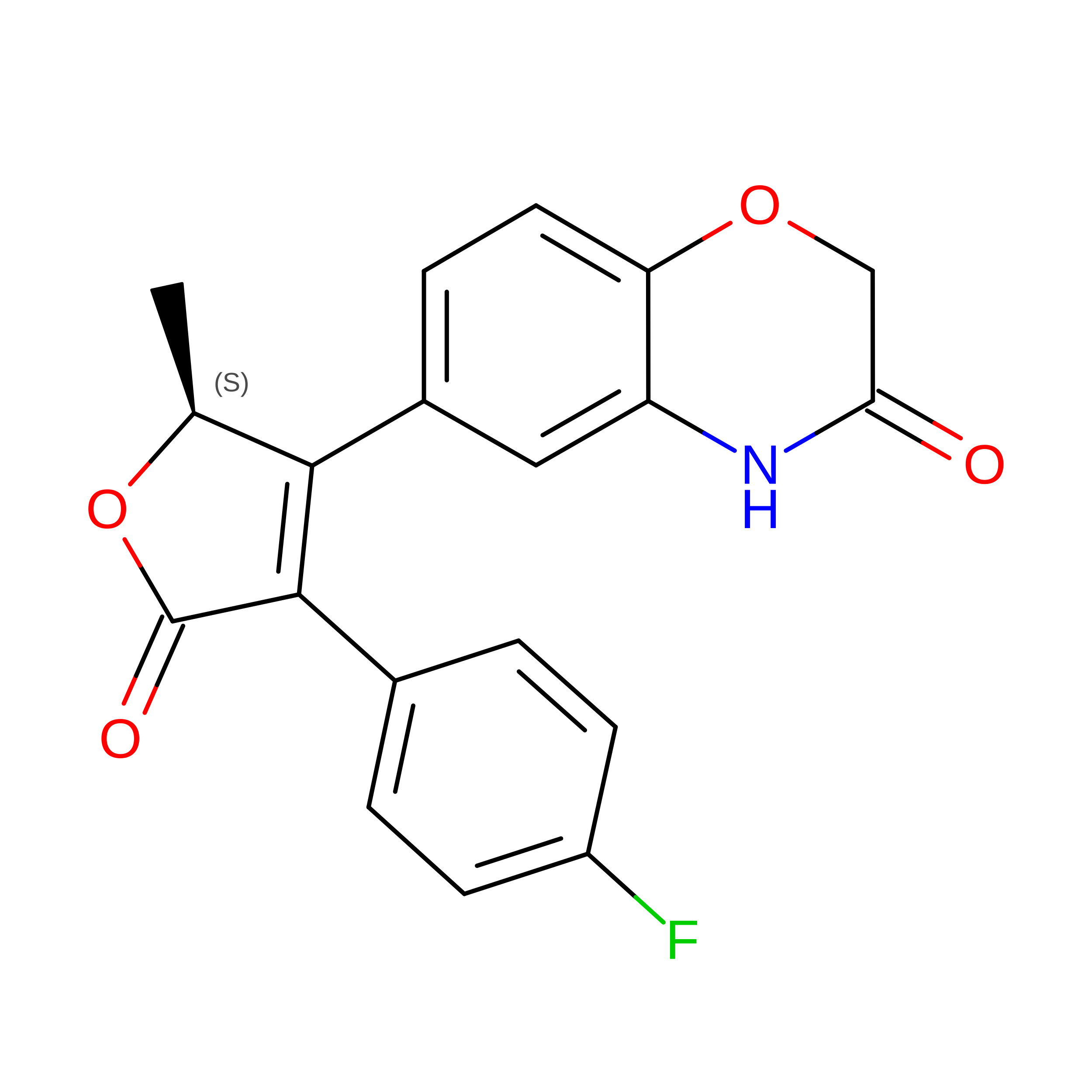
B [auth A]6-[(2S)-4-(4-fluorophenyl)-2-methyl-5-oxo-2,5-dihydrofuran-3-yl]-2H-1,4-benzoxazin-3(4H)-one
C19 H14 F N O4
FLUKKJOWQPEDIT-JTQLQIEISA-N
EDO

Query on EDO


Download:Ideal Coordinates CCD File
C [auth A]
D [auth A]
E [auth A]
F [auth A]
G [auth A]
C [auth A],
D [auth A],
E [auth A],
F [auth A],
G [auth A],
H [auth A],
I [auth A],
J [auth A],
K [auth A],
L [auth A],
M [auth A],
N [auth A],
O [auth A]
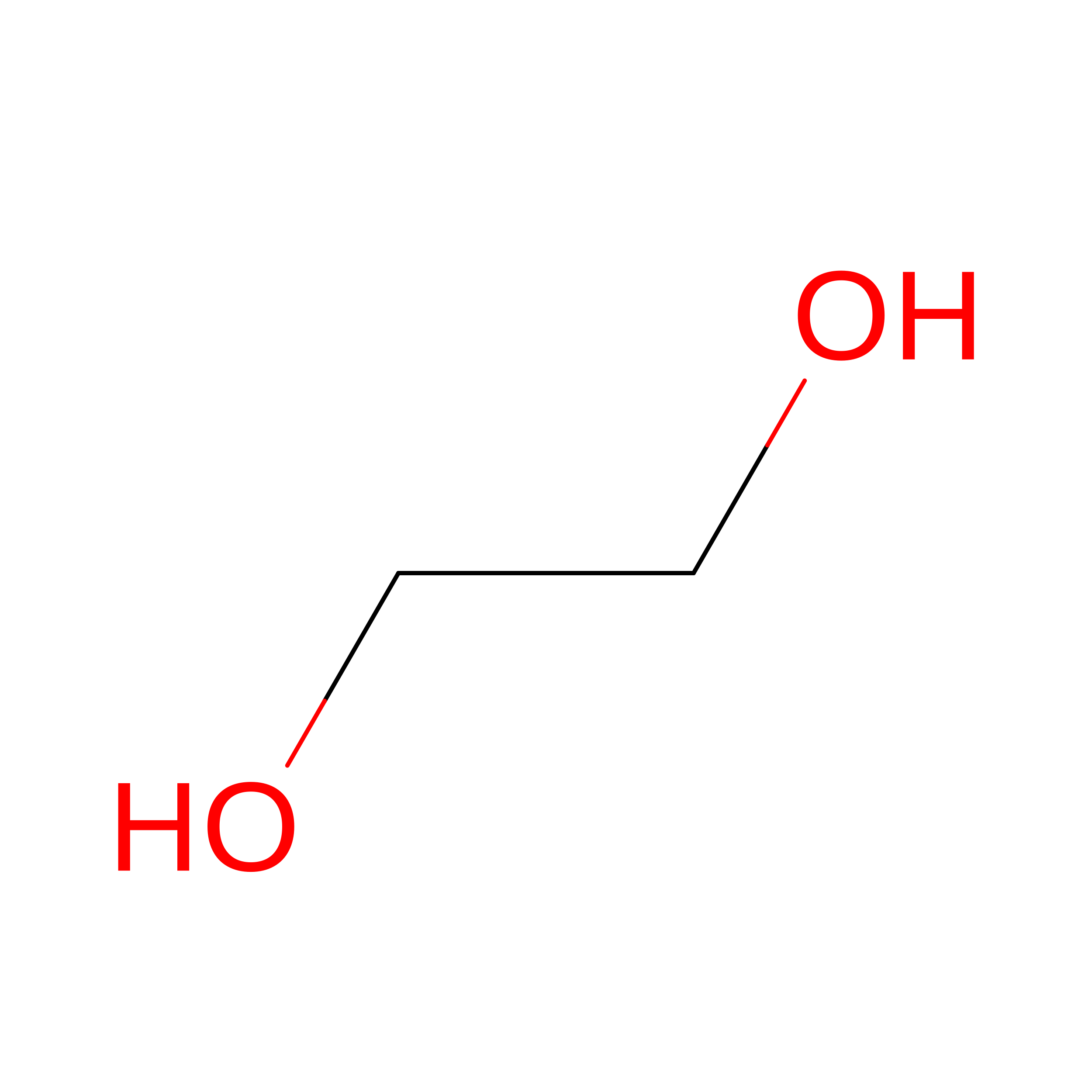
1,2-ETHANEDIOL
C2 H6 O2
LYCAIKOWRPUZTN-UHFFFAOYSA-N

Experimental Data & Validation

Experimental Data

  • Method: X-RAY DIFFRACTION
  • Resolution: 1.40 Å
  • R-Value Free:  0.179 (Depositor), 0.177 (DCC) 
  • R-Value Work:  0.164 (Depositor), 0.163 (DCC) 
  • R-Value Observed: 0.165 (Depositor) 
Space Group: P 21 21 21
Unit Cell:
Length ( Å )Angle ( ˚ )
a = 58.403α = 90
b = 66.813β = 90
c = 75.252γ = 90
Software Package:
Software NamePurpose
MOLREPphasing
REFMACrefinement
HKL-2000data reduction
HKL-2000data scaling

Structure Validation

View Full Validation Report


Ligand Structure Quality Assessment 


Entry History 

Deposition Data

Revision History  (Full details and data files)

  • Version 1.0: 2013-08-21
    Type: Initial release
  • Version 1.1: 2019-12-25
    Changes: Database references
  • Version 1.2: 2023-11-08
    Changes: Data collection, Database references, Derived calculations, Refinement description