4B3E | pdb_00004b3e

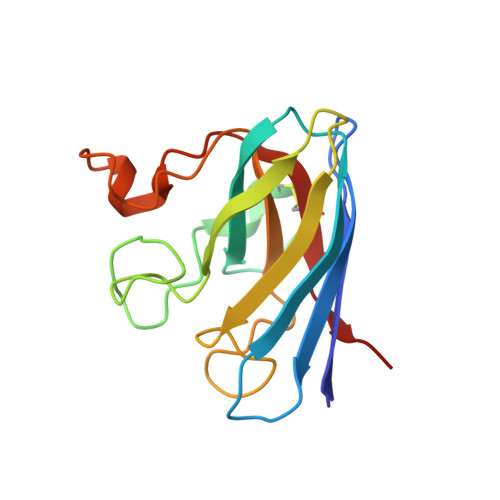
Structure of copper-zinc superoxide dismutase complexed with bicarbonate.


Experimental Data Snapshot

  • Method: X-RAY DIFFRACTION
  • Resolution: 2.15 Å
  • R-Value Free: 
    0.215 (Depositor), 0.214 (DCC) 
  • R-Value Work: 
    0.175 (Depositor), 0.176 (DCC) 
  • R-Value Observed: 
    0.177 (Depositor) 

Starting Model: experimental
View more details

wwPDB Validation 3D Report Full Report

Validation slider image for 4B3E

This is version 1.2 of the entry. See complete history

Literature

Structural Evidence for a Copper-Bound Carbonate Intermediate in the Peroxidase and Dismutase Activities of Superoxide Dismutase.

Strange, R.W.Hough, M.A.Antonyuk, S.V.Hasnain, S.S.

(2012) PLoS One 7: 44811

  • DOI: https://doi.org/10.1371/journal.pone.0044811
  • Primary Citation Related Structures: 
    4B3E

  • PubMed Abstract: 

    Copper-zinc superoxide dismutase (SOD) is of fundamental importance to our understanding of oxidative damage. Its primary function is catalysing the dismutation of superoxide to O(2) and H(2)O(2). SOD also reacts with H(2)O(2), leading to the formation of a strong copper-bound oxidant species that can either inactivate the enzyme or oxidise other substrates. In the presence of bicarbonate (or CO(2)) and H(2)O(2), this peroxidase activity is enhanced and produces the carbonate radical. This freely diffusible reactive oxygen species is proposed as the agent for oxidation of large substrates that are too bulky to enter the active site. Here, we provide direct structural evidence, from a 2.15 Å resolution crystal structure, of (bi)carbonate captured at the active site of reduced SOD, consistent with the view that a bound carbonate intermediate could be formed, producing a diffusible carbonate radical upon reoxidation of copper. The bound carbonate blocks direct access of substrates to Cu(I), suggesting that an adjunct to the accepted mechanism of SOD catalysed dismutation of superoxide operates, with Cu(I) oxidation by superoxide being driven via a proton-coupled electron transfer mechanism involving the bound carbonate rather than the solvent. Carbonate is captured in a different site when SOD is oxidised, being located in the active site channel adjacent to the catalytically important Arg143. This is the probable route of diffusion from the active site following reoxidation of the copper. In this position, the carbonate is poised for re-entry into the active site and binding to the reduced copper.


  • Organizational Affiliation
    • Molecular Biophysics Group, Institute of Integrative Biology, Faculty of Health and Life Sciences, University of Liverpool, Liverpool, United Kingdom. r.strange@liv.ac.uk

Macromolecule Content 

  • Total Structure Weight: 161.96 kDa 
  • Atom Count: 12,812 
  • Modeled Residue Count: 1,530 
  • Deposited Residue Count: 1,540 
  • Unique protein chains: 1

Macromolecules

Find similar proteins by:|  3D Structure
Entity ID: 1
MoleculeChains  Sequence LengthOrganismDetailsImage
SUPEROXIDE DISMUTASE [CU-ZN]
A, B, C, D, E
A, B, C, D, E, F, G, H, I, J
154Homo sapiensMutation(s): 0 
EC: 1.15.1.1 (PDB Primary Data), 1.8 (UniProt)
UniProt & NIH Common Fund Data Resources
Find proteins for P00441 (Homo sapiens)
Explore P00441 
Go to UniProtKB:  P00441
PHAROS:  P00441
GTEx:  ENSG00000142168 
Entity Groups
Sequence Clusters30% Identity50% Identity70% Identity90% Identity95% Identity100% Identity
UniProt GroupP00441
Sequence Annotations
Expand
Reference Sequence

Small Molecules

Ligands 4 Unique
IDChains Name / Formula / InChI Key2D Diagram3D Interactions
SO4

Query on SO4


Download:Ideal Coordinates CCD File
CA [auth F],
DA [auth F],
HA [auth G],
RA [auth J],
SA [auth J]
SULFATE ION
O4 S
QAOWNCQODCNURD-UHFFFAOYSA-L
ZN

Query on ZN


Download:Ideal Coordinates CCD File
AA [auth F]
FA [auth G]
JA [auth H]
L [auth A]
MA [auth I]
AA [auth F],
FA [auth G],
JA [auth H],
L [auth A],
MA [auth I],
O [auth B],
PA [auth J],
R [auth C],
U [auth D],
X [auth E]
ZINC ION
Zn
PTFCDOFLOPIGGS-UHFFFAOYSA-N
CU

Query on CU


Download:Ideal Coordinates CCD File
EA [auth G]
IA [auth H]
K [auth A]
LA [auth I]
N [auth B]
EA [auth G],
IA [auth H],
K [auth A],
LA [auth I],
N [auth B],
OA [auth J],
Q [auth C],
T [auth D],
W [auth E],
Z [auth F]
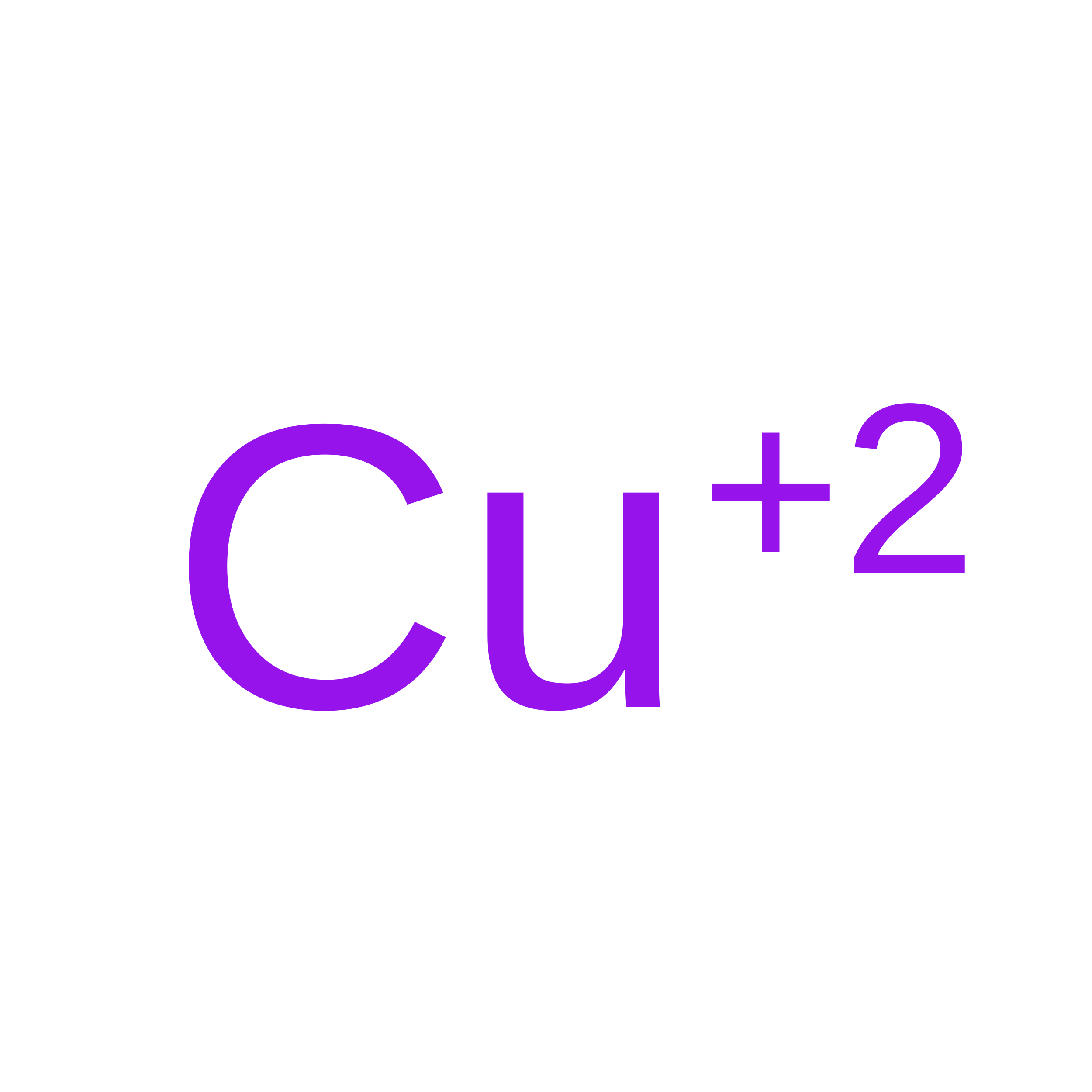
COPPER (II) ION
Cu
JPVYNHNXODAKFH-UHFFFAOYSA-N
CO3

Query on CO3


Download:Ideal Coordinates CCD File
BA [auth F]
GA [auth G]
KA [auth H]
M [auth A]
NA [auth I]
BA [auth F],
GA [auth G],
KA [auth H],
M [auth A],
NA [auth I],
P [auth B],
QA [auth J],
S [auth C],
V [auth D],
Y [auth E]
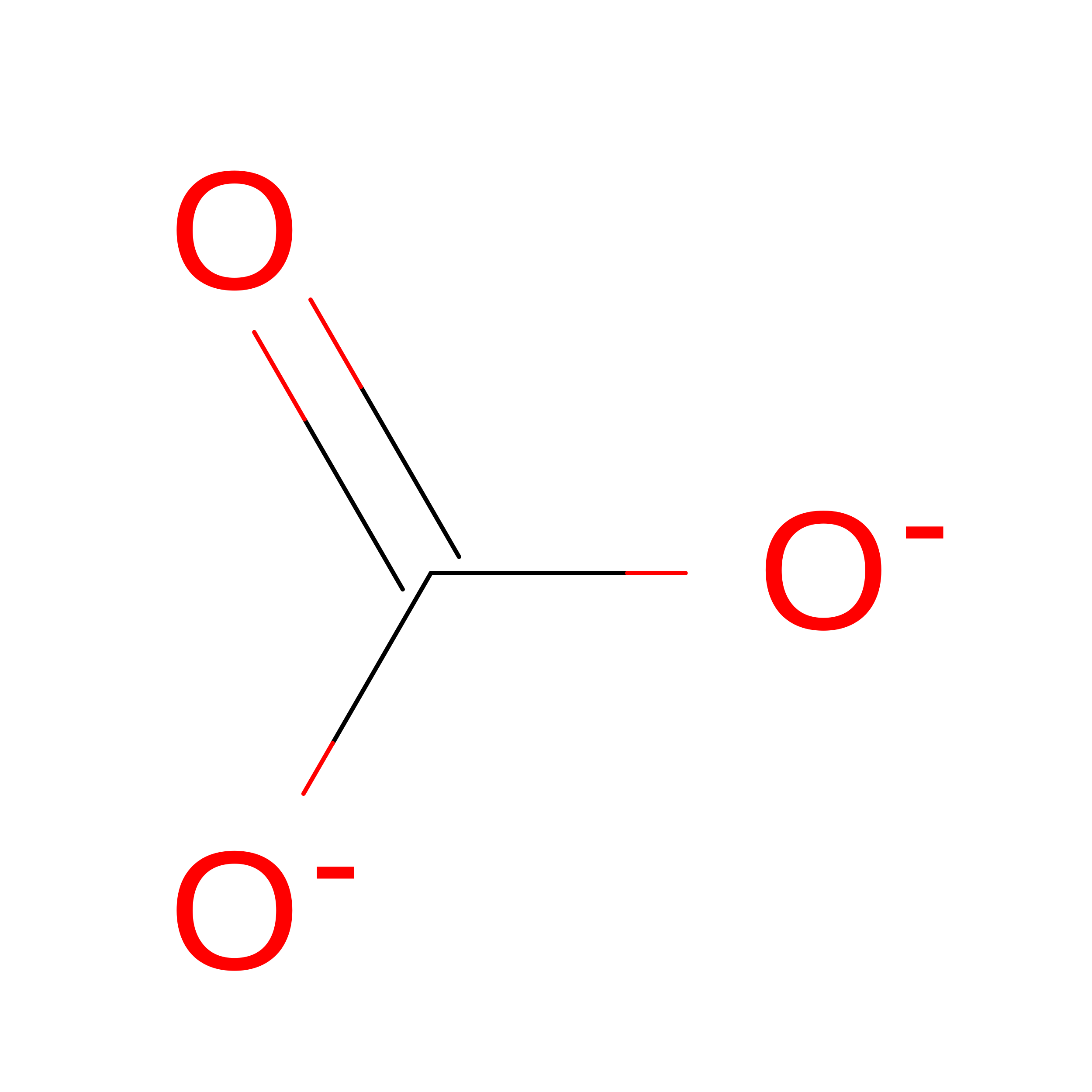
CARBONATE ION
C O3
BVKZGUZCCUSVTD-UHFFFAOYSA-L

Experimental Data & Validation

Experimental Data

  • Method: X-RAY DIFFRACTION
  • Resolution: 2.15 Å
  • R-Value Free:  0.215 (Depositor), 0.214 (DCC) 
  • R-Value Work:  0.175 (Depositor), 0.176 (DCC) 
  • R-Value Observed: 0.177 (Depositor) 
Space Group: C 2 2 21
Unit Cell:
Length ( Å )Angle ( ˚ )
a = 165.994α = 90
b = 203.107β = 90
c = 144.384γ = 90
Software Package:
Software NamePurpose
REFMACrefinement
HKL-2000data reduction
HKL-2000data scaling
MOLREPphasing

Structure Validation

View Full Validation Report


Entry History 

Deposition Data

Revision History  (Full details and data files)

  • Version 1.0: 2012-09-26
    Type: Initial release
  • Version 1.1: 2023-12-20
    Changes: Data collection, Database references, Derived calculations, Other, Refinement description
  • Version 1.2: 2024-10-23
    Changes: Structure summary