4FWT | pdb_00004fwt

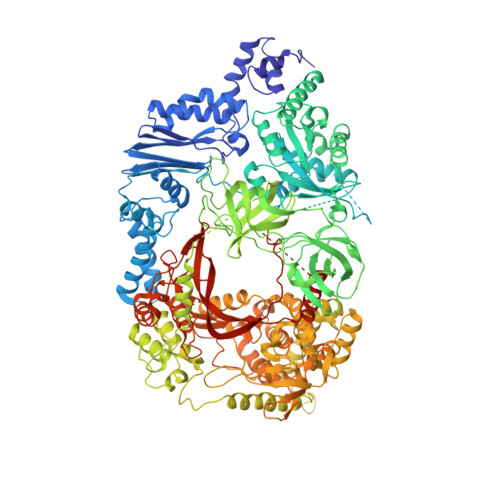
Complex structure of viral RNA polymerase form III


Experimental Data Snapshot

  • Method: X-RAY DIFFRACTION
  • Resolution: 3.20 Å
  • R-Value Free: 
    0.314 (Depositor), 0.321 (DCC) 
  • R-Value Work: 
    0.245 (Depositor), 0.246 (DCC) 
  • R-Value Observed: 
    0.248 (Depositor) 

Starting Model: experimental
View more details

wwPDB Validation 3D Report Full Report

Validation slider image for 4FWT

Ligand Structure Quality Assessment 


This is version 1.3 of the entry. See complete history

Literature

Mechanism for template-independent terminal adenylation activity of Q beta replicase

Takeshita, D.Yamashita, S.Tomita, K.

(2012) Structure 20: 1661-1669

  • DOI: https://doi.org/10.1016/j.str.2012.07.004
  • Primary Citation Related Structures: 
    3VNU, 3VNV, 4FWT

  • PubMed Abstract: 

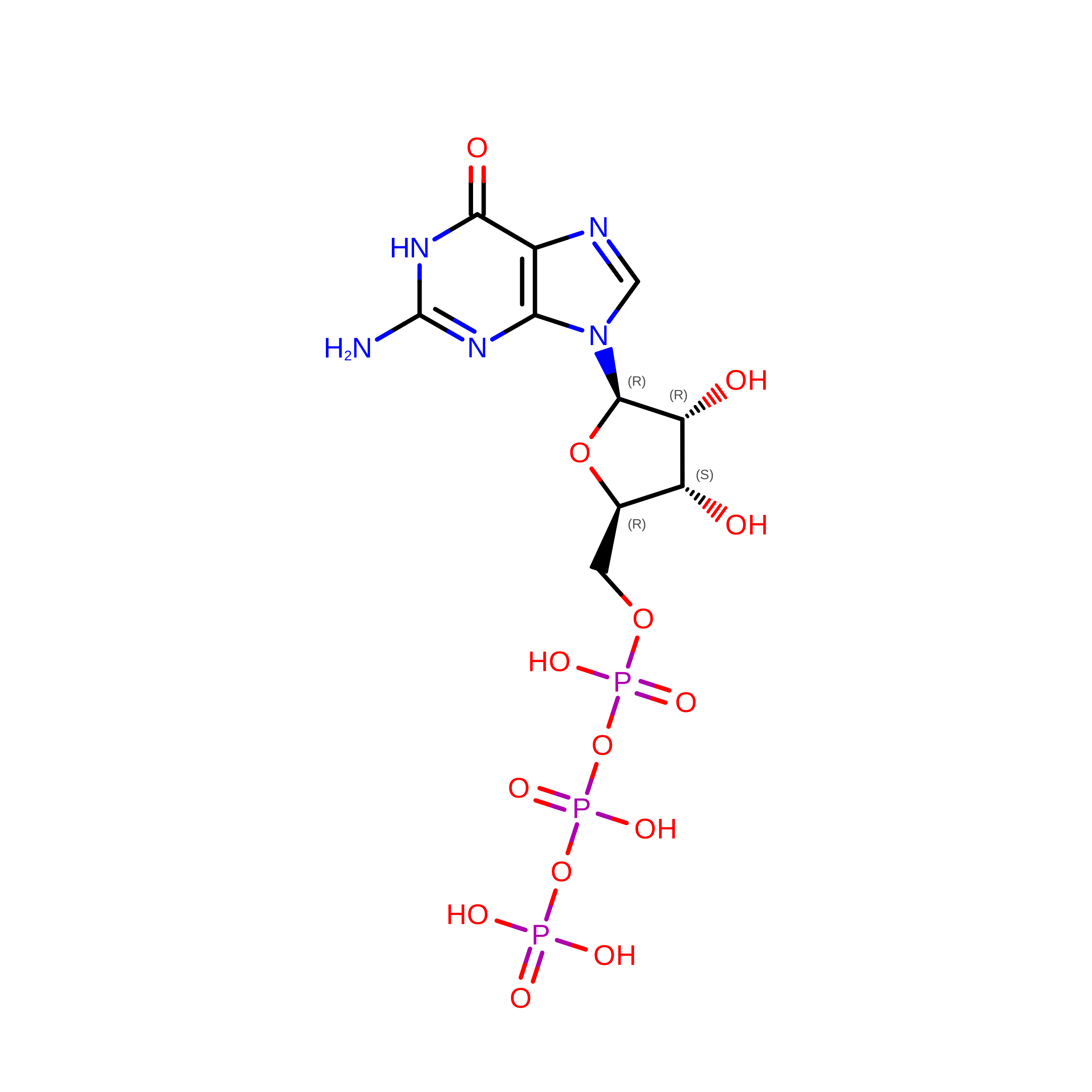
    The genomic RNA of Qβ virus is replicated by Qβ replicase, a template-dependent RNA polymerase complex. Qβ replicase has an intrinsic template-independent RNA 3'-adenylation activity, which is required for efficient viral RNA amplification in the host cells. However, the mechanism of the template-independent 3'-adenylation of RNAs by Qβ replicase has remained elusive. We determined the structure of a complex that includes Qβ replicase, a template RNA, a growing RNA complementary to the template RNA, and ATP. The structure represents the terminal stage of RNA polymerization and reveals that the shape and size of the nucleotide-binding pocket becomes available for ATP accommodation after the 3'-penultimate template-dependent C-addition. The stacking interaction between the ATP and the neighboring Watson-Crick base pair, between the 5'-G in the template and the 3'-C in the growing RNA, contributes to the nucleotide specificity. Thus, the template for the template-independent 3'-adenylation by Qβ replicase is the RNA and protein ribonucleoprotein complex.


  • Organizational Affiliation
    • Biomedical Research Institute, National Institute of Advanced Industrial Science and Technology, 1-1-1, Higashi, Tsukuba, Ibaraki 305-8566, Japan.

Macromolecule Content 

  • Total Structure Weight: 147.1 kDa 
  • Atom Count: 9,582 
  • Modeled Residue Count: 1,216 
  • Deposited Residue Count: 1,305 
  • Unique protein chains: 1
  • Unique nucleic acid chains: 2

Macromolecules


Find similar proteins by:|  3D Structure
Entity ID: 1
MoleculeChains  Sequence LengthOrganismDetailsImage
Elongation factor Ts, Elongation factor Tu, LINKER, Q beta replicase1,289Escherichia coli O157:H7Qubevirus durumMutation(s): 0 
EC: 2.7.7.48 (UniProt), 3.6.5.3 (UniProt)
UniProt
Find proteins for P0A6N3 (Escherichia coli O157:H7)
Explore P0A6N3 
Go to UniProtKB:  P0A6N3
Find proteins for P0A6P3 (Escherichia coli O157:H7)
Explore P0A6P3 
Go to UniProtKB:  P0A6P3
Find proteins for P14647 (Escherichia virus Qbeta)
Explore P14647 
Go to UniProtKB:  P14647
Entity Groups
Sequence Clusters30% Identity50% Identity70% Identity90% Identity95% Identity100% Identity
UniProt GroupsP14647P0A6P3P0A6N3
Sequence Annotations
Expand
Reference Sequence
Find similar nucleic acids by:  Sequence
Entity ID: 2
MoleculeChains LengthOrganismImage
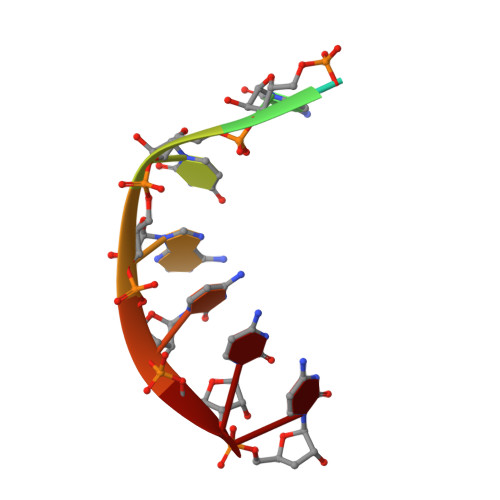
RNA (5'-R(*C*CP*CP*UP*AP*CP*CP*C)-3')B [auth G]8N/A
Sequence Annotations
Expand
Reference Sequence
Find similar nucleic acids by:  Sequence
Entity ID: 3
MoleculeChains LengthOrganismImage
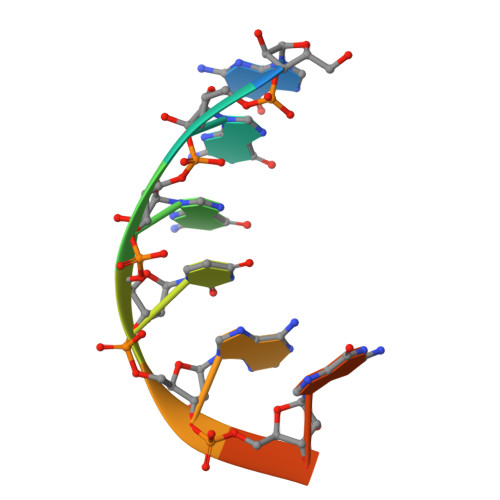
RNA (5'-R(*GP*GP*GP*UP*AP*GP*GP*G)-3')C [auth T]8N/A
Sequence Annotations
Expand
Reference Sequence

Experimental Data & Validation

Experimental Data

  • Method: X-RAY DIFFRACTION
  • Resolution: 3.20 Å
  • R-Value Free:  0.314 (Depositor), 0.321 (DCC) 
  • R-Value Work:  0.245 (Depositor), 0.246 (DCC) 
  • R-Value Observed: 0.248 (Depositor) 
Space Group: C 2 2 21
Unit Cell:
Length ( Å )Angle ( ˚ )
a = 137.514α = 90
b = 255.047β = 90
c = 100.909γ = 90
Software Package:
Software NamePurpose
ADSCdata collection
MOLREPphasing
REFMACrefinement
HKL-2000data reduction
HKL-2000data scaling

Structure Validation

View Full Validation Report


Ligand Structure Quality Assessment 


Entry History 

Deposition Data

Revision History  (Full details and data files)

  • Version 1.0: 2012-08-08
    Type: Initial release
  • Version 1.1: 2013-10-09
    Changes: Database references
  • Version 1.2: 2017-06-28
    Changes: Source and taxonomy
  • Version 1.3: 2023-11-08
    Changes: Data collection, Database references, Derived calculations, Refinement description