4I3B | pdb_00004i3b

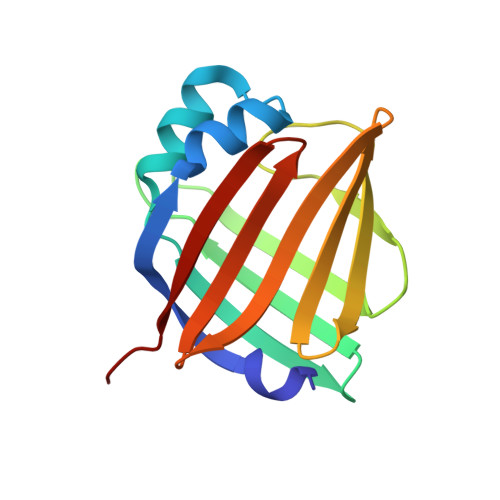
Crystal structure of fluorescent protein UnaG wild type


Experimental Data Snapshot

  • Method: X-RAY DIFFRACTION
  • Resolution: 1.20 Å
  • R-Value Free: 
    0.159 (Depositor), 0.155 (DCC) 
  • R-Value Work: 
    0.129 (Depositor), 0.128 (DCC) 
  • R-Value Observed: 
    0.131 (Depositor) 

Starting Model: experimental
View more details

wwPDB Validation 3D Report Full Report

Validation slider image for 4I3B

Ligand Structure Quality Assessment 


This is version 1.3 of the entry. See complete history

Literature

A bilirubin-inducible fluorescent protein from eel muscle

Kumagai, A.Ando, R.Miyatake, H.Greimel, P.Kobayashi, T.Hirabayashi, Y.Shimogori, T.Miyawaki, A.

(2013) Cell 153: 1602-1611

  • DOI: https://doi.org/10.1016/j.cell.2013.05.038
  • Primary Citation Related Structures: 
    4I3B, 4I3C, 4I3D

  • PubMed Abstract: 

    The fluorescent protein toolbox has revolutionized experimental biology. Despite this advance, no fluorescent proteins have been identified from vertebrates, nor has chromogenic ligand-inducible activation or clinical utility been demonstrated. Here, we report the cloning and characterization of UnaG, a fluorescent protein from Japanese eel. UnaG belongs to the fatty-acid-binding protein (FABP) family, and expression in eel is restricted to small-diameter muscle fibers. On heterologous expression in cell lines or mouse brain, UnaG produces oxygen-independent green fluorescence. Remarkably, UnaG fluorescence is triggered by an endogenous ligand, bilirubin, a membrane-permeable heme metabolite and clinical health biomarker. The holoUnaG structure at 1.2 Å revealed a biplanar coordination of bilirubin by reversible π-conjugation, and we used this high-affinity and high-specificity interaction to establish a fluorescence-based human bilirubin assay with promising clinical utility. UnaG will be the prototype for a versatile class of ligand-activated fluorescent proteins, with applications in research, medicine, and bioengineering.


  • Organizational Affiliation
    • Cell Function Dynamics, Brain Science Institute, RIKEN, 2-1 Hirosawa, Wako-city, Saitama 351-0198, Japan.

Macromolecule Content 

  • Total Structure Weight: 98.09 kDa 
  • Atom Count: 9,608 
  • Modeled Residue Count: 829 
  • Deposited Residue Count: 834 
  • Unique protein chains: 1

Macromolecules

Find similar proteins by:|  3D Structure
Entity ID: 1
MoleculeChains  Sequence LengthOrganismDetailsImage
Bilirubin-inducible fluorescent protein UnaG
A, B, C, D, E
A, B, C, D, E, F
139Anguilla japonicaMutation(s): 0 
UniProt
Find proteins for P0DM59 (Anguilla japonica)
Explore P0DM59 
Go to UniProtKB:  P0DM59
Entity Groups
Sequence Clusters30% Identity50% Identity70% Identity90% Identity95% Identity100% Identity
UniProt GroupP0DM59
Sequence Annotations
Expand
Reference Sequence

Small Molecules

Ligands 2 Unique
IDChains Name / Formula / InChI Key2D Diagram3D Interactions
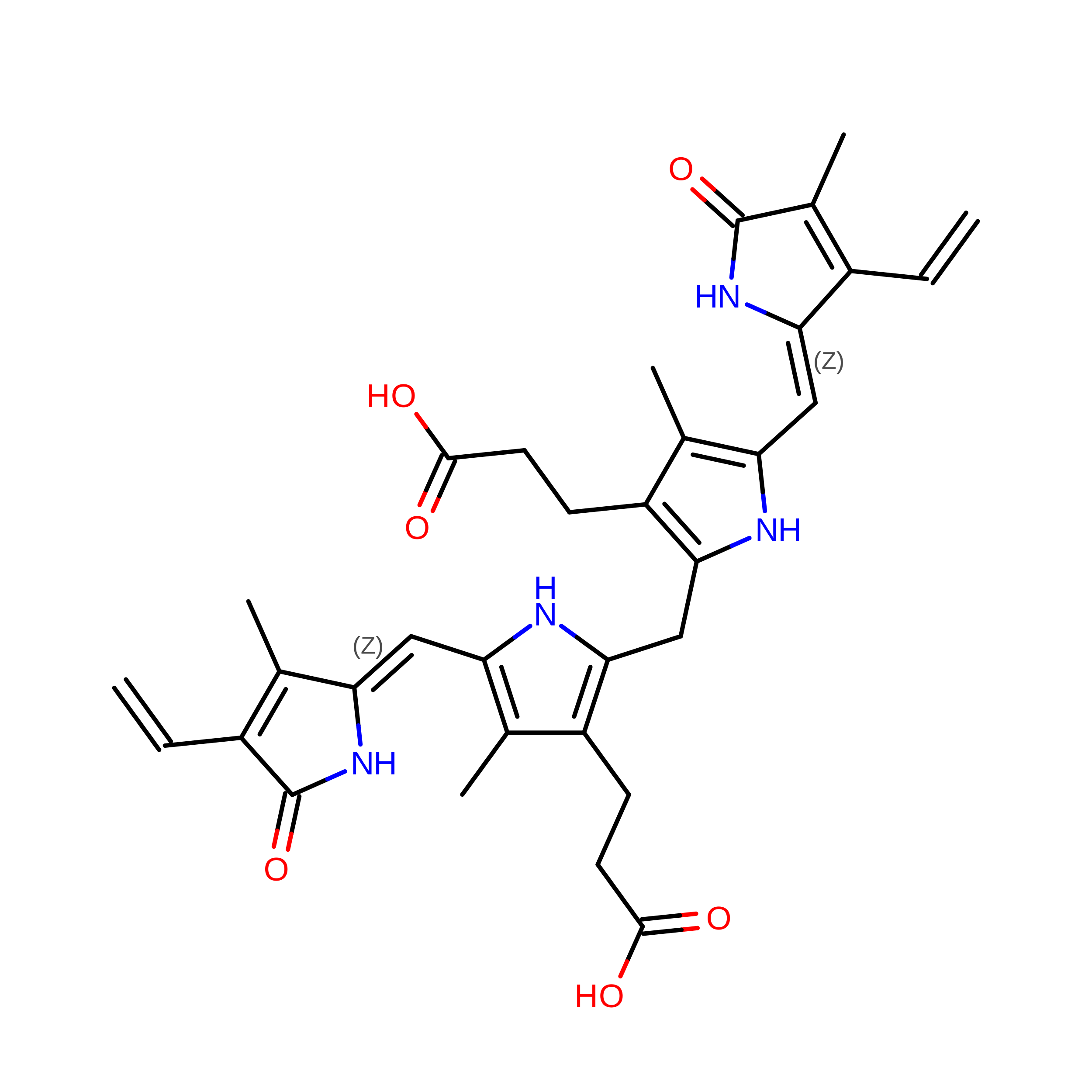
BLR

Query on BLR


Download:Ideal Coordinates CCD File
G [auth A]
I [auth B]
M [auth C]
N [auth D]
P [auth E]
G [auth A],
I [auth B],
M [auth C],
N [auth D],
P [auth E],
R [auth F]
3-[5-[(Z)-(4-ethenyl-3-methyl-5-oxidanylidene-pyrrol-2-ylidene)methyl]-2-[[5-[(Z)-(3-ethenyl-4-methyl-5-oxidanylidene-pyrrol-2-ylidene)methyl]-3-(3-hydroxy-3-oxopropyl)-4-methyl-1H-pyrrol-2-yl]methyl]-4-methyl-1H-pyrrol-3-yl]propanoic acid
C33 H36 N4 O6
BPYKTIZUTYGOLE-IFADSCNNSA-N
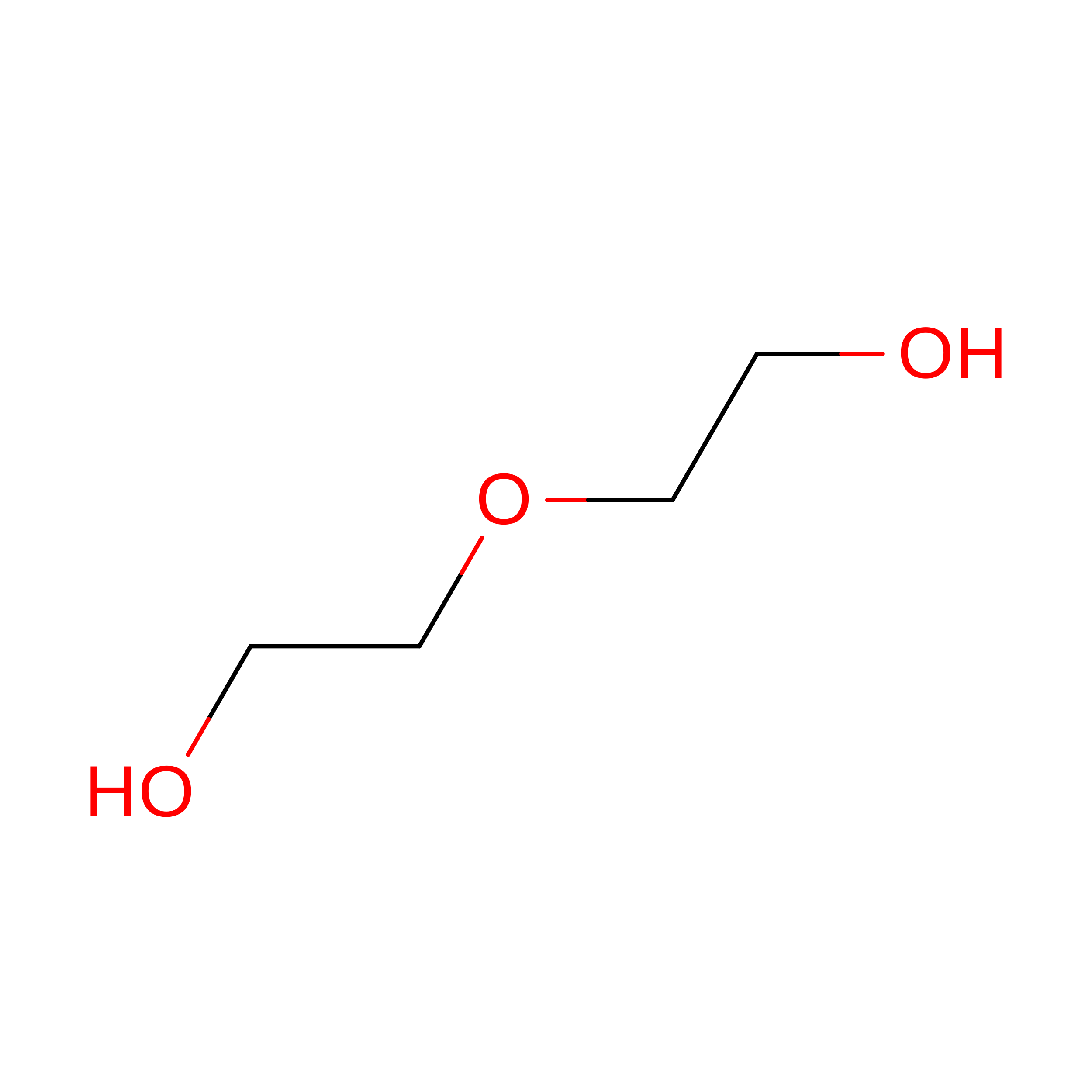
PEG

Query on PEG


Download:Ideal Coordinates CCD File
H [auth A]
J [auth B]
K [auth B]
L [auth B]
O [auth D]
H [auth A],
J [auth B],
K [auth B],
L [auth B],
O [auth D],
Q [auth E],
S [auth F],
T [auth F],
U [auth F]
DI(HYDROXYETHYL)ETHER
C4 H10 O3
MTHSVFCYNBDYFN-UHFFFAOYSA-N

Experimental Data & Validation

Experimental Data

  • Method: X-RAY DIFFRACTION
  • Resolution: 1.20 Å
  • R-Value Free:  0.159 (Depositor), 0.155 (DCC) 
  • R-Value Work:  0.129 (Depositor), 0.128 (DCC) 
  • R-Value Observed: 0.131 (Depositor) 
Space Group: P 1 21 1
Unit Cell:
Length ( Å )Angle ( ˚ )
a = 44.394α = 90
b = 73.954β = 92.45
c = 124.364γ = 90
Software Package:
Software NamePurpose
HKL-2000data collection
PHENIXmodel building
PHENIXrefinement
HKL-2000data reduction
HKL-2000data scaling
PHENIXphasing

Structure Validation

View Full Validation Report


Ligand Structure Quality Assessment 


Entry History 

Deposition Data

Revision History  (Full details and data files)

  • Version 1.0: 2013-06-19
    Type: Initial release
  • Version 1.1: 2013-07-31
    Changes: Database references
  • Version 1.2: 2015-02-04
    Changes: Database references, Non-polymer description
  • Version 1.3: 2023-11-08
    Changes: Data collection, Database references, Derived calculations, Refinement description