4X7J | pdb_00004x7j

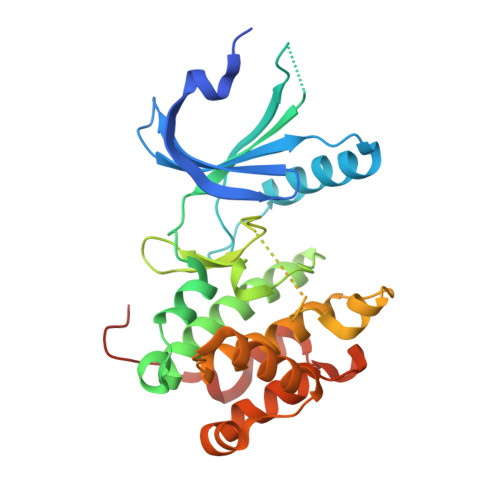
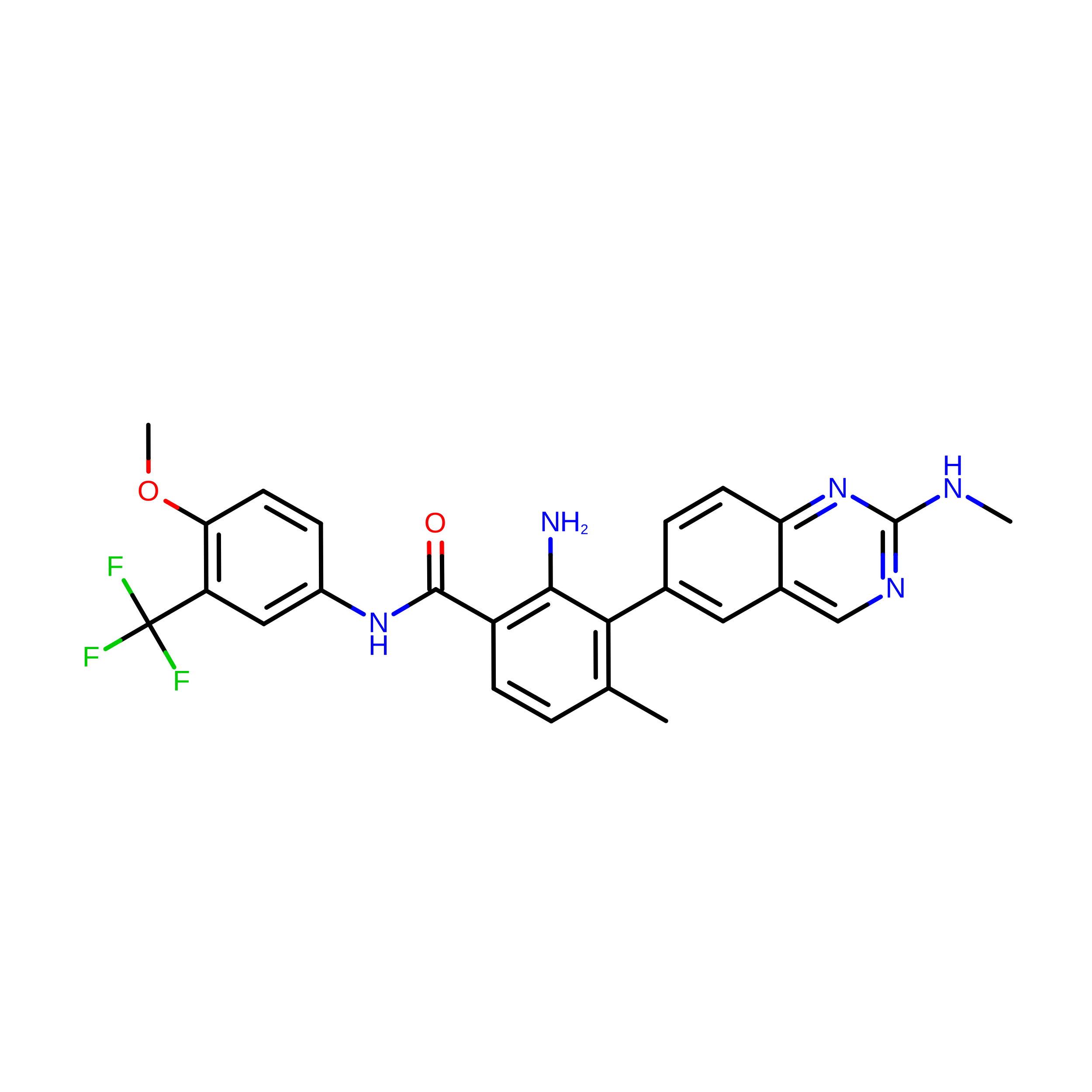
Co-crystal Structure of PERK with 2-amino-N-[4-methoxy-3-(trifluoromethyl)phenyl]-4-methyl-3-[2-(methylamino)quinazolin-6-yl]benzamide inhibitor


Experimental Data Snapshot

  • Method: X-RAY DIFFRACTION
  • Resolution: 2.30 Å
  • R-Value Free: 
    0.225 (Depositor), 0.218 (DCC) 
  • R-Value Work: 
    0.195 (Depositor), 0.191 (DCC) 
  • R-Value Observed: 
    0.196 (Depositor) 

Starting Model: experimental
View more details

wwPDB Validation 3D Report Full Report

Validation slider image for 4X7J

Ligand Structure Quality Assessment 


This is version 1.3 of the entry. See complete history

Literature

Discovery of 1H-Pyrazol-3(2H)-ones as Potent and Selective Inhibitors of Protein Kinase R-like Endoplasmic Reticulum Kinase (PERK).

Smith, A.L.Andrews, K.L.Beckmann, H.Bellon, S.F.Beltran, P.J.Booker, S.Chen, H.Chung, Y.A.D'Angelo, N.D.Dao, J.Dellamaggiore, K.R.Jaeckel, P.Kendall, R.Labitzke, K.Long, A.M.Materna-Reichelt, S.Mitchell, P.Norman, M.H.Powers, D.Rose, M.Shaffer, P.L.Wu, M.M.Lipford, J.R.

(2015) J Med Chem 58: 1426-1441

  • DOI: https://doi.org/10.1021/jm5017494
  • Primary Citation Related Structures: 
    4X7H, 4X7J, 4X7K, 4X7L, 4X7N, 4X7O

  • PubMed Abstract: 

    The structure-based design and optimization of a novel series of selective PERK inhibitors are described resulting in the identification of 44 as a potent, highly selective, and orally active tool compound suitable for PERK pathway biology exploration both in vitro and in vivo.


  • Organizational Affiliation
    • Departments of †Medicinal Chemistry, ‡Molecular Structure and Characterization, §Oncology Research, and ∥Pharmacokinetics and Drug Metabolism, Amgen Inc. , One Amgen Center Drive, Thousand Oaks, California 91320-1799, United States.

Macromolecule Content 

  • Total Structure Weight: 37.45 kDa 
  • Atom Count: 2,268 
  • Modeled Residue Count: 257 
  • Deposited Residue Count: 317 
  • Unique protein chains: 1

Macromolecules

Find similar proteins by:|  3D Structure
Entity ID: 1
MoleculeChains  Sequence LengthOrganismDetailsImage
Eukaryotic translation initiation factor 2-alpha kinase 3,Eukaryotic translation initiation factor 2-alpha kinase 3317Homo sapiensMutation(s): 1 
Gene Names: EIF2AK3PEKPERK
EC: 2.7.11.1 (PDB Primary Data), 2.7.10.2 (UniProt)
UniProt & NIH Common Fund Data Resources
Find proteins for Q9NZJ5 (Homo sapiens)
Explore Q9NZJ5 
Go to UniProtKB:  Q9NZJ5
PHAROS:  Q9NZJ5
GTEx:  ENSG00000172071 
Entity Groups
Sequence Clusters30% Identity50% Identity70% Identity90% Identity95% Identity100% Identity
UniProt GroupQ9NZJ5
Sequence Annotations
Expand
Reference Sequence

Small Molecules

Ligands 2 Unique
IDChains Name / Formula / InChI Key2D Diagram3D Interactions
3Z1

Query on 3Z1


Download:Ideal Coordinates CCD File
B [auth A]2-amino-N-[4-methoxy-3-(trifluoromethyl)phenyl]-4-methyl-3-[2-(methylamino)quinazolin-6-yl]benzamide
C25 H22 F3 N5 O2
NYVUSSXLPQHLMH-UHFFFAOYSA-N
TLA

Query on TLA


Download:Ideal Coordinates CCD File
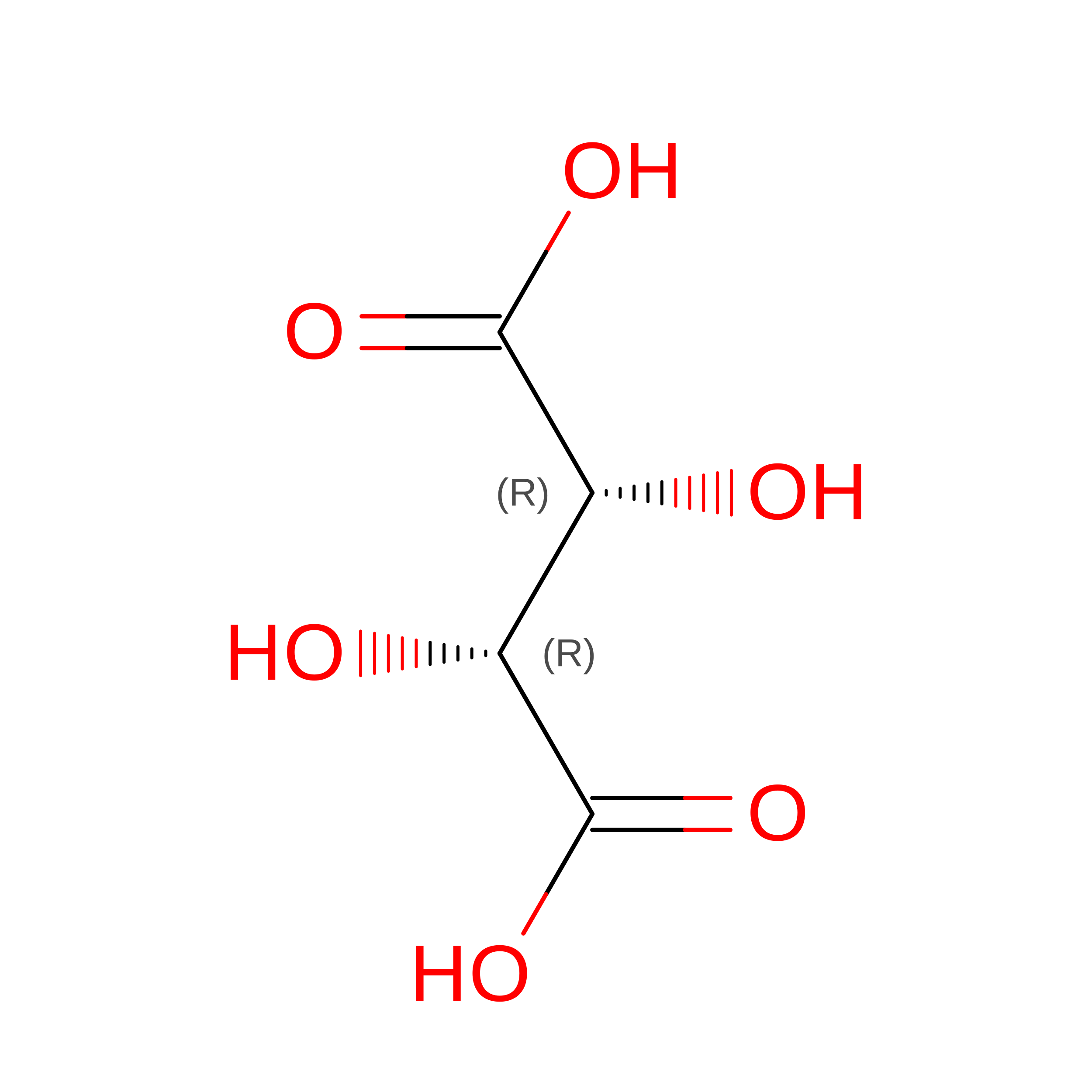
C [auth A]L(+)-TARTARIC ACID
C4 H6 O6
FEWJPZIEWOKRBE-JCYAYHJZSA-N

Experimental Data & Validation

Experimental Data

  • Method: X-RAY DIFFRACTION
  • Resolution: 2.30 Å
  • R-Value Free:  0.225 (Depositor), 0.218 (DCC) 
  • R-Value Work:  0.195 (Depositor), 0.191 (DCC) 
  • R-Value Observed: 0.196 (Depositor) 
Space Group: P 41 21 2
Unit Cell:
Length ( Å )Angle ( ˚ )
a = 81.02α = 90
b = 81.02β = 90
c = 127.617γ = 90
Software Package:
Software NamePurpose
SCALEPACKdata scaling
REFMACrefinement
PDB_EXTRACTdata extraction
HKL-2000data scaling
REFMACphasing

Structure Validation

View Full Validation Report


Ligand Structure Quality Assessment 


Entry History 

Deposition Data

Revision History  (Full details and data files)

  • Version 1.0: 2015-01-28
    Type: Initial release
  • Version 1.1: 2015-02-25
    Changes: Database references
  • Version 1.2: 2017-09-27
    Changes: Data collection, Database references, Derived calculations, Refinement description, Source and taxonomy, Structure summary
  • Version 1.3: 2023-09-27
    Changes: Data collection, Database references, Refinement description