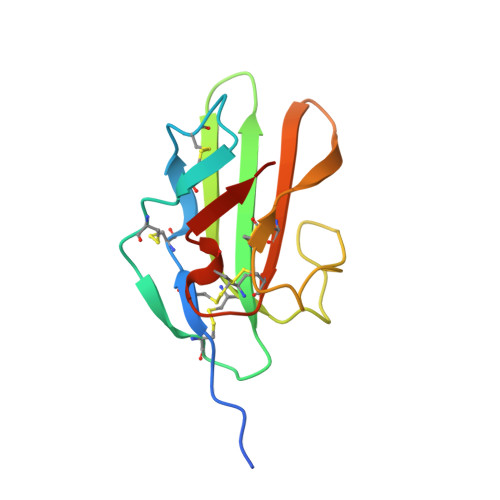
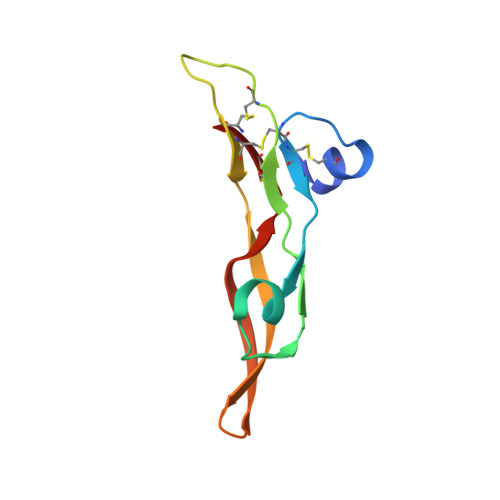
5TX4 | pdb_00005tx4

Derivative of mouse TGF-beta2, with a deletion of residues 52-71 and K25R, R26K, L51R, A74K, C77S, L89V, I92V, K94R T95K, I98V single amino acid substitutions, bound to human TGF-beta type II receptor ectodomain residues 15-130

  • Classification: TRANSFERASE/CYTOKINE
  • Organism(s): Homo sapiens
  • Expression System: Escherichia coli
  • Mutation(s): Yes 

  • Deposited: 2016-11-15 Released: 2017-03-01 
  • Deposition Author(s): Hinck, A.P., Kim, S.
  • Funding Organization(s): National Institutes of Health/National Institute of General Medical Sciences (NIH/NIGMS), National Institutes of Health/National Cancer Institute (NIH/NCI), Robert A. Welch Foundation

Experimental Data Snapshot

  • Method: X-RAY DIFFRACTION
  • Resolution: 1.88 Å
  • R-Value Free: 
    0.222 (Depositor), 0.221 (DCC) 
  • R-Value Work: 
    0.194 (Depositor), 0.195 (DCC) 
  • R-Value Observed: 
    0.195 (Depositor) 

Starting Models: experimental
View more details

wwPDB Validation 3D Report Full Report

Validation slider image for 5TX4

This is version 1.6 of the entry. See complete history

Literature

An engineered transforming growth factor beta (TGF-beta ) monomer that functions as a dominant negative to block TGF-beta signaling.

Kim, S.K.Barron, L.Hinck, C.S.Petrunak, E.M.Cano, K.E.Thangirala, A.Iskra, B.Brothers, M.Vonberg, M.Leal, B.Richter, B.Kodali, R.Taylor, A.B.Du, S.Barnes, C.O.Sulea, T.Calero, G.Hart, P.J.Hart, M.J.Demeler, B.Hinck, A.P.

(2017) J Biological Chem 292: 7173-7188

  • DOI: https://doi.org/10.1074/jbc.M116.768754
  • Primary Citation Related Structures: 
    5TX2, 5TX4, 5TX6

  • PubMed Abstract: 

    The transforming growth factor β isoforms, TGF-β1, -β2, and -β3, are small secreted homodimeric signaling proteins with essential roles in regulating the adaptive immune system and maintaining the extracellular matrix. However, dysregulation of the TGF-β pathway is responsible for promoting the progression of several human diseases, including cancer and fibrosis. Despite the known importance of TGF-βs in promoting disease progression, no inhibitors have been approved for use in humans. Herein, we describe an engineered TGF-β monomer, lacking the heel helix, a structural motif essential for binding the TGF-β type I receptor (TβRI) but dispensable for binding the other receptor required for TGF-β signaling, the TGF-β type II receptor (TβRII), as an alternative therapeutic modality for blocking TGF-β signaling in humans. As shown through binding studies and crystallography, the engineered monomer retained the same overall structure of native TGF-β monomers and bound TβRII in an identical manner. Cell-based luciferase assays showed that the engineered monomer functioned as a dominant negative to inhibit TGF-β signaling with a K i of 20-70 nm Investigation of the mechanism showed that the high affinity of the engineered monomer for TβRII, coupled with its reduced ability to non-covalently dimerize and its inability to bind and recruit TβRI, enabled it to bind endogenous TβRII but prevented it from binding and recruiting TβRI to form a signaling complex. Such engineered monomers provide a new avenue to probe and manipulate TGF-β signaling and may inform similar modifications of other TGF-β family members.


  • Organizational Affiliation
    • the Departments of Biochemistry and Structural Biology and.

Macromolecule Content 

  • Total Structure Weight: 23.73 kDa 
  • Atom Count: 1,657 
  • Modeled Residue Count: 199 
  • Deposited Residue Count: 208 
  • Unique protein chains: 2

Macromolecules

Find similar proteins by:|  3D Structure
Entity ID: 1
MoleculeChains  Sequence LengthOrganismDetailsImage
TGF-beta receptor type-2116Homo sapiensMutation(s): 0 
Gene Names: TGFBR2
EC: 2.7.11.30
UniProt & NIH Common Fund Data Resources
Find proteins for P37173 (Homo sapiens)
Explore P37173 
Go to UniProtKB:  P37173
PHAROS:  P37173
GTEx:  ENSG00000163513 
Entity Groups
Sequence Clusters30% Identity50% Identity70% Identity90% Identity95% Identity100% Identity
UniProt GroupP37173
Sequence Annotations
Expand
Reference Sequence
Find similar proteins by:|  3D Structure
Entity ID: 2
MoleculeChains  Sequence LengthOrganismDetailsImage
Transforming growth factor beta-292Homo sapiensMutation(s): 10 
Gene Names: TGFB2
UniProt & NIH Common Fund Data Resources
Find proteins for P61812 (Homo sapiens)
Explore P61812 
Go to UniProtKB:  P61812
PHAROS:  P61812
GTEx:  ENSG00000092969 
Entity Groups
Sequence Clusters30% Identity50% Identity70% Identity90% Identity95% Identity100% Identity
UniProt GroupP61812
Sequence Annotations
Expand
Reference Sequence

Experimental Data & Validation

Experimental Data

  • Method: X-RAY DIFFRACTION
  • Resolution: 1.88 Å
  • R-Value Free:  0.222 (Depositor), 0.221 (DCC) 
  • R-Value Work:  0.194 (Depositor), 0.195 (DCC) 
  • R-Value Observed: 0.195 (Depositor) 
Space Group: P 21 21 21
Unit Cell:
Length ( Å )Angle ( ˚ )
a = 39.019α = 90
b = 70.772β = 90
c = 77.116γ = 90
Software Package:
Software NamePurpose
PHENIXrefinement
iMOSFLMdata reduction
SCALAdata scaling
PHASERphasing

Structure Validation

View Full Validation Report


Entry History 

& Funding Information

Deposition Data


Funding OrganizationLocationGrant Number
National Institutes of Health/National Institute of General Medical Sciences (NIH/NIGMS)United StatesGM58670
National Institutes of Health/National Cancer Institute (NIH/NCI)United StatesCA172886
Robert A. Welch FoundationUnited StatesAQ1842

Revision History  (Full details and data files)

  • Version 1.0: 2017-03-01
    Type: Initial release
  • Version 1.1: 2017-03-08
    Changes: Database references
  • Version 1.2: 2017-05-10
    Changes: Database references
  • Version 1.3: 2017-09-27
    Changes: Author supporting evidence
  • Version 1.4: 2019-12-04
    Changes: Author supporting evidence
  • Version 1.5: 2023-10-04
    Changes: Data collection, Database references, Refinement description
  • Version 1.6: 2024-10-23
    Changes: Structure summary