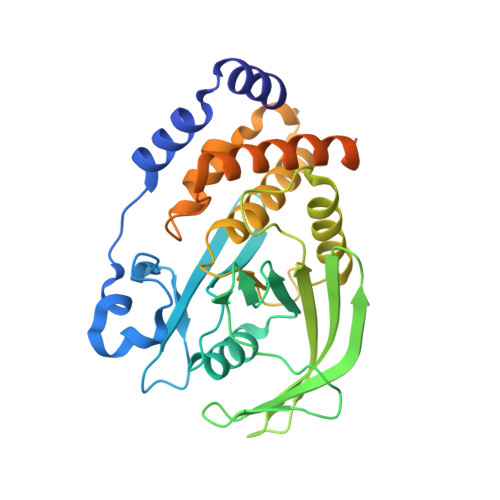
6CWV | pdb_00006cwv

Protein Tyrosine Phosphatase 1B A122S mutant


Experimental Data Snapshot

  • Method: X-RAY DIFFRACTION
  • Resolution: 1.98 Å
  • R-Value Free: 
    0.246 (Depositor), 0.245 (DCC) 
  • R-Value Work: 
    0.205 (Depositor), 0.205 (DCC) 
  • R-Value Observed: 
    0.207 (Depositor) 

Starting Model: experimental
View more details

wwPDB Validation 3D Report Full Report

Validation slider image for 6CWV

This is version 1.4 of the entry. See complete history

Literature

Evolutionarily Conserved Allosteric Communication in Protein Tyrosine Phosphatases.

Hjortness, M.K.Riccardi, L.Hongdusit, A.Zwart, P.H.Sankaran, B.De Vivo, M.Fox, J.M.

(2018) Biochemistry 57: 6443-6451

  • DOI: https://doi.org/10.1021/acs.biochem.8b00656
  • Primary Citation Related Structures: 
    6CWU, 6CWV

  • PubMed Abstract: 

    Protein tyrosine phosphatases (PTPs) are an important class of regulatory enzymes that exhibit aberrant activities in a wide range of diseases. A detailed mapping of allosteric communication in these enzymes could, thus, reveal the structural basis of physiologically relevant-and, perhaps, therapeutically informative-perturbations (i.e., mutations, post-translational modifications, or binding events) that influence their catalytic states. This study combines detailed biophysical studies of protein tyrosine phosphatase 1B (PTP1B) with bioinformatic analyses of the PTP family to examine allosteric communication in this class of enzymes. Results of X-ray crystallography, molecular dynamics simulations, and sequence-based statistical analyses indicate that PTP1B possesses a broadly distributed allosteric network that is evolutionarily conserved across the PTP family, and findings from both kinetic studies and mutational analyses show that this network is functionally intact in sequence-diverse PTPs. The allosteric network resolved in this study reveals new sites for targeting allosteric inhibitors of PTPs and helps explain the functional influence of a diverse set of disease-associated mutations.


  • Organizational Affiliation
    • Department of Chemical and Biological Engineering , University of Colorado , 3415 Colorado Avenue , Boulder , Colorado 80303 , United States.

Macromolecule Content 

  • Total Structure Weight: 38.48 kDa 
  • Atom Count: 2,576 
  • Modeled Residue Count: 281 
  • Deposited Residue Count: 329 
  • Unique protein chains: 1

Macromolecules

Find similar proteins by:|  3D Structure
Entity ID: 1
MoleculeChains  Sequence LengthOrganismDetailsImage
Tyrosine-protein phosphatase non-receptor type 1329Homo sapiensMutation(s): 1 
Gene Names: PTPN1PTP1B
EC: 3.1.3.48
UniProt & NIH Common Fund Data Resources
Find proteins for P18031 (Homo sapiens)
Explore P18031 
Go to UniProtKB:  P18031
PHAROS:  P18031
GTEx:  ENSG00000196396 
Entity Groups
Sequence Clusters30% Identity50% Identity70% Identity90% Identity95% Identity100% Identity
UniProt GroupP18031
Sequence Annotations
Expand
Reference Sequence

Small Molecules

Ligands 1 Unique
IDChains Name / Formula / InChI Key2D Diagram3D Interactions
MG

Query on MG


Download:Ideal Coordinates CCD File
B [auth A]MAGNESIUM ION
Mg
JLVVSXFLKOJNIY-UHFFFAOYSA-N

Experimental Data & Validation

Experimental Data

  • Method: X-RAY DIFFRACTION
  • Resolution: 1.98 Å
  • R-Value Free:  0.246 (Depositor), 0.245 (DCC) 
  • R-Value Work:  0.205 (Depositor), 0.205 (DCC) 
  • R-Value Observed: 0.207 (Depositor) 
Space Group: P 31 2 1
Unit Cell:
Length ( Å )Angle ( ˚ )
a = 89.434α = 90
b = 89.434β = 90
c = 105.554γ = 120
Software Package:
Software NamePurpose
DIALSdata collection
xia2data reduction
xia2data scaling
PHENIXphasing
PHENIXrefinement

Structure Validation

View Full Validation Report


Entry History 

& Funding Information

Deposition Data


Funding OrganizationLocationGrant Number
National Science Foundation (NSF, United States)United States1750244
National Science Foundation (NSF, United States)United States1804897

Revision History  (Full details and data files)

  • Version 1.0: 2018-10-24
    Type: Initial release
  • Version 1.1: 2018-10-31
    Changes: Data collection, Database references
  • Version 1.2: 2018-11-21
    Changes: Data collection, Database references
  • Version 1.3: 2019-11-27
    Changes: Author supporting evidence
  • Version 1.4: 2023-10-04
    Changes: Data collection, Database references, Refinement description