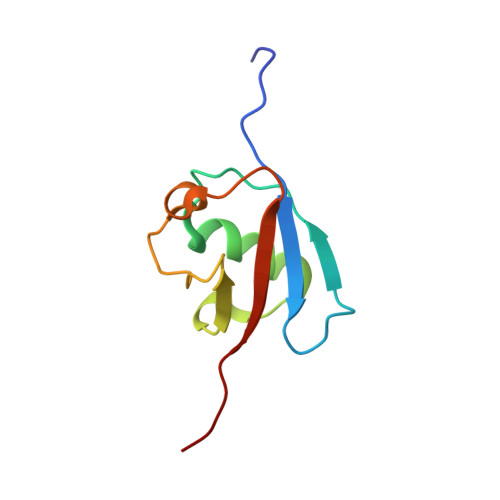
6GF2 | pdb_00006gf2

The structure of the ubiquitin-like modifier FAT10 reveals a novel targeting mechanism for degradation by the 26S proteasome


Experimental Data Snapshot

  • Method: SOLUTION NMR
  • Conformers Calculated: 250 
  • Conformers Submitted: 10 
  • Selection Criteria: structures with the lowest energy 

wwPDB Validation 3D Report Full Report

Validation slider image for 6GF2

This is version 1.3 of the entry. See complete history

Literature

The structure of the ubiquitin-like modifier FAT10 reveals an alternative targeting mechanism for proteasomal degradation.

Aichem, A.Anders, S.Catone, N.Stotz, S.Berg, A.Schwab, R.Scheuermann, S.Bialas, J.Schutz-Stoffregen, M.C.Schmidtke, G.Peter, C.Groettrup, M.Wiesner, S.

(2018) Nat Commun 9: 3321-3321

  • DOI: https://doi.org/10.1038/s41467-018-05776-3
  • Primary Citation Related Structures: 
    6GF1, 6GF2

  • PubMed Abstract: 

    FAT10 is a ubiquitin-like modifier that directly targets proteins for proteasomal degradation. Here, we report the high-resolution structures of the two individual ubiquitin-like domains (UBD) of FAT10 that are joined by a flexible linker. While the UBDs of FAT10 show the typical ubiquitin-fold, their surfaces are entirely different from each other and from ubiquitin explaining their unique binding specificities. Deletion of the linker abrogates FAT10-conjugation while its mutation blocks auto-FAT10ylation of the FAT10-conjugating enzyme USE1 but not bulk conjugate formation. FAT10- but not ubiquitin-mediated degradation is independent of the segregase VCP/p97 in the presence but not the absence of FAT10's unstructured N-terminal heptapeptide. Stabilization of the FAT10 UBDs strongly decelerates degradation suggesting that the intrinsic instability of FAT10 together with its disordered N-terminus enables the rapid, joint degradation of FAT10 and its substrates without the need for FAT10 de-conjugation and partial substrate unfolding.


  • Organizational Affiliation
    • Division of Immunology, Department of Biology, University of Konstanz, Konstanz, D-78457, Germany.

Macromolecule Content 

  • Total Structure Weight: 9.26 kDa 
  • Atom Count: 647 
  • Modeled Residue Count: 85 
  • Deposited Residue Count: 85 
  • Unique protein chains: 1

Macromolecules

Find similar proteins by:|  3D Structure
Entity ID: 1
MoleculeChains  Sequence LengthOrganismDetailsImage
Ubiquitin D85Homo sapiensMutation(s): 0 
Gene Names: UBDFAT10
UniProt & NIH Common Fund Data Resources
Find proteins for O15205 (Homo sapiens)
Explore O15205 
Go to UniProtKB:  O15205
PHAROS:  O15205
GTEx:  ENSG00000213886 
Entity Groups
Sequence Clusters30% Identity50% Identity70% Identity90% Identity95% Identity100% Identity
UniProt GroupO15205
Sequence Annotations
Expand
Reference Sequence

Experimental Data & Validation

Experimental Data

  • Method: SOLUTION NMR
  • Conformers Calculated: 250 
  • Conformers Submitted: 10 
  • Selection Criteria: structures with the lowest energy 

Structure Validation

View Full Validation Report


Entry History 

& Funding Information

Deposition Data


Funding OrganizationLocationGrant Number
Max Planck SocietyGermany--

Revision History  (Full details and data files)

  • Version 1.0: 2018-08-08
    Type: Initial release
  • Version 1.1: 2018-08-29
    Changes: Data collection, Database references
  • Version 1.2: 2023-06-14
    Changes: Data collection, Database references, Other
  • Version 1.3: 2024-06-19
    Changes: Data collection, Database references