6M7G | pdb_00006m7g

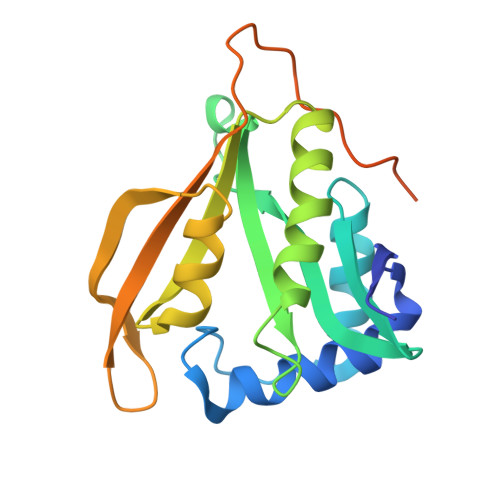
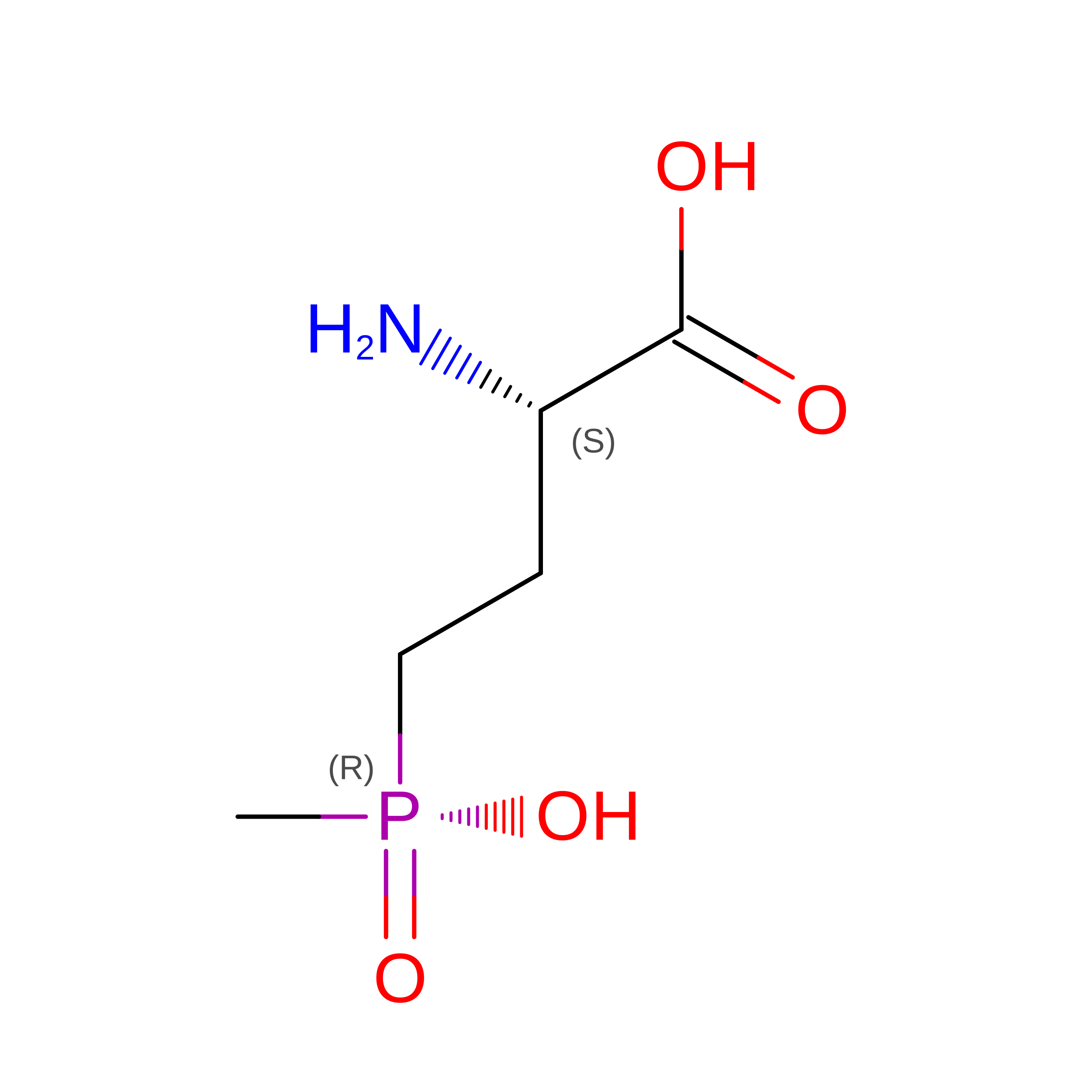
Crystal structure of ArsN, N-acetyltransferase with substrate phosphinothricin from Pseudomonas putida KT2440


Experimental Data Snapshot

  • Method: X-RAY DIFFRACTION
  • Resolution: 2.66 Å
  • R-Value Free: 
    0.273 (Depositor), 0.272 (DCC) 
  • R-Value Work: 
    0.224 (Depositor), 0.225 (DCC) 
  • R-Value Observed: 
    0.227 (Depositor) 

Starting Model: experimental
View more details

wwPDB Validation 3D Report Full Report

Validation slider image for 6M7G

Ligand Structure Quality Assessment 


This is version 1.2 of the entry. See complete history

Literature

Arsinothricin, an arsenic-containing non-proteinogenic amino acid analog of glutamate, is a broad-spectrum antibiotic.

Nadar, V.S.Chen, J.Dheeman, D.S.Galvan, A.E.Yoshinaga-Sakurai, K.Kandavelu, P.Sankaran, B.Kuramata, M.Ishikawa, S.Rosen, B.P.Yoshinaga, M.

(2019) Commun Biol 2: 131-131

  • DOI: https://doi.org/10.1038/s42003-019-0365-y
  • Primary Citation Related Structures: 
    5JTF, 5WPH, 6M7G

  • PubMed Abstract: 

    The emergence and spread of antimicrobial resistance highlights the urgent need for new antibiotics. Organoarsenicals have been used as antimicrobials since Paul Ehrlich's salvarsan. Recently a soil bacterium was shown to produce the organoarsenical arsinothricin. We demonstrate that arsinothricin, a non-proteinogenic analog of glutamate that inhibits glutamine synthetase, is an effective broad-spectrum antibiotic against both Gram-positive and Gram-negative bacteria, suggesting that bacteria have evolved the ability to utilize the pervasive environmental toxic metalloid arsenic to produce a potent antimicrobial. With every new antibiotic, resistance inevitably arises. The arsN1 gene, widely distributed in bacterial arsenic resistance ( ars ) operons, selectively confers resistance to arsinothricin by acetylation of the α-amino group. Crystal structures of ArsN1 N -acetyltransferase, with or without arsinothricin, shed light on the mechanism of its substrate selectivity. These findings have the potential for development of a new class of organoarsenical antimicrobials and ArsN1 inhibitors.


  • Organizational Affiliation
    • 1Department of Cellular Biology and Pharmacology, Florida International University, Herbert Wertheim College of Medicine, Miami, FL 33199 USA.

Macromolecule Content 

  • Total Structure Weight: 282.02 kDa 
  • Atom Count: 16,138 
  • Modeled Residue Count: 2,109 
  • Deposited Residue Count: 2,484 
  • Unique protein chains: 1

Macromolecules

Find similar proteins by:|  3D Structure
Entity ID: 1
MoleculeChains  Sequence LengthOrganismDetailsImage
Phosphinothricin N-acetyltransferase
A, B, C, D, E
A, B, C, D, E, F, G, H, I, J, K, L
207Pseudomonas putida KT2440Mutation(s): 0 
Gene Names: PP_1924
UniProt
Find proteins for Q88LK7 (Pseudomonas putida (strain ATCC 47054 / DSM 6125 / CFBP 8728 / NCIMB 11950 / KT2440))
Explore Q88LK7 
Go to UniProtKB:  Q88LK7
Entity Groups
Sequence Clusters30% Identity50% Identity70% Identity90% Identity95% Identity100% Identity
UniProt GroupQ88LK7
Sequence Annotations
Expand
Reference Sequence

Experimental Data & Validation

Experimental Data

  • Method: X-RAY DIFFRACTION
  • Resolution: 2.66 Å
  • R-Value Free:  0.273 (Depositor), 0.272 (DCC) 
  • R-Value Work:  0.224 (Depositor), 0.225 (DCC) 
  • R-Value Observed: 0.227 (Depositor) 
Space Group: P 1 21 1
Unit Cell:
Length ( Å )Angle ( ˚ )
a = 53.841α = 90
b = 142.693β = 89.99
c = 178.308γ = 90
Software Package:
Software NamePurpose
PHENIXrefinement
HKL-2000data reduction
HKL-2000data scaling
PHASERphasing

Structure Validation

View Full Validation Report


Ligand Structure Quality Assessment 


Entry History 

& Funding Information

Deposition Data


Funding OrganizationLocationGrant Number
National Institutes of Health/National Institute of Environmental Health Sciences (NIH/NIEHS)United StatesR37 GM55425

Revision History  (Full details and data files)

  • Version 1.0: 2019-04-24
    Type: Initial release
  • Version 1.1: 2019-12-18
    Changes: Author supporting evidence
  • Version 1.2: 2023-10-11
    Changes: Data collection, Database references, Refinement description