6OBC | pdb_00006obc

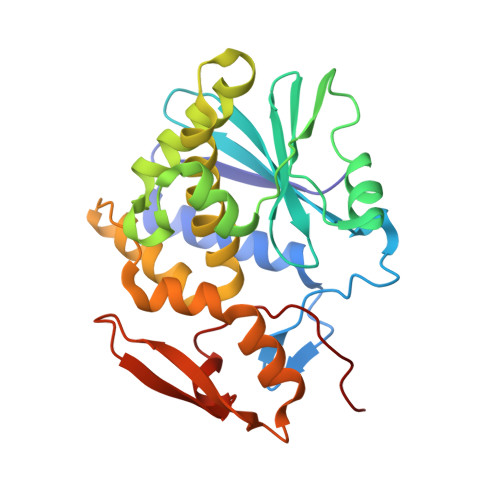
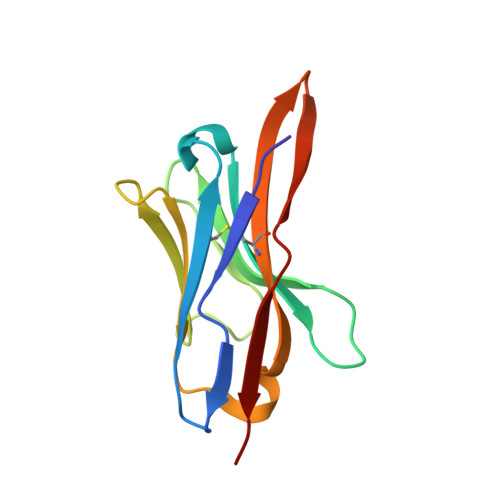
Ricin A chain bound to camelid

  • Classification: TOXIN
  • Organism(s): Ricinus communis, Vicugna pacos
  • Expression System: Escherichia coli
  • Mutation(s): No 

  • Deposited: 2019-03-20 Released: 2020-04-01 
  • Deposition Author(s): Rudolph, M.J.
  • Funding Organization(s): National Institutes of Health/National Institute Of Allergy and Infectious Diseases (NIH/NIAID)

Experimental Data Snapshot

  • Method: X-RAY DIFFRACTION
  • Resolution: 1.76 Å
  • R-Value Free: 
    0.227 (Depositor), 0.224 (DCC) 
  • R-Value Work: 
    0.185 (Depositor), 0.183 (DCC) 
  • R-Value Observed: 
    0.187 (Depositor) 

wwPDB Validation 3D Report Full Report

Validation slider image for 6OBC

This is version 1.2 of the entry. See complete history

Literature

Intracellular Neutralization of Ricin Toxin by Single-domain Antibodies Targeting the Active Site.

Rudolph, M.J.Czajka, T.F.Davis, S.A.Thi Nguyen, C.M.Li, X.P.Tumer, N.E.Vance, D.J.Mantis, N.J.

(2020) J Mol Biology 432: 1109-1125

  • DOI: https://doi.org/10.1016/j.jmb.2020.01.006
  • Primary Citation Related Structures: 
    6OBC, 6OBE, 6OBG, 6OBM, 6OBO, 6OCA, 6OCD

  • PubMed Abstract: 

    The extreme potency of the plant toxin, ricin, is due to its enzymatic subunit, RTA, which inactivates mammalian ribosomes with near-perfect efficiency. Here we characterized, at the functional and structural levels, seven alpaca single-domain antibodies (V H Hs) previously reported to recognize epitopes in proximity to RTA's active site. Three of the V H Hs, V2A11, V8E6, and V2G10, were potent inhibitors of RTA in vitro and protected Vero cells from ricin when expressed as intracellular antibodies ("intrabodies"). Crystal structure analysis revealed that the complementarity-determining region 3 (CDR3) elements of V2A11 and V8E6 penetrate RTA's active site and interact with key catalytic residues. V2G10, by contrast, sits atop the enzymatic pocket and occludes substrate accessibility. The other four V H Hs also penetrated/occluded RTA's active site, but lacked sufficient binding affinities to outcompete RTA-ribosome interactions. Intracellular delivery of high-affinity, single-domain antibodies may offer a new avenue in the development of countermeasures against ricin toxin.toxin, antibody, structure, intracellular.


  • Organizational Affiliation
    • New York Structural Biology Center, New York, NY 10027, United States. Electronic address: mrudolph@nysbc.org.

Macromolecule Content 

  • Total Structure Weight: 42.42 kDa 
  • Atom Count: 3,265 
  • Modeled Residue Count: 378 
  • Deposited Residue Count: 378 
  • Unique protein chains: 2

Macromolecules

Find similar proteins by:|  3D Structure
Entity ID: 1
MoleculeChains  Sequence LengthOrganismDetailsImage
Ricin A chain259Ricinus communisMutation(s): 0 
EC: 3.2.2.22
UniProt
Find proteins for P02879 (Ricinus communis)
Explore P02879 
Go to UniProtKB:  P02879
Entity Groups
Sequence Clusters30% Identity50% Identity70% Identity90% Identity95% Identity100% Identity
UniProt GroupP02879
Sequence Annotations
Expand
Reference Sequence
Find similar proteins by:|  3D Structure
Entity ID: 2
MoleculeChains  Sequence LengthOrganismDetailsImage
VHH antibody119Vicugna pacosMutation(s): 0 

Experimental Data & Validation

Experimental Data

  • Method: X-RAY DIFFRACTION
  • Resolution: 1.76 Å
  • R-Value Free:  0.227 (Depositor), 0.224 (DCC) 
  • R-Value Work:  0.185 (Depositor), 0.183 (DCC) 
  • R-Value Observed: 0.187 (Depositor) 
Space Group: P 1
Unit Cell:
Length ( Å )Angle ( ˚ )
a = 38.748α = 100.25
b = 47.197β = 97.3
c = 58.43γ = 109.71
Software Package:
Software NamePurpose
HKL-2000data reduction
HKL-2000data scaling
PHASERphasing
PHENIXrefinement
PDB_EXTRACTdata extraction

Structure Validation

View Full Validation Report


Entry History 

& Funding Information

Deposition Data


Funding OrganizationLocationGrant Number
National Institutes of Health/National Institute Of Allergy and Infectious Diseases (NIH/NIAID)United StatesHHSN272201400021C

Revision History  (Full details and data files)

  • Version 1.0: 2020-04-01
    Type: Initial release
  • Version 1.1: 2020-10-14
    Changes: Database references
  • Version 1.2: 2024-10-30
    Changes: Data collection, Database references, Structure summary