6ZSX | pdb_00006zsx

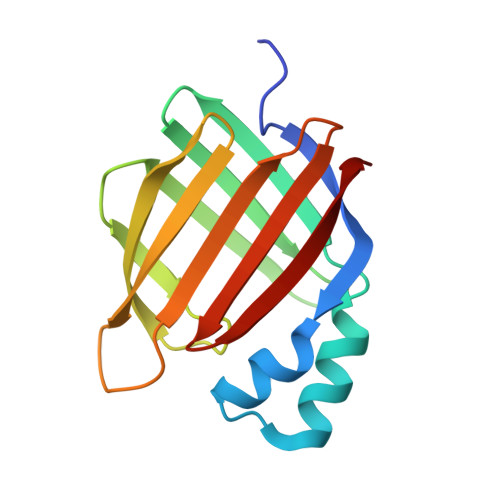
M2 mutant (R111K:Y134F:T54V:R132Q:P39Y:R59Y) of human cellular retinoic acid binding protein II - 4 conjugate


Experimental Data Snapshot

  • Method: X-RAY DIFFRACTION
  • Resolution: 2.40 Å
  • R-Value Free: 
    0.249 (Depositor), 0.251 (DCC) 
  • R-Value Work: 
    0.196 (Depositor), 0.197 (DCC) 
  • R-Value Observed: 
    0.199 (Depositor) 

Starting Model: experimental
View more details

wwPDB Validation 3D Report Full Report

Validation slider image for 6ZSX

Ligand Structure Quality Assessment 


This is version 1.4 of the entry. See complete history

Literature

Xanthopsin-Like Systems via Site-Specific Click-Functionalization of a Retinoic Acid Binding Protein.

Tassone, G.Paolino, M.Pozzi, C.Reale, A.Salvini, L.Giorgi, G.Orlandini, M.Galvagni, F.Mangani, S.Yang, X.Carlotti, B.Ortica, F.Latterini, L.Olivucci, M.Cappelli, A.

(2022) Chembiochem 23: e202100449-e202100449

  • DOI: https://doi.org/10.1002/cbic.202100449
  • Primary Citation Related Structures: 
    6Z2U, 6Z2Z, 6ZSW, 6ZSX

  • PubMed Abstract: 

    The use of light-responsive proteins to control both living or synthetic cells, is at the core of the expanding fields of optogenetics and synthetic biology. It is thus apparent that a richer reaction toolbox for the preparation of such systems is of fundamental importance. Here, we provide a proof-of-principle demonstration that Morita-Baylis-Hillman adducts can be employed to perform a facile site-specific, irreversible and diastereoselective click-functionalization of a lysine residue buried into a lipophilic binding pocket and yielding an unnatural chromophore with an extended π-system. In doing so we effectively open the path to the in vitro preparation of a library of synthetic proteins structurally reminiscent of xanthopsin eubacterial photoreceptors. We argue that such a library, made of variable unnatural chromophores inserted in an easy-to-mutate and crystallize retinoic acid transporter, significantly expand the scope of the recently introduced rhodopsin mimics as both optogenetic and "lab-on-a-molecule" tools.


  • Organizational Affiliation
    • Dipartimento di Biotecnologie, Chimica e Farmacia, Dipartimento di Eccellenza 2018-2022), Università degli Studi di Siena, Via A. Moro 2, 53100, Siena, Italy.

Macromolecule Content 

  • Total Structure Weight: 16.17 kDa 
  • Atom Count: 1,108 
  • Modeled Residue Count: 139 
  • Deposited Residue Count: 141 
  • Unique protein chains: 1

Macromolecules

Find similar proteins by:|  3D Structure
Entity ID: 1
MoleculeChains  Sequence LengthOrganismDetailsImage
Cellular retinoic acid-binding protein 2141Homo sapiensMutation(s): 6 
Gene Names: CRABP2
UniProt & NIH Common Fund Data Resources
Find proteins for P29373 (Homo sapiens)
Explore P29373 
Go to UniProtKB:  P29373
PHAROS:  P29373
GTEx:  ENSG00000143320 
Entity Groups
Sequence Clusters30% Identity50% Identity70% Identity90% Identity95% Identity100% Identity
UniProt GroupP29373
Sequence Annotations
Expand
Reference Sequence

Small Molecules

Ligands 1 Unique
IDChains Name / Formula / InChI Key2D Diagram3D Interactions
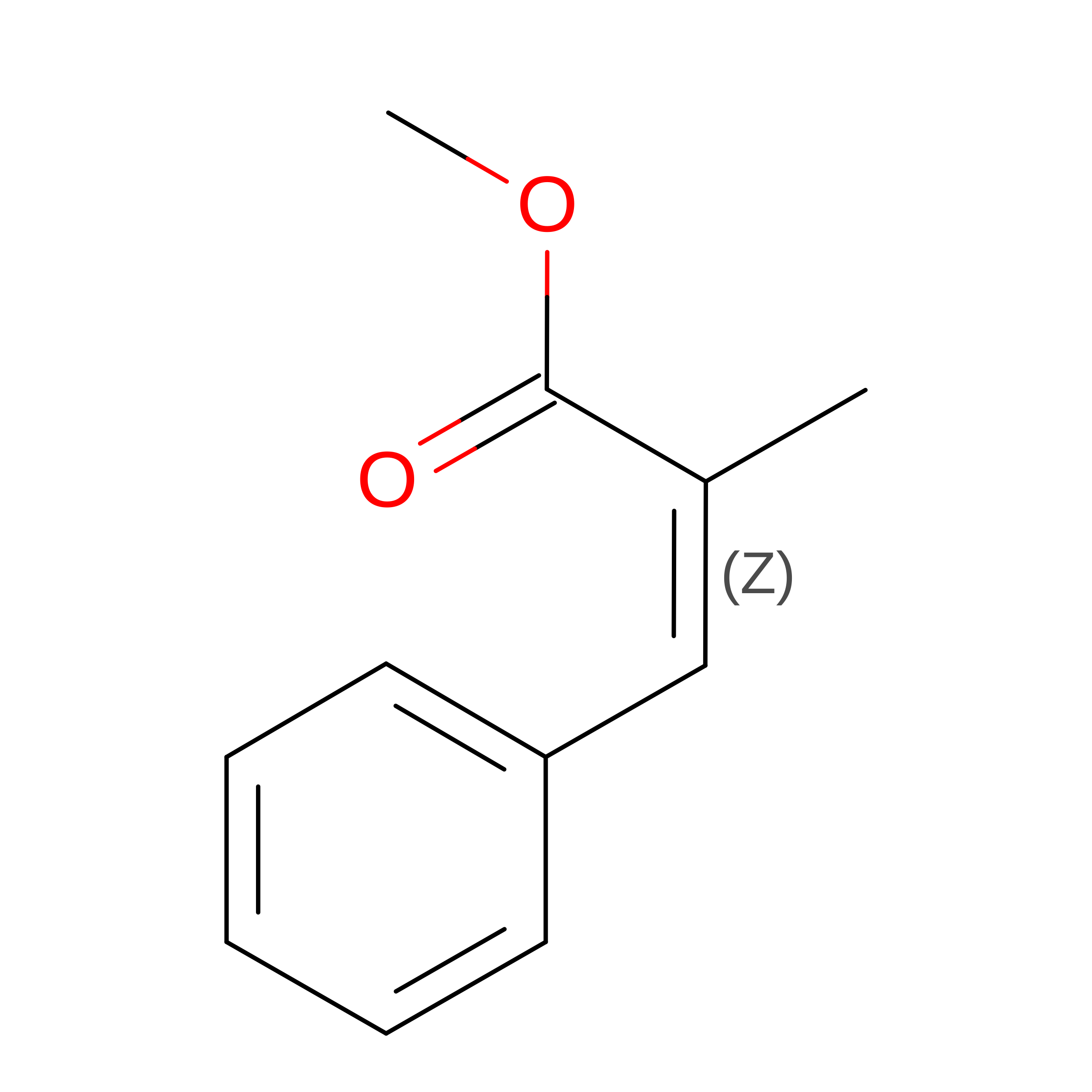
QPE
(Subject of Investigation/LOI)

Query on QPE


Download:Ideal Coordinates CCD File
B [auth A]methyl (~{Z})-2-methyl-3-phenyl-prop-2-enoate
C11 H12 O2
QILOUBBQVGUFNG-HJWRWDBZSA-N

Experimental Data & Validation

Experimental Data

  • Method: X-RAY DIFFRACTION
  • Resolution: 2.40 Å
  • R-Value Free:  0.249 (Depositor), 0.251 (DCC) 
  • R-Value Work:  0.196 (Depositor), 0.197 (DCC) 
  • R-Value Observed: 0.199 (Depositor) 
Space Group: P 31 2 1
Unit Cell:
Length ( Å )Angle ( ˚ )
a = 57.339α = 90
b = 57.339β = 90
c = 102.816γ = 120
Software Package:
Software NamePurpose
REFMACrefinement
PDB_EXTRACTdata extraction
XDSdata reduction
SCALAdata scaling
MOLREPphasing

Structure Validation

View Full Validation Report


Ligand Structure Quality Assessment 


Entry History 

Deposition Data

Revision History  (Full details and data files)

  • Version 1.0: 2021-07-28
    Type: Initial release
  • Version 1.1: 2021-11-17
    Changes: Data collection, Database references
  • Version 1.2: 2022-01-19
    Changes: Data collection, Database references
  • Version 1.3: 2024-01-31
    Changes: Data collection, Refinement description
  • Version 1.4: 2024-10-16
    Changes: Structure summary