7LK7 | pdb_00007lk7

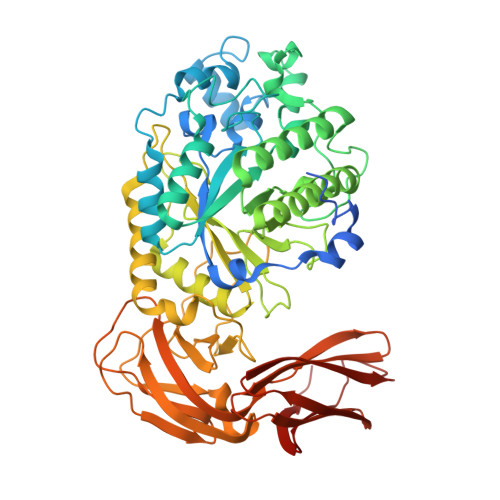
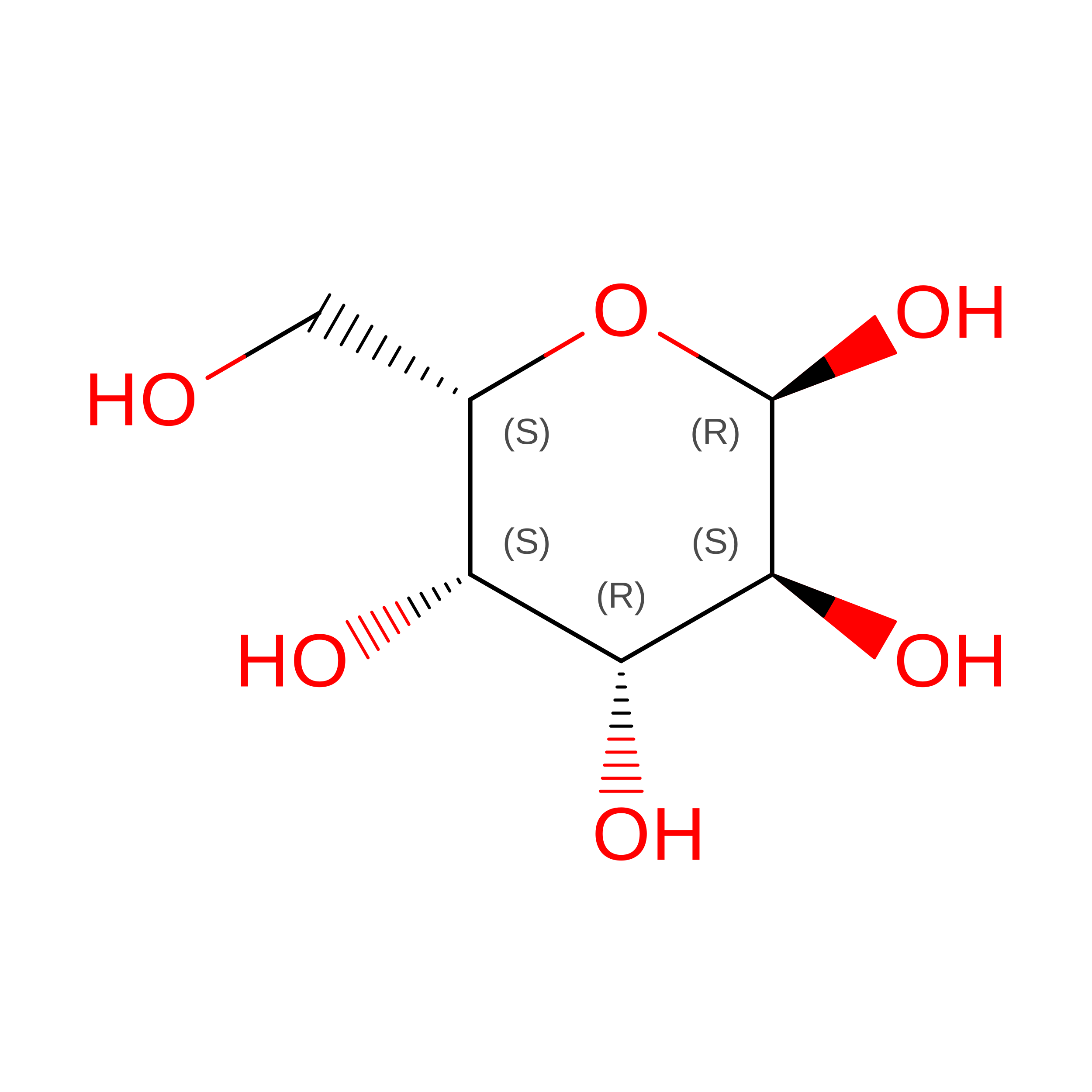
Structure of the Exo-alpha-L-galactosidase BpGH29 from Bacteroides plebeius in complex with L-galactose


Experimental Data Snapshot

  • Method: X-RAY DIFFRACTION
  • Resolution: 2.19 Å
  • R-Value Free: 
    0.230 (Depositor), 0.231 (DCC) 
  • R-Value Work: 
    0.181 (Depositor), 0.182 (DCC) 
  • R-Value Observed: 
    0.184 (Depositor) 

Starting Model: experimental
View more details

wwPDB Validation 3D Report Full Report

Validation slider image for 7LK7

Ligand Structure Quality Assessment 


This is version 1.3 of the entry. See complete history

Literature

Metabolism of a hybrid algal galactan by members of the human gut microbiome.

Robb, C.S.Hobbs, J.K.Pluvinage, B.Reintjes, G.Klassen, L.Monteith, S.Giljan, G.Amundsen, C.Vickers, C.Hettle, A.G.Hills, R.Xing, X.Montina, T.Zandberg, W.F.Abbott, D.W.Boraston, A.B.

(2022) Nat Chem Biol 18: 501-510

  • DOI: https://doi.org/10.1038/s41589-022-00983-y
  • Primary Citation Related Structures: 
    7LH6, 7LHA, 7LJ2, 7LJJ, 7LK7, 7LNP

  • PubMed Abstract: 

    Native porphyran is a hybrid of porphryan and agarose. As a common element of edible seaweed, this algal galactan is a frequent component of the human diet. Bacterial members of the human gut microbiota have acquired polysaccharide utilization loci (PULs) that enable the metabolism of porphyran or agarose. However, the molecular mechanisms that underlie the deconstruction and use of native porphyran remains incompletely defined. Here, we have studied two human gut bacteria, porphyranolytic Bacteroides plebeius and agarolytic Bacteroides uniformis, that target native porphyran. This reveals an exo-based cycle of porphyran depolymerization that incorporates a keystone sulfatase. In both PULs this cycle also works together with a PUL-encoded agarose depolymerizing machinery to synergistically reduce native porphyran to monosaccharides. This provides a framework for understanding the deconstruction of a hybrid algal galactan, and insight into the competitive and/or syntrophic relationship of gut microbiota members that target rare nutrients.


  • Organizational Affiliation
    • Department of Biochemistry and Microbiology, University of Victoria, Victoria, British Columbia, Canada.

Macromolecule Content 

  • Total Structure Weight: 68.63 kDa 
  • Atom Count: 4,906 
  • Modeled Residue Count: 562 
  • Deposited Residue Count: 599 
  • Unique protein chains: 1

Macromolecules

Find similar proteins by:|  3D Structure
Entity ID: 1
MoleculeChains  Sequence LengthOrganismDetailsImage
Exo-alpha-L-galactosidase599Phocaeicola plebeius DSM 17135Mutation(s): 0 
Gene Names: BACPLE_01702
EC: 3.2.1.51
UniProt
Find proteins for B5CYA5 (Phocaeicola plebeius (strain DSM 17135 / JCM 12973 / CCUG 54634 / M2))
Explore B5CYA5 
Go to UniProtKB:  B5CYA5
Entity Groups
Sequence Clusters30% Identity50% Identity70% Identity90% Identity95% Identity100% Identity
UniProt GroupB5CYA5
Sequence Annotations
Expand
Reference Sequence

Experimental Data & Validation

Experimental Data

  • Method: X-RAY DIFFRACTION
  • Resolution: 2.19 Å
  • R-Value Free:  0.230 (Depositor), 0.231 (DCC) 
  • R-Value Work:  0.181 (Depositor), 0.182 (DCC) 
  • R-Value Observed: 0.184 (Depositor) 
Space Group: P 21 21 2
Unit Cell:
Length ( Å )Angle ( ˚ )
a = 78.156α = 90
b = 132.902β = 90
c = 54.486γ = 90
Software Package:
Software NamePurpose
PHENIXrefinement
d*TREKdata scaling
d*TREKdata reduction
PHASERphasing

Structure Validation

View Full Validation Report


Ligand Structure Quality Assessment 


Entry History 

Deposition Data

Revision History  (Full details and data files)

  • Version 1.0: 2022-02-09
    Type: Initial release
  • Version 1.1: 2022-04-20
    Changes: Database references
  • Version 1.2: 2022-05-11
    Changes: Database references
  • Version 1.3: 2023-10-18
    Changes: Data collection, Refinement description