7MR8 | pdb_00007mr8

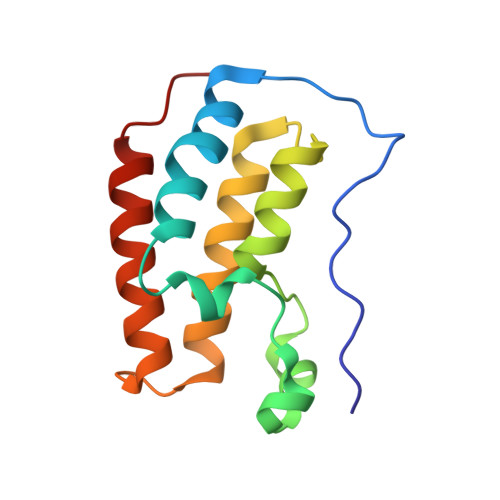
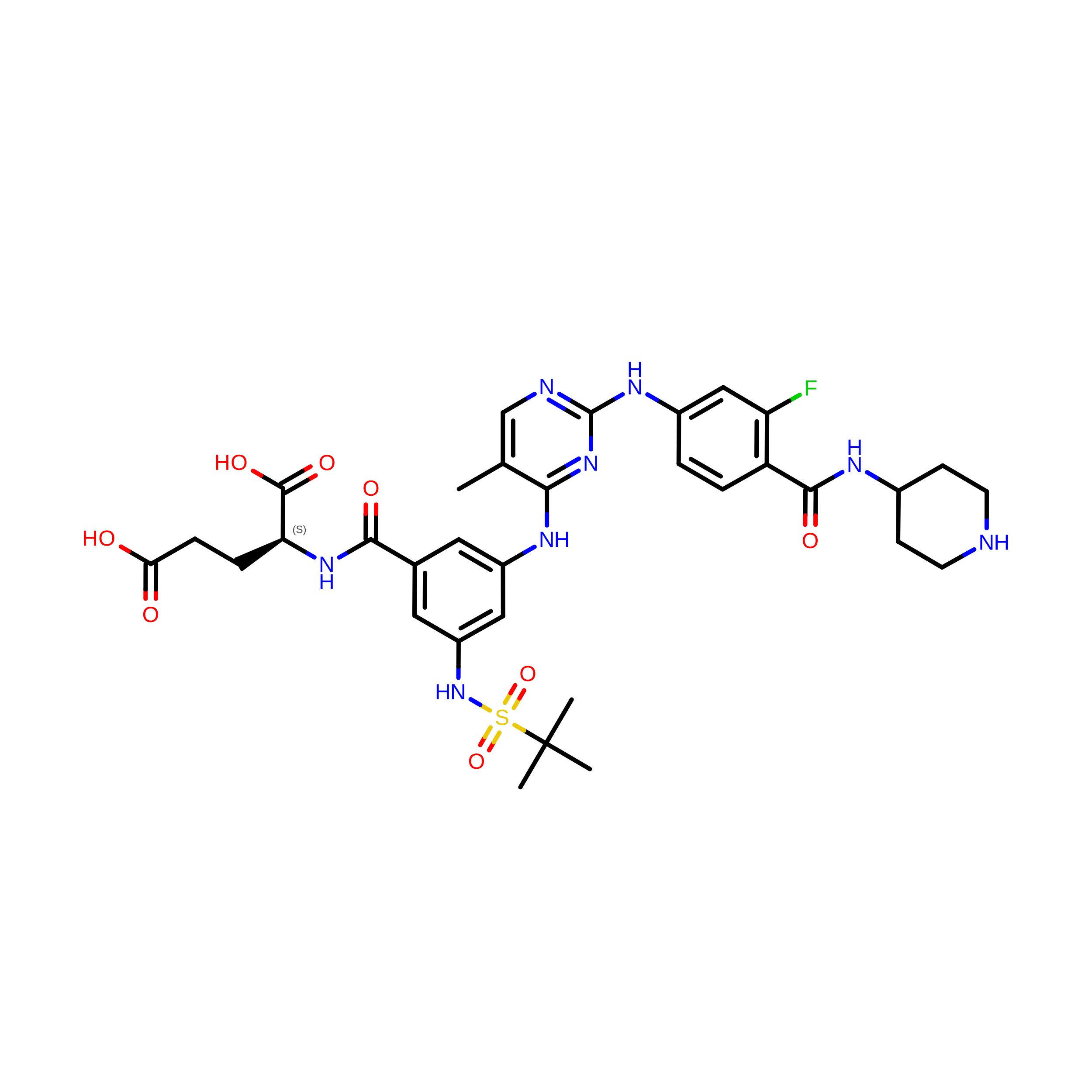
Crystal structure of the first bromodomain (BD1) of human BRD4 bound to GXH-II-076


Experimental Data Snapshot

  • Method: X-RAY DIFFRACTION
  • Resolution: 1.20 Å
  • R-Value Free: 
    0.177 (Depositor), 0.179 (DCC) 
  • R-Value Work: 
    0.166 (Depositor), 0.167 (DCC) 
  • R-Value Observed: 
    0.167 (Depositor) 

Starting Model: experimental
View more details

wwPDB Validation 3D Report Full Report

Validation slider image for 7MR8

Ligand Structure Quality Assessment 


This is version 1.2 of the entry. See complete history

Literature

Structural Basis for BD1-Preferring 2,4-Disubstituted Pyrimidine BRDT Inhibitors.

Liang, T.Guan, X.Chan, A.Kalra, P.Shi, R.Solberg, J.Sigua, L.H.Qi, J.Pomerantz, W.C.K.Schonbrunn, E.Hawkinson, J.E.Georg, G.I.

(2026) J Med Chem 69: 11088-11108

  • DOI: https://doi.org/10.1021/acs.jmedchem.6c00180
  • Primary Citation Related Structures: 
    7MR8, 9YCQ

  • PubMed Abstract: 

    The first bromodomain of the BET protein BRDT (BRDT-BD1) possesses a unique Arg54 residue at the terminus of the ZA channel, absent in other BET family members. We explored this structural uniqueness with 23 analogs of the BET/kinase inhibitor SG3-179 , each bearing an amino acid side chain to enable potential interactions between the positively charged arginine group and the negatively charged carboxylate groups. In an AlphaScreen assay, serine analog 13 showed 35-fold selectivity for BRDT-T over BRD4-T. The BRDT-BD1 cocrystal structure with glutamic acid analog 14 showed no interaction with Arg54, suggesting that the observed preference may be related to differences in the structured water molecules. Compound 13 displayed exceptional in vitro metabolic stability but had limited cellular permeability in MDCK-MDR1 cells. Compounds 13 and 14 are among the best BRDT-BD1-preferring inhibitors reported to date and demonstrate a significant step toward identifying highly selective BRDT inhibitors for male contraception.


  • Organizational Affiliation
    • Department of Chemistry, University of Minnesota, 207 Pleasant Street, SE, Minneapolis, Minnesota 55455-0431, United States.

Macromolecule Content 

  • Total Structure Weight: 15.95 kDa 
  • Atom Count: 1,350 
  • Modeled Residue Count: 126 
  • Deposited Residue Count: 127 
  • Unique protein chains: 1

Macromolecules

Find similar proteins by:|  3D Structure
Entity ID: 1
MoleculeChains  Sequence LengthOrganismDetailsImage
Bromodomain-containing protein 4127Homo sapiensMutation(s): 0 
Gene Names: BRD4HUNK1
UniProt & NIH Common Fund Data Resources
Find proteins for O60885 (Homo sapiens)
Explore O60885 
Go to UniProtKB:  O60885
GTEx:  ENSG00000141867 
Entity Groups
Sequence Clusters30% Identity50% Identity70% Identity90% Identity95% Identity100% Identity
UniProt GroupO60885
Sequence Annotations
Expand
Reference Sequence

Small Molecules

Ligands 2 Unique
IDChains Name / Formula / InChI Key2D Diagram3D Interactions
ZNJ
(Subject of Investigation/LOI)

Query on ZNJ


Download:Ideal Coordinates CCD File
B [auth A]N-{3-[(2-{3-fluoro-4-[(piperidin-4-yl)carbamoyl]anilino}-5-methylpyrimidin-4-yl)amino]-5-[(2-methylpropane-2-sulfonyl)amino]benzoyl}-L-glutamic acid
C33 H41 F N8 O8 S
LRKZLSYOZLJAAM-SANMLTNESA-N
EDO

Query on EDO


Download:Ideal Coordinates CCD File
C [auth A],
D [auth A]
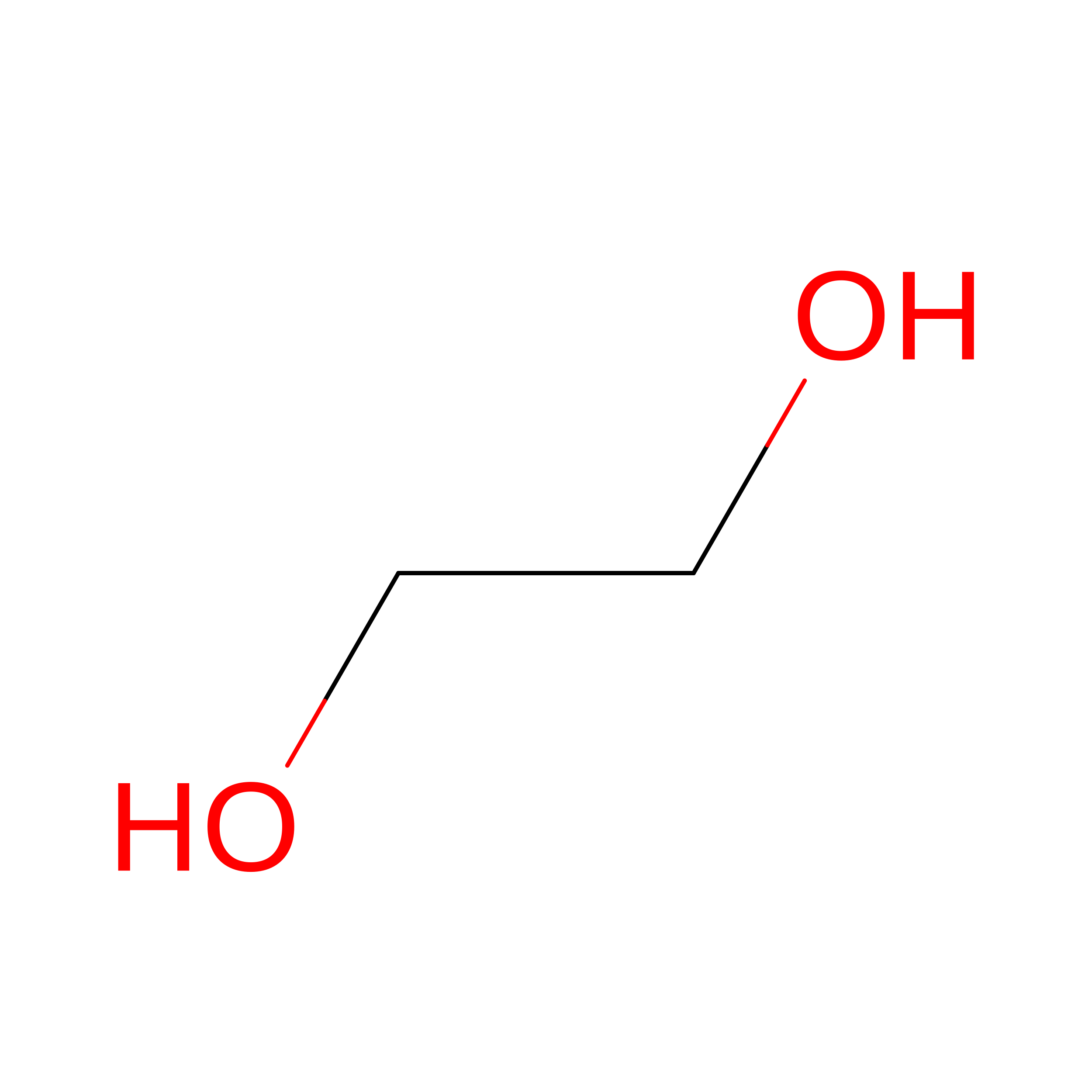
1,2-ETHANEDIOL
C2 H6 O2
LYCAIKOWRPUZTN-UHFFFAOYSA-N

Experimental Data & Validation

Experimental Data

  • Method: X-RAY DIFFRACTION
  • Resolution: 1.20 Å
  • R-Value Free:  0.177 (Depositor), 0.179 (DCC) 
  • R-Value Work:  0.166 (Depositor), 0.167 (DCC) 
  • R-Value Observed: 0.167 (Depositor) 
Space Group: P 21 21 21
Unit Cell:
Length ( Å )Angle ( ˚ )
a = 38.54α = 90
b = 39.99β = 90
c = 96.33γ = 90
Software Package:
Software NamePurpose
XSCALEdata scaling
PHENIXrefinement
PDB_EXTRACTdata extraction
XDSdata reduction
PHASERphasing

Structure Validation

View Full Validation Report


Ligand Structure Quality Assessment 


Entry History 

& Funding Information

Deposition Data


Funding OrganizationLocationGrant Number
National Institutes of Health/Eunice Kennedy Shriver National Institute of Child Health & Human Development (NIH/NICHD)United States1U54HD093540

Revision History  (Full details and data files)

  • Version 1.0: 2022-05-11
    Type: Initial release
  • Version 1.1: 2023-10-18
    Changes: Data collection, Refinement description
  • Version 1.2: 2026-07-29
    Changes: Database references, Structure summary