7VM0 | pdb_00007vm0

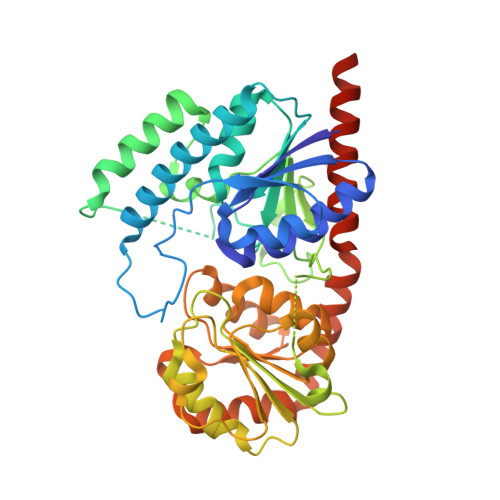
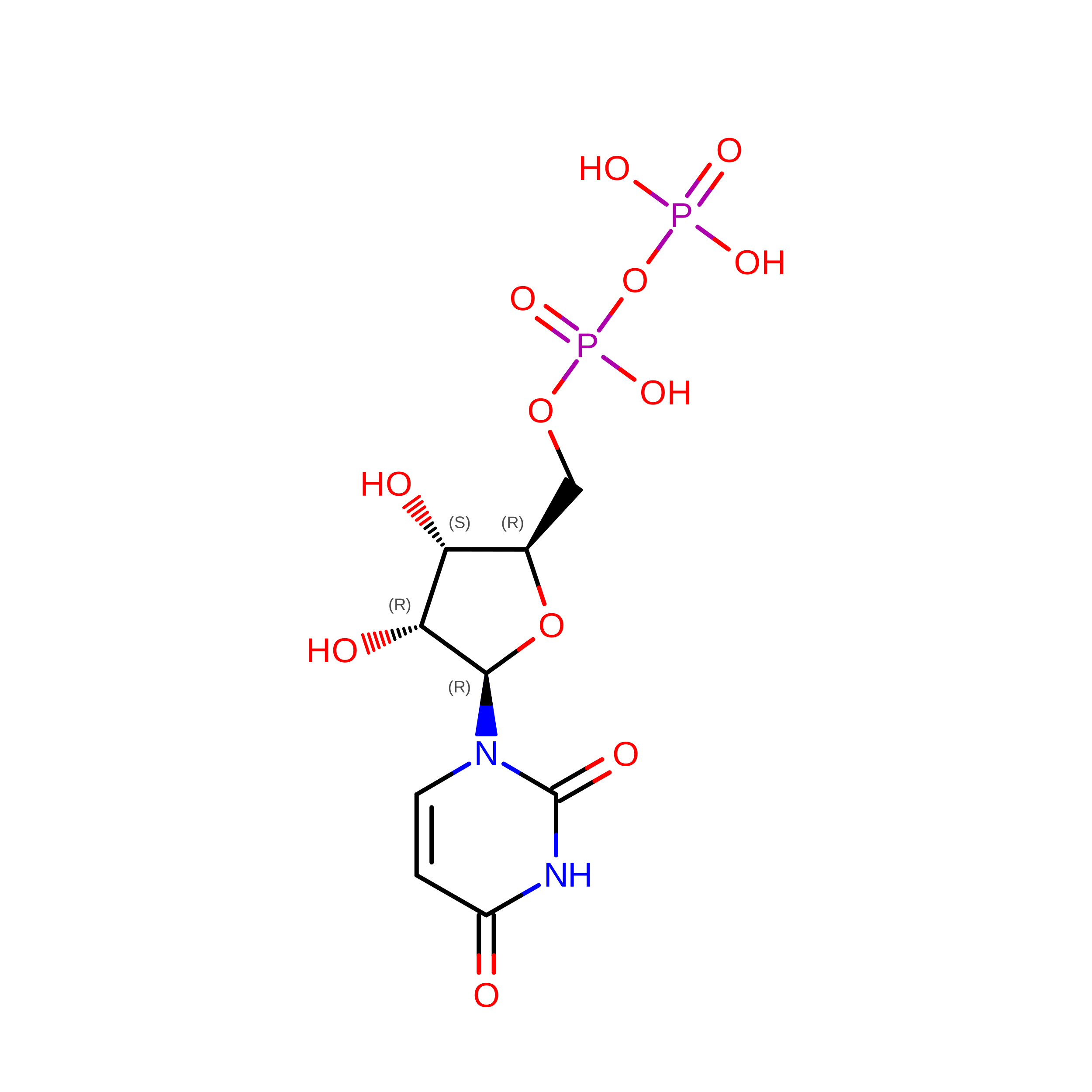
Crystal structure of YojK from B.subtilis in complex with UDP


Experimental Data Snapshot

  • Method: X-RAY DIFFRACTION
  • Resolution: 1.90 Å
  • R-Value Free: 
    0.243 (Depositor), 0.249 (DCC) 
  • R-Value Work: 
    0.198 (Depositor), 0.206 (DCC) 
  • R-Value Observed: 
    0.200 (Depositor) 

Starting Model: experimental
View more details

wwPDB Validation 3D Report Full Report

Validation slider image for 7VM0

Ligand Structure Quality Assessment 


This is version 2.1 of the entry. See complete history

Literature

Highly efficient production of rebaudioside D enabled by structure-guided engineering of bacterial glycosyltransferase YojK.

Guo, B.Hou, X.Zhang, Y.Deng, Z.Ping, Q.Fu, K.Yuan, Z.Rao, Y.

(2022) Front Bioeng Biotechnol 10: 985826-985826

  • DOI: https://doi.org/10.3389/fbioe.2022.985826
  • Primary Citation Related Structures: 
    7VM0

  • PubMed Abstract: 

    Owing to zero-calorie, high-intensity sweetness and good taste profile, the plant-derived sweetener rebaudioside D (Reb D) has attracted great interest to replace sugars. However, low content of Reb D in stevia rebaudiana Bertoni as well as low soluble expression and enzymatic activity of plant-derived glycosyltransferase in Reb D preparation restrict its commercial usage. To address these problems, a novel glycosyltransferase YojK from Bacillus subtilis 168 with the ability to glycosylate Reb A to produce Reb D was identified. Then, structure-guided engineering was performed after solving its crystal structure. A variant YojK-I241T/G327N with 7.35-fold increase of the catalytic activity was obtained, which allowed to produce Reb D on a scale preparation with a great yield of 91.29%. Moreover, based on the results from molecular docking and molecular dynamics simulations, the improvement of enzymatic activity of YojK-I241T/G327N was ascribed to the formation of new hydrogen bonds between the enzyme and substrate or uridine diphosphate glucose. Therefore, this study provides an engineered bacterial glycosyltransferase YojK-I241T/G327N with high solubility and catalytic efficiency for potential industrial scale-production of Reb D.


  • Organizational Affiliation
    • Key Laboratory of Carbohydrate Chemistry and Biotechnology, Ministry of Education, School of Biotechnology, Jiangnan University, Wuxi, China.

Macromolecule Content 

  • Total Structure Weight: 94.81 kDa 
  • Atom Count: 6,538 
  • Modeled Residue Count: 792 
  • Deposited Residue Count: 828 
  • Unique protein chains: 1

Macromolecules

Find similar proteins by:|  3D Structure
Entity ID: 1
MoleculeChains  Sequence LengthOrganismDetailsImage
Glycosyl transferase family 1
A, B
414Bacillus subtilisMutation(s): 0 
Gene Names: yojK1B4417_0117CFD21_20150
EC: 2.4.1
UniProt
Find proteins for O31853 (Bacillus subtilis (strain 168))
Explore O31853 
Go to UniProtKB:  O31853
Entity Groups
Sequence Clusters30% Identity50% Identity70% Identity90% Identity95% Identity100% Identity
UniProt GroupO31853
Sequence Annotations
Expand
Reference Sequence

Small Molecules

Experimental Data & Validation

Experimental Data

  • Method: X-RAY DIFFRACTION
  • Resolution: 1.90 Å
  • R-Value Free:  0.243 (Depositor), 0.249 (DCC) 
  • R-Value Work:  0.198 (Depositor), 0.206 (DCC) 
  • R-Value Observed: 0.200 (Depositor) 
Space Group: P 1 21 1
Unit Cell:
Length ( Å )Angle ( ˚ )
a = 46.602α = 90
b = 81.053β = 91.87
c = 100.676γ = 90
Software Package:
Software NamePurpose
REFMACrefinement
HKL-2000data scaling
PDB_EXTRACTdata extraction
HKL-2000data reduction
REFMACrefinement

Structure Validation

View Full Validation Report


Ligand Structure Quality Assessment 


Entry History 

& Funding Information

Deposition Data


Funding OrganizationLocationGrant Number
Other privateChina2018YFA0901700
Other privateChinaJUSRP12015
Other privateChina2020M671329
Other privateChina2020Z383

Revision History  (Full details and data files)

  • Version 1.0: 2022-10-12
    Type: Initial release
  • Version 2.0: 2022-10-19
    Changes: Advisory, Database references, Non-polymer description, Polymer sequence, Source and taxonomy, Structure summary
  • Version 2.1: 2023-11-29
    Changes: Data collection, Refinement description