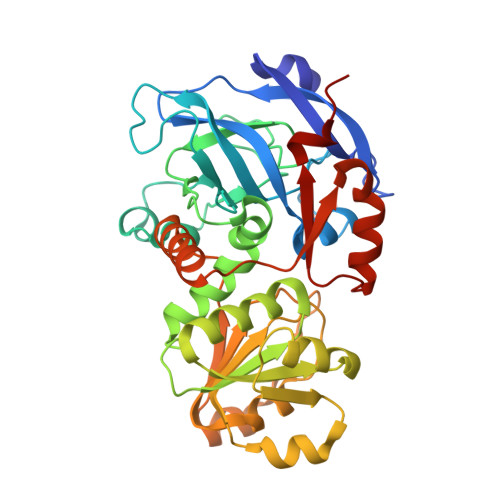
8B26 | pdb_00008b26

Dihydroprecondylocarpine acetate synthase 2 from Tabernanthe iboga


Experimental Data Snapshot

  • Method: X-RAY DIFFRACTION
  • Resolution: 2.42 Å
  • R-Value Free: 
    0.258 (Depositor), 0.255 (DCC) 
  • R-Value Work: 
    0.214 (Depositor), 0.215 (DCC) 
  • R-Value Observed: 
    0.216 (Depositor) 

Starting Model: experimental
View more details

wwPDB Validation 3D Report Full Report

Validation slider image for 8B26

This is version 1.3 of the entry. See complete history

Literature

Expansion of the Catalytic Repertoire of Alcohol Dehydrogenases in Plant Metabolism.

Langley, C.Tatsis, E.Hong, B.Nakamura, Y.Paetz, C.Stevenson, C.E.M.Basquin, J.Lawson, D.M.Caputi, L.O'Connor, S.E.

(2022) Angew Chem Int Ed Engl 61: e202210934-e202210934

  • DOI: https://doi.org/10.1002/anie.202210934
  • Primary Citation Related Structures: 
    8A3N, 8B1V, 8B25, 8B26, 8B27

  • PubMed Abstract: 

    Medium-chain alcohol dehydrogenases (ADHs) comprise a highly conserved enzyme family that catalyse the reversible reduction of aldehydes. However, recent discoveries in plant natural product biosynthesis suggest that the catalytic repertoire of ADHs has been expanded. Here we report the crystal structure of dihydroprecondylocarpine acetate synthase (DPAS), an ADH that catalyses the non-canonical 1,4-reduction of an α,β-unsaturated iminium moiety. Comparison with structures of plant-derived ADHs suggest the 1,4-iminium reduction does not require a proton relay or the presence of a catalytic zinc ion in contrast to canonical 1,2-aldehyde reducing ADHs that require the catalytic zinc and a proton relay. Furthermore, ADHs that catalysed 1,2-iminium reduction required the presence of the catalytic zinc and the loss of the proton relay. This suggests how the ADH active site can be modified to perform atypical carbonyl reductions, providing insight into how chemical reactions are diversified in plant metabolism.


  • Organizational Affiliation
    • Department of Natural Product Biosynthesis, Max Planck Institute for Chemical Ecology, Hans-Knöll Straße 8, Jena, 07745, Germany.

Macromolecule Content 

  • Total Structure Weight: 78.69 kDa 
  • Atom Count: 5,310 
  • Modeled Residue Count: 717 
  • Deposited Residue Count: 730 
  • Unique protein chains: 1

Macromolecules

Find similar proteins by:|  3D Structure
Entity ID: 1
MoleculeChains  Sequence LengthOrganismDetailsImage
Dihydroprecondylocarpine acetate synthase 2
A, B
365Tabernanthe ibogaMutation(s): 0 
EC: 1.3.1.128
UniProt
Find proteins for A0A5B8X8Z0 (Tabernanthe iboga)
Explore A0A5B8X8Z0 
Go to UniProtKB:  A0A5B8X8Z0
Entity Groups
Sequence Clusters30% Identity50% Identity70% Identity90% Identity95% Identity100% Identity
UniProt GroupA0A5B8X8Z0
Sequence Annotations
Expand
Reference Sequence

Experimental Data & Validation

Experimental Data

  • Method: X-RAY DIFFRACTION
  • Resolution: 2.42 Å
  • R-Value Free:  0.258 (Depositor), 0.255 (DCC) 
  • R-Value Work:  0.214 (Depositor), 0.215 (DCC) 
  • R-Value Observed: 0.216 (Depositor) 
Space Group: P 21 21 21
Unit Cell:
Length ( Å )Angle ( ˚ )
a = 74.422α = 90
b = 78.124β = 90
c = 131.207γ = 90
Software Package:
Software NamePurpose
PHENIXrefinement
XDSdata reduction
Aimlessdata scaling
PHASERphasing

Structure Validation

View Full Validation Report


Entry History 

& Funding Information

Deposition Data


Funding OrganizationLocationGrant Number
Max Planck SocietyGermany--
European Research Council (ERC)European Union788301

Revision History  (Full details and data files)

  • Version 1.0: 2022-10-19
    Type: Initial release
  • Version 1.1: 2022-11-16
    Changes: Database references
  • Version 1.2: 2022-11-30
    Changes: Database references
  • Version 1.3: 2024-01-31
    Changes: Data collection, Refinement description