9CJG | pdb_00009cjg

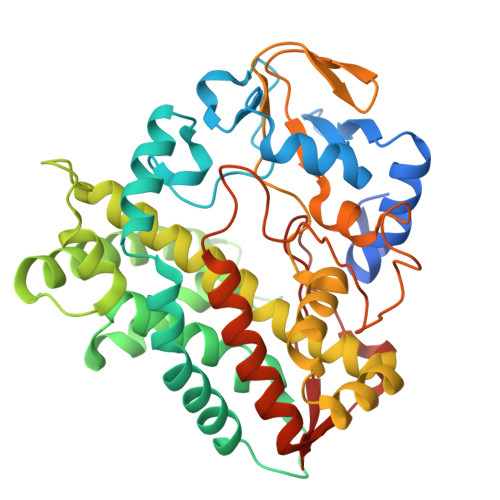
P450-G9 from Actinokineospora terrae, a non-canonical, serine-ligated cytochrome P450 in the ligand-free, closed conformation


Experimental Data Snapshot

  • Method: X-RAY DIFFRACTION
  • Resolution: 1.85 Å
  • R-Value Free: 
    0.242 (Depositor), 0.243 (DCC) 
  • R-Value Work: 
    0.214 (Depositor), 0.216 (DCC) 
  • R-Value Observed: 
    0.215 (Depositor) 

Starting Model: in silico
View more details

wwPDB Validation 3D Report Full Report

Validation slider image for 9CJG

Ligand Structure Quality Assessment 


This is version 1.2 of the entry. See complete history

Literature

Discovery of noncanonical cytochrome P450 enzymes in nature.

Nguy, A.K.L.Ireland, K.A.Kayrouz, C.M.Caceres, J.C.Huang, J.Z.Ying, V.Y.Quaye, J.A.Greene, B.L.Davis, K.M.Seyedsayamdost, M.R.

(2026) Nat Chem Biol 

  • DOI: https://doi.org/10.1038/s41589-026-02235-9
  • Primary Citation Related Structures: 
    9CJG

  • PubMed Abstract: 

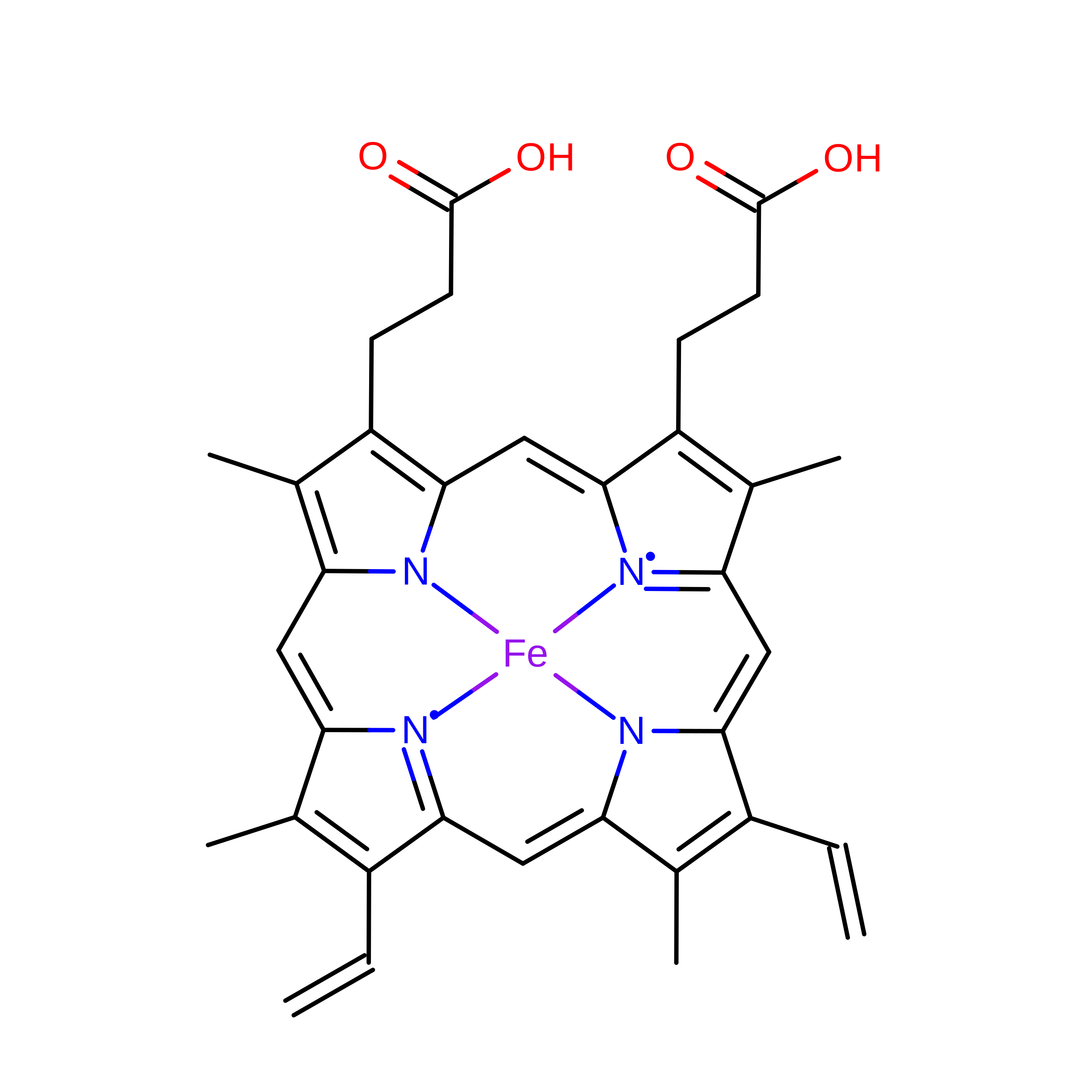
    Cytochrome P450s (CYPs) constitute a superfamily of thiolate-ligated heme metalloenzymes principally responsible for the hydroxylation of unactivated C-H bonds. The proximal cysteine is an obligatory and universally conserved residue for the CYP enzyme class. Herein, we challenge this paradigm by systematically identifying noncanonical CYPs (ncCYPs) that do not harbor a proximal cysteine ligand. Our bioinformatic search revealed 20 distinct ncCYP families encoded in diverse microbial genomes with alternative residues at this position. We characterize a native serine-ligated CYP with a high-spin ferric resting state that catalyzes azide reduction and nitrene insertion reactions. Its crystal structure clearly shows a typical CYP fold and a serine alkoxide as a proximal heme ligand. In addition, we report the discovery and characterization of the first native selenocysteine-ligated CYP in nature. Our findings expand the CYP metalloenzyme family and provide opportunities for future enzymatic and biocatalytic discoveries.


  • Organizational Affiliation
    • Department of Chemistry, Princeton University, Princeton, NJ, USA.

Macromolecule Content 

  • Total Structure Weight: 90.33 kDa 
  • Atom Count: 6,282 
  • Modeled Residue Count: 772 
  • Deposited Residue Count: 822 
  • Unique protein chains: 1

Macromolecules

Find similar proteins by:|  3D Structure
Entity ID: 1
MoleculeChains  Sequence LengthOrganismDetailsImage
Cytochrome P450-G9
A, B
411Actinokineospora terraeMutation(s): 0 
Gene Names: SAMN04487818_101238
EC: 1.14
UniProt
Find proteins for A0A1H9KM06 (Actinokineospora terrae)
Explore A0A1H9KM06 
Go to UniProtKB:  A0A1H9KM06
Entity Groups
Sequence Clusters30% Identity50% Identity70% Identity90% Identity95% Identity100% Identity
UniProt GroupA0A1H9KM06
Sequence Annotations
Expand
Reference Sequence

Experimental Data & Validation

Experimental Data

  • Method: X-RAY DIFFRACTION
  • Resolution: 1.85 Å
  • R-Value Free:  0.242 (Depositor), 0.243 (DCC) 
  • R-Value Work:  0.214 (Depositor), 0.216 (DCC) 
  • R-Value Observed: 0.215 (Depositor) 
Space Group: P 21 21 21
Unit Cell:
Length ( Å )Angle ( ˚ )
a = 53.13α = 90
b = 59.65β = 90
c = 233.8γ = 90
Software Package:
Software NamePurpose
MOSFLMdata reduction
Aimlessdata scaling
PHASERphasing
Cootmodel building
PHENIXrefinement

Structure Validation

View Full Validation Report


Ligand Structure Quality Assessment 


Entry History 

& Funding Information

Deposition Data


Funding OrganizationLocationGrant Number
National Institutes of Health/John E. Fogarty International Center (NIH/FIC)United StatesR35-GM147557
National Science Foundation (NSF, United States)United States1937971

Revision History  (Full details and data files)

  • Version 1.0: 2025-03-12
    Type: Initial release
  • Version 1.1: 2026-07-15
    Changes: Database references
  • Version 1.2: 2026-08-12
    Type: Remediation
    Reason: Metalloprotein remediation
    Changes: Derived calculations, Structure summary