Download Mendeley
Pre-activation and gating pathway of AMPA receptors revealed by full and partial agonists.
Newton, T.P., Aktolun, M., Yelshanskaya, M.V., Alekseev, A.A., Yen, L.Y., Gangwar, S.P., Sobolevsky, I.A., Kurnikova, M.G., Sobolevsky, A.I.(2026) Nat Struct Mol Biol
- PubMed: 42717062 Search on PubMedSearch on PubMed Central
- DOI: https://doi.org/10.1038/s41594-026-01882-9
- Primary Citation Related Structures:
11VV, 11VW, 11VX, 11VY, 11VZ, 11WA, 11WB, 11WC, 11WD, 11WE - PubMed Abstract:
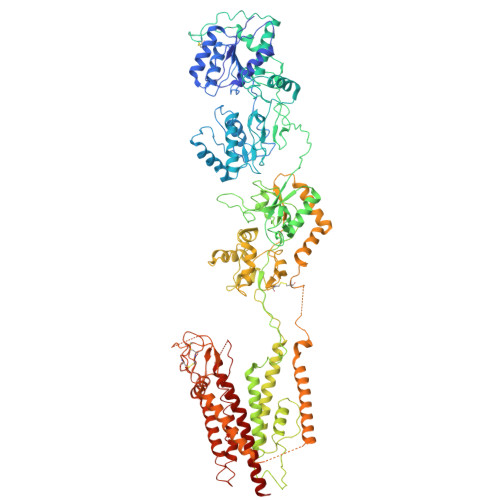
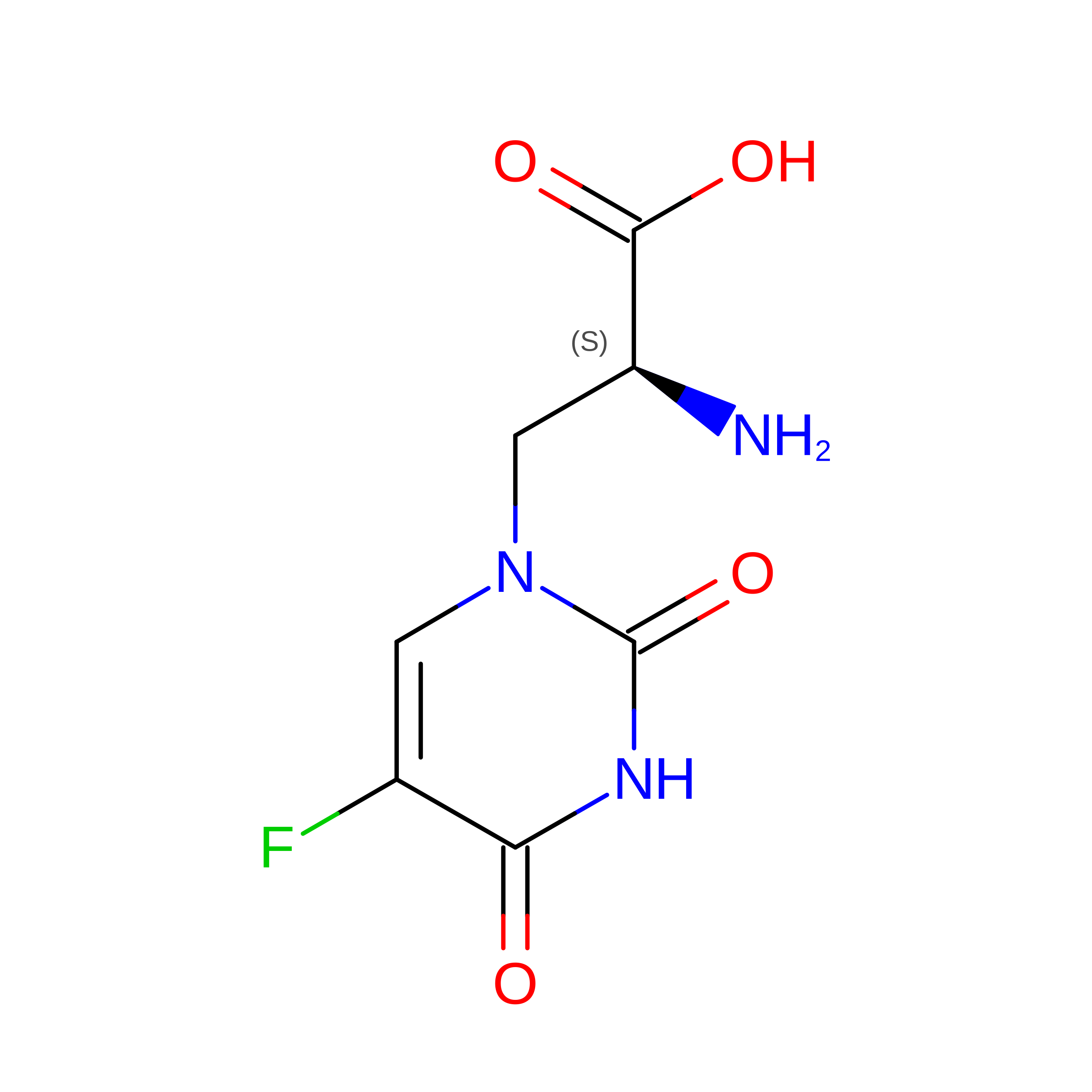
AMPA receptors (AMPARs) mediate fast excitatory neurotransmission. Gating of AMPARs starts with agonist binding and transition into a non-conducting pre-active state, followed by transition into conducting open or non-conducting desensitized states. While the terminal apo, open and desensitized states have been structurally characterized, the intermediate pre-active state has remained an enigma. Compared to full agonist glutamate, partial agonists reduce the maximal occupancy of the open state and increase the probability of the pre-active state occurrence. Here we use different partial agonists and time-resolved cryo-electron microscopy (cryo-EM) to capture a structural ensemble of GluA2-γ2 AMPAR complexes in the closed apo, pre-active, open and desensitized states. Binding of partial agonists to the ligand-binding domain (LBD) results in different extents of LBD clamshell closure, with closures exceeding a threshold of ~17° resulting in the open and desensitized states and smaller closures stabilizing the pre-active state. The pre-active state has a distinct gate conformation intermediate between the other two discrete states, completely open and closed. Combined with single-channel current recordings and molecular dynamics simulations, our structural results reveal the complete gating pathway of AMPARs and shed light on the molecular mechanisms of partial agonism and pre-activation.
- Department of Biochemistry and Molecular Biophysics, Columbia University, New York, NY, USA.
Organizational Affiliation: