1BDA | pdb_00001bda

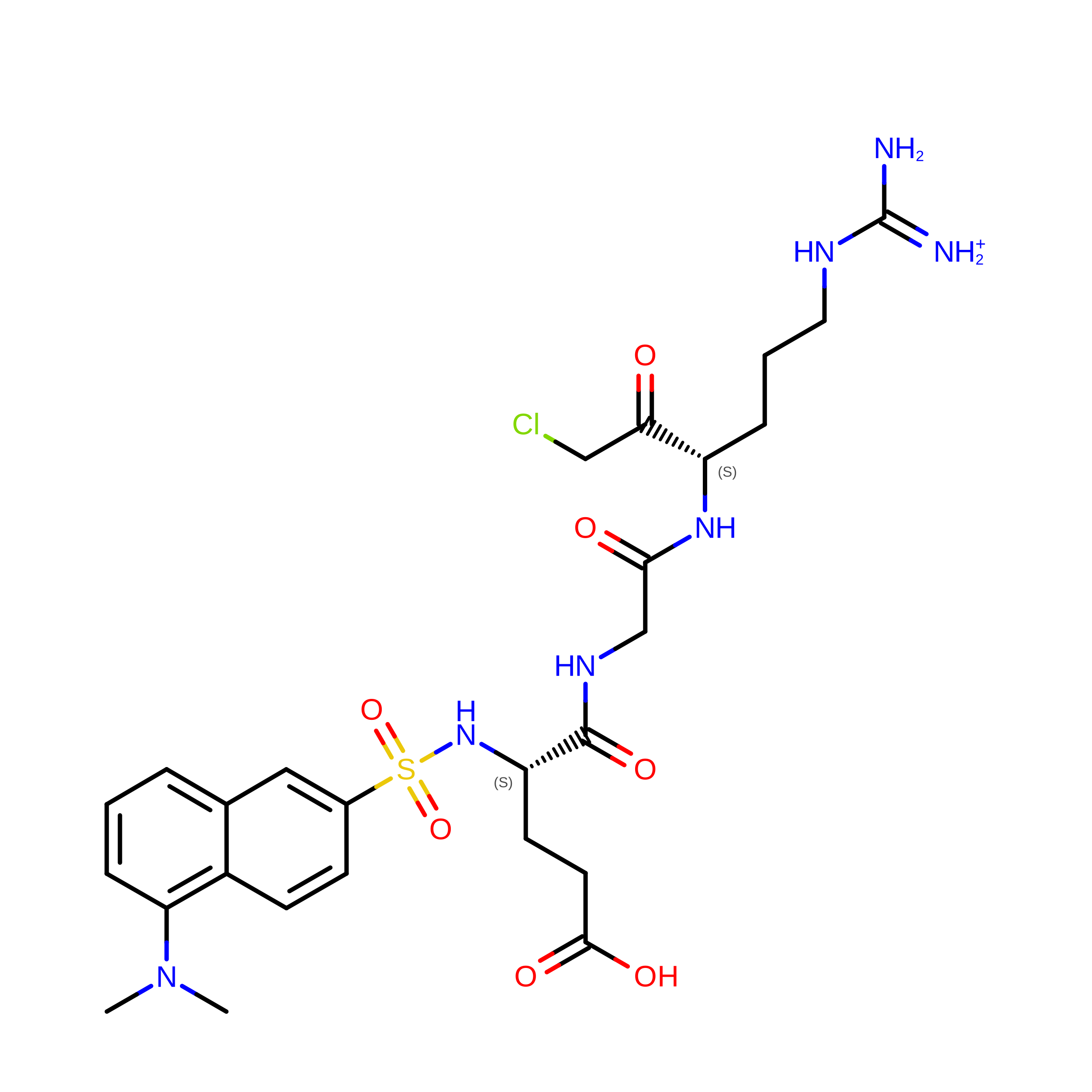
CATALYTIC DOMAIN OF HUMAN SINGLE CHAIN TISSUE PLASMINOGEN ACTIVATOR IN COMPLEX WITH DANSYL-EGR-CMK (DANSYL-GLU-GLY-ARG CHLOROMETHYL KETONE)


Experimental Data Snapshot

  • Method: X-RAY DIFFRACTION
  • Resolution: 3.35 Å

Starting Model: experimental
View more details

wwPDB Validation 3D Report Full Report

Validation slider image for 1BDA

This is version 1.5 of the entry. See complete history

Literature

Lysine 156 promotes the anomalous proenzyme activity of tPA: X-ray crystal structure of single-chain human tPA.

Renatus, M.Engh, R.A.Stubbs, M.T.Huber, R.Fischer, S.Kohnert, U.Bode, W.

(1997) EMBO J 16: 4797-4805

  • DOI: https://doi.org/10.1093/emboj/16.16.4797
  • Primary Citation Related Structures: 
    1BDA

  • PubMed Abstract: 

    Tissue type plasminogen activator (tPA) is the physiological initiator of fibrinolysis, activating plasminogen via highly specific proteolysis; plasmin then degrades fibrin with relatively broad specificity. Unlike other chymotrypsin family serine proteinases, tPA is proteolytically active in a single-chain form. This form is also preferred for therapeutic administration of tPA in cases of acute myocardial infarction. The proteolytic cleavage which activates most other chymotrypsin family serine proteinases increases the catalytic efficiency of tPA only 5- to 10-fold. The X-ray crystal structure of the catalytic domain of recombinant human single-chain tPA shows that Lys156 forms a salt bridge with Asp194, promoting an active conformation in the single-chain form. Comparisons with the structures of other serine proteinases that also possess Lys156, such as trypsin, factor Xa and human urokinase plasminogen activator (uPA), identify a set of secondary interactions which are required for Lys156 to fulfil this activating role. These findings help explain the anomalous single-chain activity of tPA and may suggest strategies for design of new therapeutic plasminogen activators.


  • Organizational Affiliation
    • Max-Planck-Institute of Biochemistry, Department of Structural Research, Martinsried, Germany. renatus@biochem.mpg.de

Macromolecule Content 

  • Total Structure Weight: 60.71 kDa 
  • Atom Count: 4,271 
  • Modeled Residue Count: 530 
  • Deposited Residue Count: 530 
  • Unique protein chains: 1

Macromolecules

Find similar proteins by:|  3D Structure
Entity ID: 1
MoleculeChains  Sequence LengthOrganismDetailsImage
SINGLE CHAIN TISSUE TYPE PLASMINOGEN ACTIVATOR
A, B
265Homo sapiensMutation(s): 0 
EC: 3.4.21.68
UniProt & NIH Common Fund Data Resources
Find proteins for P00750 (Homo sapiens)
Explore P00750 
Go to UniProtKB:  P00750
PHAROS:  P00750
GTEx:  ENSG00000104368 
Entity Groups
Sequence Clusters30% Identity50% Identity70% Identity90% Identity95% Identity100% Identity
UniProt GroupP00750
Sequence Annotations
Expand
Reference Sequence

Small Molecules

Ligands 1 Unique
IDChains Name / Formula / InChI Key2D Diagram3D Interactions
2Z0

Query on 2Z0


Download:Ideal Coordinates CCD File
C [auth A],
D [auth B]
N-{[5-(dimethylamino)naphthalen-2-yl]sulfonyl}-L-alpha-glutamyl-N-[(1S)-4-{[amino(iminio)methyl]amino}-1-(chloroacetyl) butyl]glycinamide
C26 H37 Cl N7 O7 S
VKQAIOBCWDJDIP-PMACEKPBSA-O

Biologically Interesting Molecules (External Reference) 

1 Unique

Experimental Data & Validation

Experimental Data

  • Method: X-RAY DIFFRACTION
  • Resolution: 3.35 Å
Space Group: P 21 21 21
Unit Cell:
Length ( Å )Angle ( ˚ )
a = 43.99α = 90
b = 80.78β = 90
c = 159.16γ = 90
Software Package:
Software NamePurpose
MOSFLMdata reduction
ROTAGRdata reduction
X-PLORmodel building
X-PLORrefinement
ROTAGRdata scaling
X-PLORphasing

Structure Validation

View Full Validation Report


Entry History 

Deposition Data

Revision History  (Full details and data files)

  • Version 1.0: 1999-05-11
    Type: Initial release
  • Version 1.1: 2008-05-22
    Changes: Version format compliance
  • Version 1.2: 2011-07-13
    Changes: Atomic model, Database references, Derived calculations, Non-polymer description, Structure summary, Version format compliance
  • Version 1.3: 2012-12-12
    Changes: Other
  • Version 1.4: 2023-08-02
    Changes: Database references, Derived calculations, Refinement description, Structure summary
  • Version 1.5: 2024-10-16
    Changes: Data collection, Structure summary