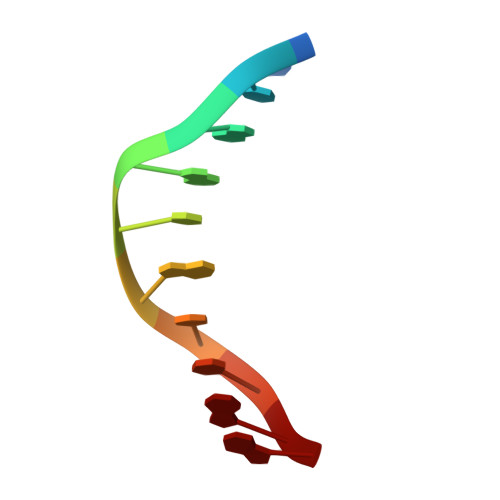
1CGC | pdb_00001cgc

DOUBLE HELIX CONFORMATION GROOVE DIMENSIONS AND LIGAND BINDING POTENTIAL OF A G/C-STRETCH IN B-DNA

  • Classification: DNA
  • Mutation(s): No 

  • Deposited: 1992-01-15 Released: 1993-04-15 
  • Deposition Author(s): Heinemann, U., Bansal, M.

Experimental Data Snapshot

  • Method: X-RAY DIFFRACTION
  • Resolution: 2.20 Å
  • R-Value Work: 
    0.163 (DCC) 
  • R-Value Observed: 
    0.167 (Depositor) 

wwPDB Validation 3D Report Full Report

Validation slider image for 1CGC

This is version 1.4 of the entry. See complete history

Literature

Double helix conformation, groove dimensions and ligand binding potential of a G/C stretch in B-DNA.

Heinemann, U.Alings, C.Bansal, M.

(1992) EMBO J 11: 1931-1939

  • DOI: https://doi.org/10.1002/j.1460-2075.1992.tb05246.x
  • Primary Citation Related Structures: 
    1CGC

  • PubMed Abstract: 

    The self-complementary DNA fragment CCGGCGCCGG crystallizes in the rhombohedral space group R3 with unit cell parameters a = 54.07 A and c = 44.59 A. The structure has been determined by X-ray diffraction methods at 2.2 A resolution and refined to an R value of 16.7%. In the crystal, the decamer forms B-DNA double helices with characteristic groove dimensions: compared with B-DNA of random sequence, the minor groove is wide and deep and the major groove is rather shallow. Local base pair geometries and stacking patterns are within the range commonly observed in B-DNA crystal structures. The duplex bears no resemblance to A-form DNA as might have been expected for a sequence with only GC base pairs. The shallow major groove permits an unusual crystal packing pattern with several direct intermolecular hydrogen bonds between phosphate oxygens and cytosine amino groups. In addition, decameric duplexes form quasi-infinite double helices in the crystal by end-to-end stacking. The groove geometries and accessibilities of this molecule as observed in the crystal may be important for the mode of binding of both proteins and drug molecules to G/C stretches in DNA.


  • Organizational Affiliation
    • Institut für Kristallographie, Freie Universität Berlin, FRG.

Macromolecule Content 

  • Total Structure Weight: 6.09 kDa 
  • Atom Count: 451 
  • Modeled Residue Count: 20 
  • Deposited Residue Count: 20 
  • Unique nucleic acid chains: 1

Macromolecules

Find similar nucleic acids by:  Sequence
Entity ID: 1
MoleculeChains LengthOrganismImage
DNA (5'-D(*CP*CP*GP*GP*CP*GP*CP*CP*GP*G)-3')
A, B
10N/A
Sequence Annotations
Expand
Reference Sequence

Experimental Data & Validation

Experimental Data

  • Method: X-RAY DIFFRACTION
  • Resolution: 2.20 Å
  • R-Value Work:  0.163 (DCC) 
  • R-Value Observed: 0.167 (Depositor) 
Space Group: H 3
Unit Cell:
Length ( Å )Angle ( ˚ )
a = 54.07α = 90
b = 54.07β = 90
c = 44.59γ = 120
Software Package:
Software NamePurpose
NUCLSQrefinement

Structure Validation

View Full Validation Report


Entry History 

Deposition Data

Revision History  (Full details and data files)

  • Version 1.0: 1993-04-15
    Type: Initial release
  • Version 1.1: 2008-05-22
    Changes: Version format compliance
  • Version 1.2: 2011-07-13
    Changes: Version format compliance
  • Version 1.3: 2018-04-18
    Changes: Data collection
  • Version 1.4: 2024-02-07
    Changes: Data collection, Database references