Download Mendeley
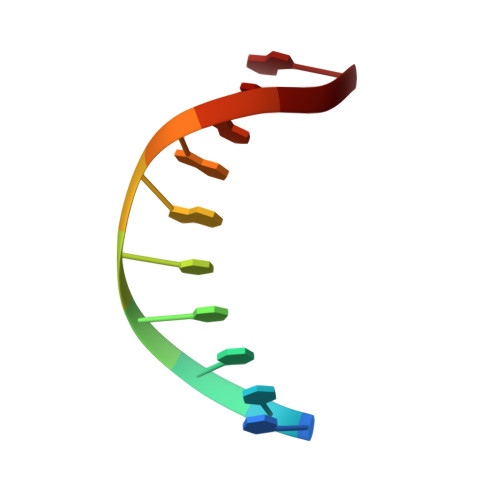
Intrinsic bending and deformability at the T-A step of CCTTTAAAGG: a comparative analysis of T-A and A-T steps within A-tracts.
Mack, D.R., Chiu, T.K., Dickerson, R.E.(2001) J Mol Biol 312: 1037-1049
- PubMed: 11580248 Search on PubMed
- DOI: https://doi.org/10.1006/jmbi.2001.4994
- Primary Citation Related Structures:
1IKK - PubMed Abstract:
Introduction of a T-A or pyrimidine-purine step into a straight and rigid A-tract can cause a positive roll deformation that kinks the DNA helix at that step. In CCTTTAAAGG, the central T-A step has an 8.6 degrees bend toward the major groove. We report the structural analysis of CCTTTAAAGG and a comparison with 25 other representative crystal structures from the NDB containing at least four consecutive A or T bases. On average, more local bending occurs at the disruptive T-A step (8.21 degrees ) than at an A-T step (5.71 degrees ). In addition, A-tracts containing an A-T step are more bent than are pure A-tracts, and hence A-A and A-T steps are not equivalent. All T-A steps examined exhibit positive roll, bending towards the major groove, while A-T steps display negative roll and bend slightly towards the minor groove. This illustrates how inherent negative and positive roll are, respectively, at A-T and T-A steps within A-tracts. T-A steps are more deformable, showing larger and more variable deformations of minor groove width, rise, cup, twist, and buckle. Standard deviations of twist, rise, and cup for T-A steps are 6.66 degrees, 0.55 A, and 15.90 degrees, versus 2.28 degrees, 0.21 A, and 2.99 degrees for A-T steps. Packing constraints determine which local values of these helical parameters an individual T-A step will adopt. For instance, with CCTTTAAAGG and three isomorphous structures, CGATTAATCG, CGATATATCG, and CGATCGATCG, crystal packing forces lead to a series of correlated changes: widened minor groove, large slide, low twist, and large rise. The difference in helical parameters between A-T steps lying within A-tracts, versus A-T steps within alternating AT sequences, demonstrates the importance of neighboring steps on the conformation of a given dinucleotide step.
- Department of Chemistry and Biochemistry, University of California, Los Angeles, CA 90095, USA.
Organizational Affiliation: