1JAE | pdb_00001jae

STRUCTURE OF TENEBRIO MOLITOR LARVAL ALPHA-AMYLASE


Experimental Data Snapshot

  • Method: X-RAY DIFFRACTION
  • Resolution: 1.65 Å
  • R-Value Free: 
    0.206 (Depositor) 
  • R-Value Work: 
    0.177 (Depositor) 
  • R-Value Observed: 
    0.177 (Depositor) 

Starting Model: experimental
View more details

wwPDB Validation 3D Report Full Report

Validation slider image for 1JAE

This is version 2.2 of the entry. See complete history

Literature

Crystal structure of yellow meal worm alpha-amylase at 1.64 A resolution.

Strobl, S.Maskos, K.Betz, M.Wiegand, G.Huber, R.Gomis-Ruth, F.X.Glockshuber, R.

(1998) J Mol Biology 278: 617-628

  • DOI: https://doi.org/10.1006/jmbi.1998.1667
  • Primary Citation Related Structures: 
    1JAE

  • PubMed Abstract: 

    The three-dimensional structure of the alpha-amylase from Tenebrio molitor larvae (TMA) has been determined by molecular replacement techniques using diffraction data of a crystal of space group P212121 (a=51.24 A; b=93.46 A; c=96.95 A). The structure has been refined to a crystallographic R-factor of 17.7% for 58,219 independent reflections in the 7.0 to 1.64 A resolution range, with root-mean-square deviations of 0.008 A for bond lengths and 1.482 degrees for bond angles. The final model comprises all 471 residues of TMA, 261 water molecules, one calcium cation and one chloride anion. The electron density confirms that the N-terminal glutamine residue has undergone a post-transitional modification resulting in a stable 5-oxo-proline residue. The X-ray structure of TMA provides the first three-dimensional model of an insect alpha-amylase. The monomeric enzyme exhibits an elongated shape approximately 75 Ax46 Ax40 A and consists of three distinct domains, in line with models for alpha-amylases from microbial, plant and mammalian origin. However, the structure of TMA reflects in the substrate and inhibitor binding region a remarkable difference from mammalian alpha-amylases: the lack of a highly flexible, glycine-rich loop, which has been proposed to be involved in a "trap-release" mechanism of substrate hydrolysis by mammalian alpha-amylases. The structural differences between alpha-amylases of various origins might explain the specificity of inhibitors directed exclusively against insect alpha-amylases.


  • Organizational Affiliation
    • Institut für Molekularbiologie und Biophysik, Eidenössische Technische Hochschule Hönggerberg, Zürich, CH-8093, Switzerland.

Macromolecule Content 

  • Total Structure Weight: 51.34 kDa 
  • Atom Count: 3,869 
  • Modeled Residue Count: 471 
  • Deposited Residue Count: 471 
  • Unique protein chains: 1

Macromolecules

Find similar proteins by:|  3D Structure
Entity ID: 1
MoleculeChains  Sequence LengthOrganismDetailsImage
ALPHA-AMYLASE471Tenebrio molitorMutation(s): 0 
EC: 3.2.1.1
UniProt
Find proteins for P56634 (Tenebrio molitor)
Explore P56634 
Go to UniProtKB:  P56634
Entity Groups
Sequence Clusters30% Identity50% Identity70% Identity90% Identity95% Identity100% Identity
UniProt GroupP56634
Sequence Annotations
Expand
Reference Sequence

Small Molecules

Ligands 2 Unique
IDChains Name / Formula / InChI Key2D Diagram3D Interactions
CA

Query on CA


Download:Ideal Coordinates CCD File
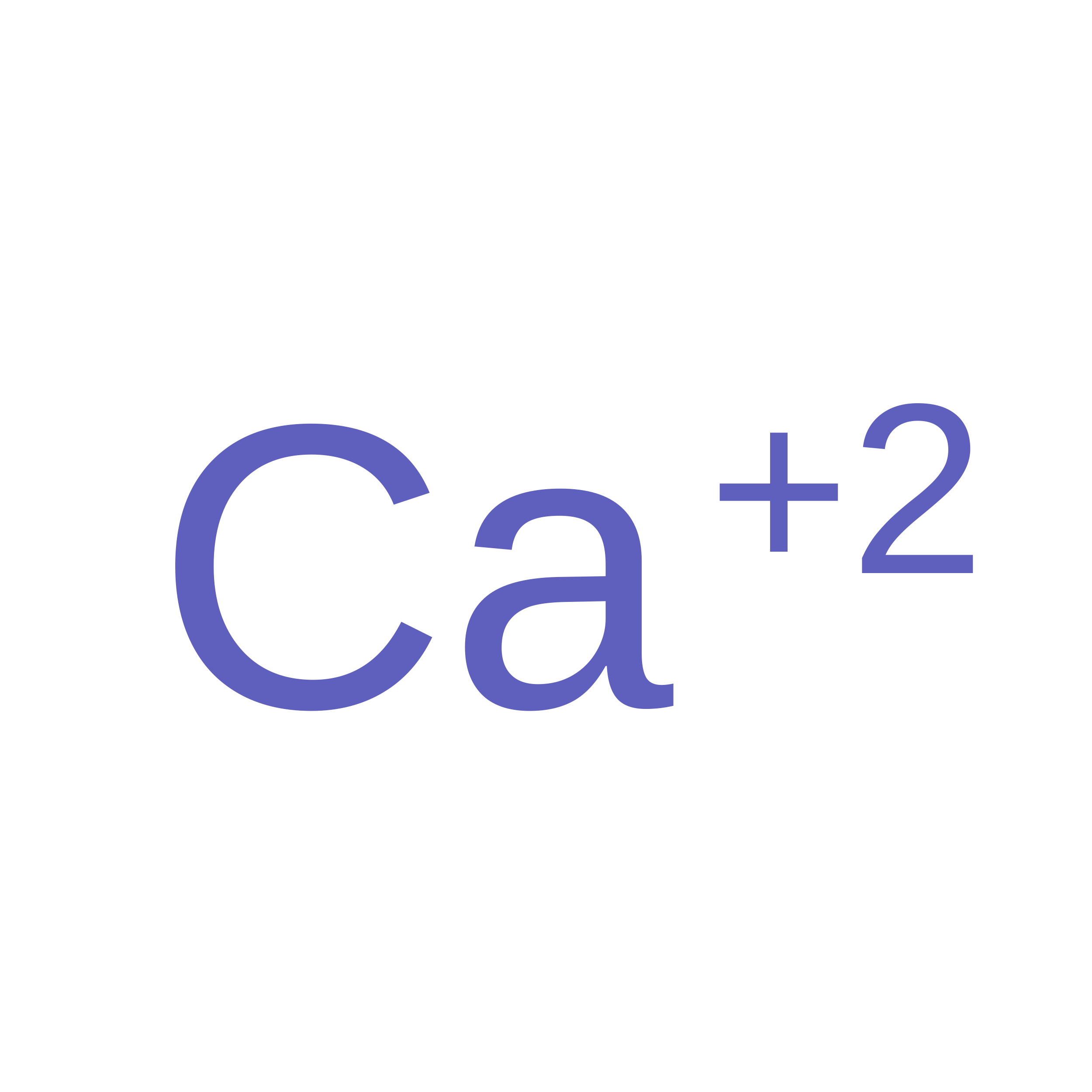
B [auth A]CALCIUM ION
Ca
BHPQYMZQTOCNFJ-UHFFFAOYSA-N
CL

Query on CL


Download:Ideal Coordinates CCD File
C [auth A]CHLORIDE ION
Cl
VEXZGXHMUGYJMC-UHFFFAOYSA-M
Modified Residues  1 Unique
IDChains TypeFormula2D DiagramParent
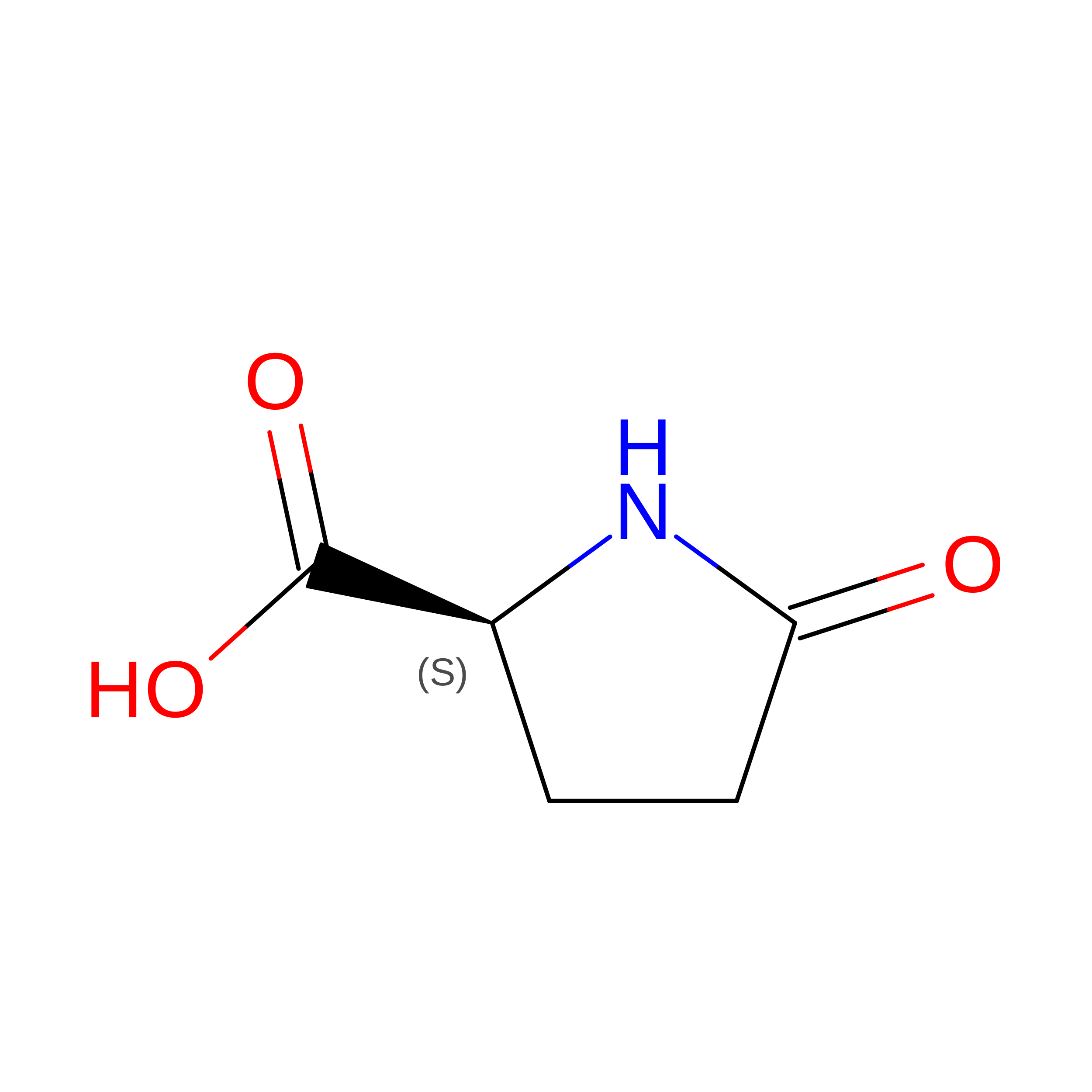
PCA
Query on PCA
A
L-PEPTIDE LINKINGC5 H7 N O3GLN

Experimental Data & Validation

Experimental Data

  • Method: X-RAY DIFFRACTION
  • Resolution: 1.65 Å
  • R-Value Free:  0.206 (Depositor) 
  • R-Value Work:  0.177 (Depositor) 
  • R-Value Observed: 0.177 (Depositor) 
Space Group: P 21 21 21
Unit Cell:
Length ( Å )Angle ( ˚ )
a = 51.24α = 90
b = 93.46β = 90
c = 96.95γ = 90
Software Package:
Software NamePurpose
MOSFLMdata reduction
CCP4data reduction
X-PLORmodel building
X-PLORrefinement
CCP4data scaling
X-PLORphasing

Structure Validation

View Full Validation Report


Entry History 

Deposition Data

Revision History  (Full details and data files)

  • Version 1.0: 1998-11-04
    Type: Initial release
  • Version 1.1: 2008-03-24
    Changes: Version format compliance
  • Version 1.2: 2011-07-13
    Changes: Version format compliance
  • Version 1.3: 2019-11-20
    Changes: Advisory, Derived calculations
  • Version 2.0: 2019-12-25
    Changes: Derived calculations, Polymer sequence
  • Version 2.1: 2024-04-03
    Changes: Advisory, Data collection, Database references, Derived calculations, Refinement description
  • Version 2.2: 2024-10-23
    Changes: Structure summary