1JVQ | pdb_00001jvq

Crystal structure at 2.6A of the ternary complex between antithrombin, a P14-P8 reactive loop peptide, and an exogenous tetrapeptide


Experimental Data Snapshot

  • Method: X-RAY DIFFRACTION
  • Resolution: 2.60 Å
  • R-Value Free: 
    0.258 (Depositor), 0.248 (DCC) 
  • R-Value Work: 
    0.204 (Depositor), 0.197 (DCC) 

Starting Model: experimental
View more details

wwPDB Validation 3D Report Full Report

Validation slider image for 1JVQ

Ligand Structure Quality Assessment 


This is version 2.2 of the entry. See complete history

Literature

How small peptides block and reverse serpin polymerisation

Zhou, A.Stein, P.E.Huntington, J.A.Sivasothy, P.Lomas, D.A.Carrell, R.W.

(2004) J Mol Biology 342: 931-941

  • DOI: https://doi.org/10.1016/j.jmb.2004.07.078
  • Primary Citation Related Structures: 
    1JVQ

  • PubMed Abstract: 

    Many of the late-onset dementias, including Alzheimer's disease and the prion encephalopathies, arise from the aberrant aggregation of individual proteins. The serpin family of serine protease inhibitors provides a well-defined structural example of such pathological aggregation, as its mutant variants readily form long-chain polymers, resulting in diseases ranging from thrombosis to dementia. The intermolecular linkages result from the insertion of the reactive site loop of one serpin molecule into the middle strand (s4A) position of the A beta-sheet of another molecule. We define here the structural requirements for small peptides to competitively bind to and block the s4A position to prevent this intermolecular linkage and polymerisation. The entry and anchoring of blocking-peptides is facilitated by the presence of a threonine which inserts into the site equivalent to P8 of s4A. But the critical requirement for small blocking-peptides is demonstrated in crystallographic structures of the complexes formed with selected tri- and tetrapeptides. These structures indicate that the binding is primarily due to the insertion of peptide hydrophobic side-chains into the P4 and P6 sites of s4A. The findings allow the rational design of synthetic blocking-peptides small enough to be suitable for mimetic design. This is demonstrated here with a tetrapeptide that preferentially blocks the polymerisation of a pathologically unstable serpin commonly present in people of European descent.


  • Organizational Affiliation
    • Departments of Haematology and Medicine, University of Cambridge, Cambridge Institute for Medical Research, Hills Road, Cambridge CB2 2XY, UK.

Macromolecule Content 

  • Total Structure Weight: 101.45 kDa 
  • Atom Count: 6,801 
  • Modeled Residue Count: 829 
  • Deposited Residue Count: 877 
  • Unique protein chains: 3

Macromolecules

Find similar proteins by:|  3D Structure
Entity ID: 1
MoleculeChains  Sequence LengthOrganismDetailsImage
ANTITHROMBIN-IIIA [auth L],
B [auth I]
432Homo sapiensMutation(s): 0 
UniProt & NIH Common Fund Data Resources
Find proteins for P01008 (Homo sapiens)
Explore P01008 
Go to UniProtKB:  P01008
PHAROS:  P01008
GTEx:  ENSG00000117601 
Entity Groups
Sequence Clusters30% Identity50% Identity70% Identity90% Identity95% Identity100% Identity
UniProt GroupP01008
Sequence Annotations
Expand
Reference Sequence
Find similar proteins by:  Sequence   |   3D Structure  
Entity ID: 2
MoleculeChains  Sequence LengthOrganismDetailsImage
P14-P8 reactive loop peptide8N/AMutation(s): 0 
Find similar proteins by:  Sequence   |   3D Structure  
Entity ID: 3
MoleculeChains  Sequence LengthOrganismDetailsImage
exogenous Cholecystokinin tetrapeptide5N/AMutation(s): 0 

Small Molecules

Ligands 2 Unique
IDChains Name / Formula / InChI Key2D Diagram3D Interactions
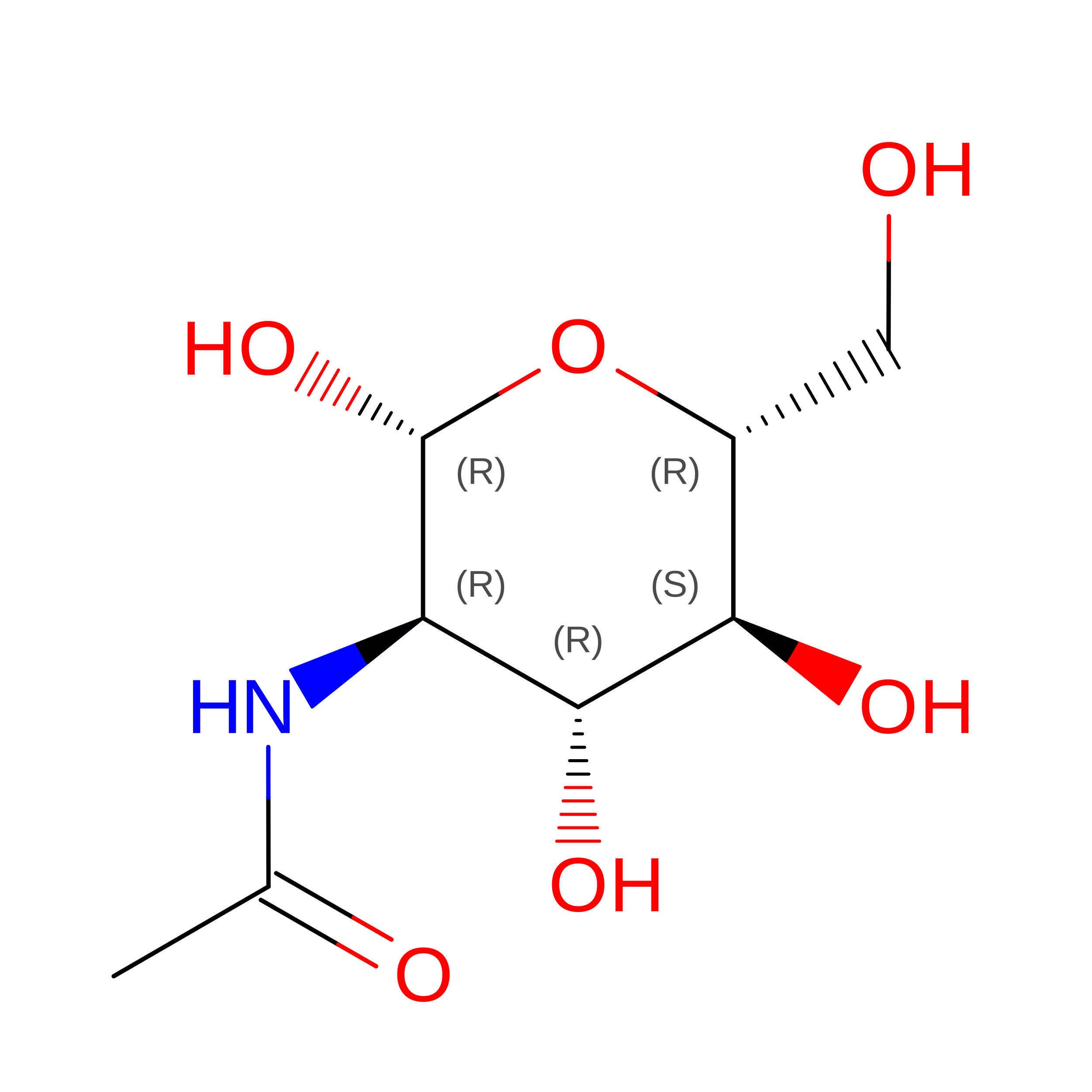
NDG

Query on NDG


Download:Ideal Coordinates CCD File
E [auth L]
F [auth L]
G [auth L]
H [auth L]
I
E [auth L],
F [auth L],
G [auth L],
H [auth L],
I,
K [auth I],
M [auth I]
2-acetamido-2-deoxy-alpha-D-glucopyranose
C8 H15 N O6
OVRNDRQMDRJTHS-PVFLNQBWSA-N
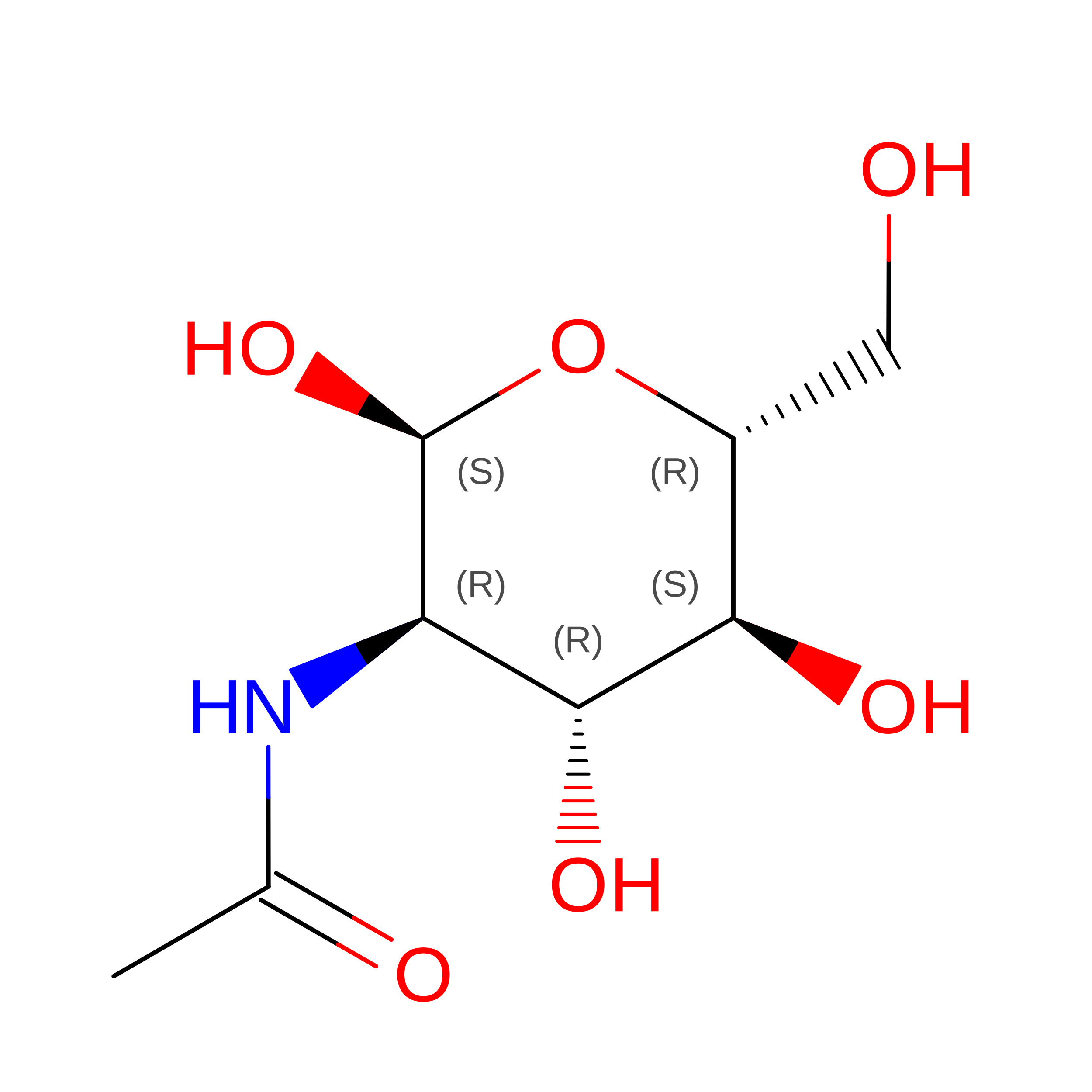
NAG

Query on NAG


Download:Ideal Coordinates CCD File
J [auth I],
L [auth I]
2-acetamido-2-deoxy-beta-D-glucopyranose
C8 H15 N O6
OVRNDRQMDRJTHS-FMDGEEDCSA-N

Experimental Data & Validation

Experimental Data

  • Method: X-RAY DIFFRACTION
  • Resolution: 2.60 Å
  • R-Value Free:  0.258 (Depositor), 0.248 (DCC) 
  • R-Value Work:  0.204 (Depositor), 0.197 (DCC) 
Space Group: P 1 21 1
Unit Cell:
Length ( Å )Angle ( ˚ )
a = 69.144α = 90
b = 100.622β = 104.42
c = 87.157γ = 90
Software Package:
Software NamePurpose
MOSFLMdata reduction
TRUNCATEdata reduction
AMoREphasing
CNSrefinement
CCP4data scaling

Structure Validation

View Full Validation Report


Ligand Structure Quality Assessment 


Entry History 

Deposition Data

Revision History  (Full details and data files)

  • Version 1.0: 2003-06-03
    Type: Initial release
  • Version 1.1: 2008-04-27
    Changes: Version format compliance
  • Version 1.2: 2011-07-13
    Changes: Atomic model, Database references, Derived calculations, Non-polymer description, Structure summary, Version format compliance
  • Version 2.0: 2020-07-29
    Type: Remediation
    Reason: Carbohydrate remediation
    Changes: Advisory, Atomic model, Data collection, Derived calculations, Structure summary
  • Version 2.1: 2023-08-16
    Changes: Data collection, Database references, Refinement description, Structure summary
  • Version 2.2: 2024-11-13
    Changes: Structure summary