1NMU | pdb_00001nmu

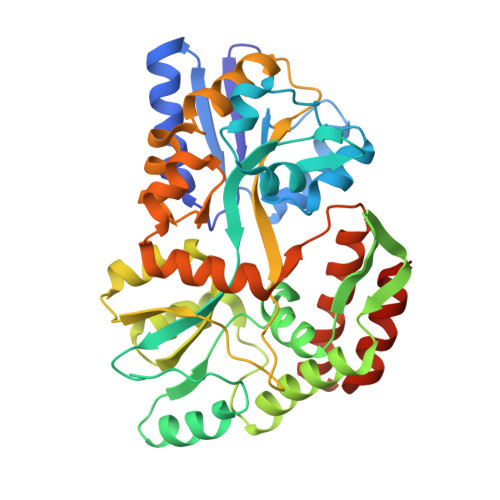
MBP-L30


Experimental Data Snapshot

  • Method: X-RAY DIFFRACTION
  • Resolution: 2.31 Å
  • R-Value Free: 
    0.254 (Depositor) 
  • R-Value Work: 
    0.214 (Depositor) 
  • R-Value Observed: 
    0.223 (Depositor) 

wwPDB Validation 3D Report Full Report

Validation slider image for 1NMU

This is version 2.2 of the entry. See complete history

Literature

Inherent Protein Structural Flexibility at the RNA-binding Interface of L30e

Chao, J.A.Prasad, G.S.White, S.A.Stout, C.D.Williamson, J.R.

(2003) J Mol Biology 326: 999-1004

  • DOI: https://doi.org/10.1016/s0022-2836(02)01476-6
  • Primary Citation Related Structures: 
    1NMU

  • PubMed Abstract: 

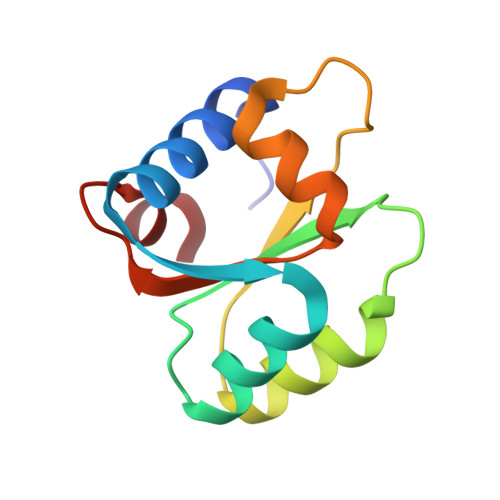
    The Saccharomyces cerevisiae ribosomal protein L30 autoregulates its own expression by binding to a purine-rich internal loop in its pre-mRNA and mRNA. NMR studies of L30 and its RNA complex showed that both the internal loop of the RNA as well as a region of the protein become substantially more ordered upon binding. A crystal structure of a maltose binding protein (MBP)-L30 fusion protein with two copies in the asymmetric unit has been determined. The flexible RNA-binding region in the L30 copies has two distinct conformations, one resembles the RNA bound form solved by NMR and the other is unique. Structure prediction algorithms also had difficulty accurately predicting this region, which is consistent with conformational flexibility seen in the NMR and X-ray crystallography studies. Inherent conformational flexibility may be a hallmark of regions involved in intermolecular interactions.


  • Organizational Affiliation
    • Department of Molecular Biology, Department of Chemistry and The Skaggs Institute for Chemical Biology, The Scripps Research Institute, 10550 North Torrey Pines Road, La Jolla, CA 92037, USA.

Macromolecule Content 

  • Total Structure Weight: 107.61 kDa 
  • Atom Count: 7,593 
  • Modeled Residue Count: 943 
  • Deposited Residue Count: 972 
  • Unique protein chains: 2

Macromolecules

Find similar proteins by:|  3D Structure
Entity ID: 1
MoleculeChains  Sequence LengthOrganismDetailsImage
maltose-binding periplasmic protein
A, C
382Escherichia coliMutation(s): 0 
UniProt
Find proteins for P0AEX9 (Escherichia coli (strain K12))
Explore P0AEX9 
Go to UniProtKB:  P0AEX9
Entity Groups
Sequence Clusters30% Identity50% Identity70% Identity90% Identity95% Identity100% Identity
UniProt GroupP0AEX9
Sequence Annotations
Expand
Reference Sequence
Find similar proteins by:|  3D Structure
Entity ID: 2
MoleculeChains  Sequence LengthOrganismDetailsImage
60S ribosomal protein L30
B, D
104Saccharomyces cerevisiaeMutation(s): 0 
UniProt
Find proteins for P14120 (Saccharomyces cerevisiae (strain ATCC 204508 / S288c))
Explore P14120 
Go to UniProtKB:  P14120
Entity Groups
Sequence Clusters30% Identity50% Identity70% Identity90% Identity95% Identity100% Identity
UniProt GroupP14120
Sequence Annotations
Expand
Reference Sequence

Oligosaccharides

Help  
Entity ID: 3
MoleculeChains Length2D Diagram GlycosylationD Interactions
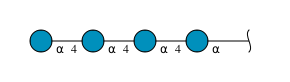
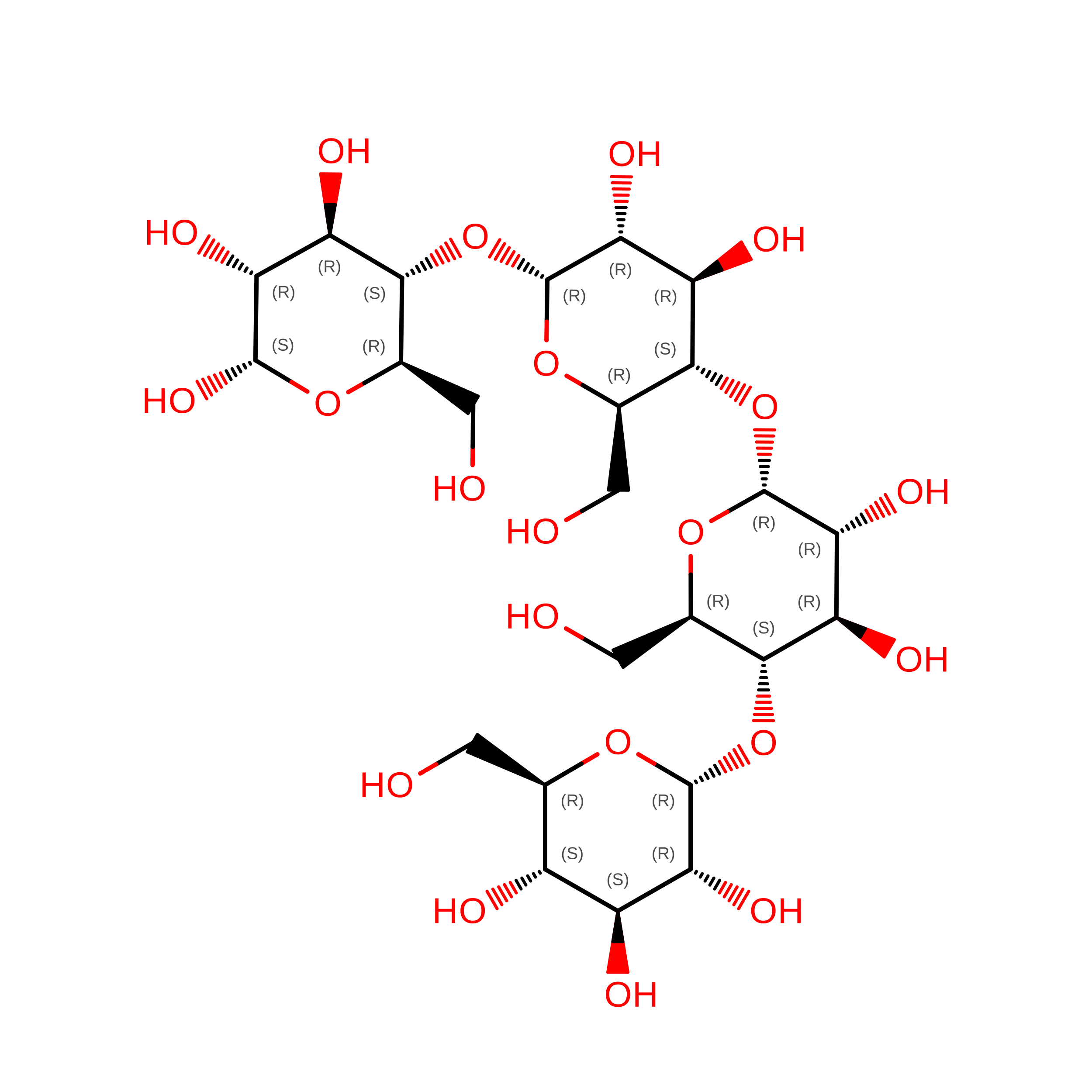
alpha-D-glucopyranose-(1-4)-alpha-D-glucopyranose-(1-4)-alpha-D-glucopyranose-(1-4)-alpha-D-glucopyranose
E, F
4N/A
Glycosylation Resources
GlyTouCan: G87171PZ
GlyCosmos: G87171PZ
GlyGen: G87171PZ

Biologically Interesting Molecules (External Reference) 

1 Unique

Experimental Data & Validation

Experimental Data

  • Method: X-RAY DIFFRACTION
  • Resolution: 2.31 Å
  • R-Value Free:  0.254 (Depositor) 
  • R-Value Work:  0.214 (Depositor) 
  • R-Value Observed: 0.223 (Depositor) 
Space Group: P 21 21 21
Unit Cell:
Length ( Å )Angle ( ˚ )
a = 79.65α = 90
b = 118.39β = 90
c = 153.78γ = 90
Software Package:
Software NamePurpose
MOSFLMdata reduction
SCALAdata scaling
AMoREphasing
CNSrefinement
CCP4data scaling

Structure Validation

View Full Validation Report


Entry History 

Deposition Data

Revision History  (Full details and data files)

  • Version 1.0: 2003-02-18
    Type: Initial release
  • Version 1.1: 2008-04-29
    Changes: Version format compliance
  • Version 1.2: 2011-07-13
    Changes: Version format compliance
  • Version 2.0: 2020-07-29
    Type: Remediation
    Reason: Carbohydrate remediation
    Changes: Advisory, Atomic model, Data collection, Database references, Derived calculations, Non-polymer description, Structure summary
  • Version 2.1: 2022-12-21
    Changes: Database references, Structure summary
  • Version 2.2: 2024-05-22
    Changes: Data collection