1NST | pdb_00001nst

THE SULFOTRANSFERASE DOMAIN OF HUMAN HAPARIN SULFATE N-DEACETYLASE/N-SULFOTRANSFERASE


Experimental Data Snapshot

  • Method: X-RAY DIFFRACTION
  • Resolution: 2.30 Å
  • R-Value Free: 
    0.257 (Depositor) 
  • R-Value Work: 
    0.210 (Depositor) 
  • R-Value Observed: 
    0.210 (Depositor) 

wwPDB Validation 3D Report Full Report

Validation slider image for 1NST

This is version 1.5 of the entry. See complete history

Literature

Crystal structure of the sulfotransferase domain of human heparan sulfate N-deacetylase/ N-sulfotransferase 1.

Kakuta, Y.Sueyoshi, T.Negishi, M.Pedersen, L.C.

(1999) J Biological Chem 274: 10673-10676

  • DOI: https://doi.org/10.1074/jbc.274.16.10673
  • Primary Citation Related Structures: 
    1NST

  • PubMed Abstract: 

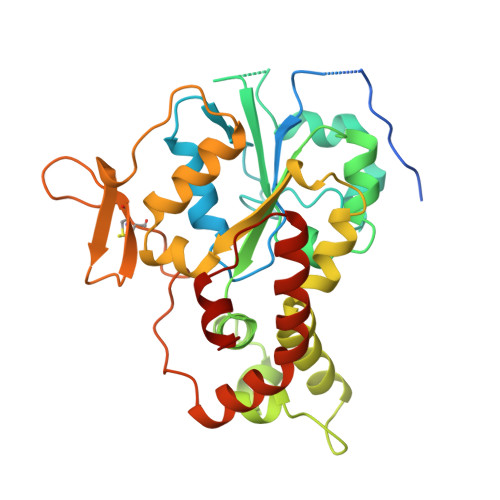
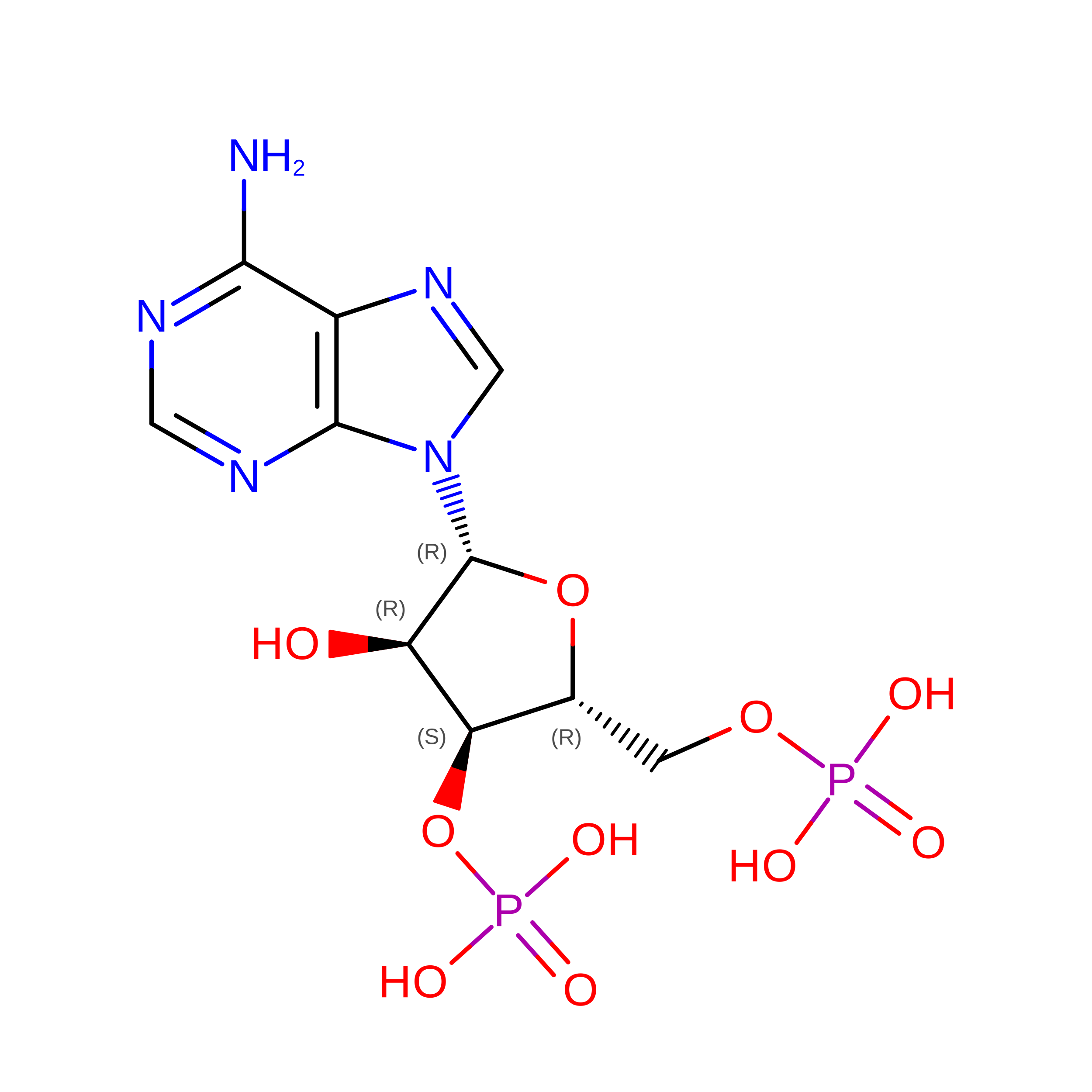
    Heparan sulfate N-deacetylase/N-sulfotransferase (HSNST) catalyzes the first and obligatory step in the biosynthesis of heparan sulfates and heparin. The crystal structure of the sulfotransferase domain (NST1) of human HSNST-1 has been determined at 2.3-A resolution in a binary complex with 3'-phosphoadenosine 5'-phosphate (PAP). NST1 is approximately spherical with an open cleft, and consists of a single alpha/beta fold with a central five-stranded parallel beta-sheet and a three-stranded anti-parallel beta-sheet bearing an interstrand disulfide bond. The structural regions alpha1, alpha6, beta1, beta7, 5'-phosphosulfate binding loop (between beta1 and alpha1), and a random coil (between beta8 and alpha13) constitute the PAP binding site of NST1. The alpha6 and random coil (between beta2 and alpha2), which form an open cleft near the 5'-phosphate of the PAP molecule, may provide interactions for substrate binding. The conserved residue Lys-614 is in position to form a hydrogen bond with the bridge oxygen of the 5'-phosphate.


  • Organizational Affiliation
    • Pharmacogenetics Section, Laboratory of Reproductive and Developmental Toxicology, NIEHS, National Institutes of Health, Research Triangle Park, North Carolina 27709, USA.

Macromolecule Content 

  • Total Structure Weight: 38.34 kDa 
  • Atom Count: 2,383 
  • Modeled Residue Count: 282 
  • Deposited Residue Count: 325 
  • Unique protein chains: 1

Macromolecules

Find similar proteins by:|  3D Structure
Entity ID: 1
MoleculeChains  Sequence LengthOrganismDetailsImage
HEPARAN SULFATE N-DEACETYLASE/N-SULFOTRANSFERASE325Homo sapiensMutation(s): 0 
EC: 2.8.2 (PDB Primary Data), 3.5.1 (UniProt), 2.8.2.8 (UniProt)
UniProt & NIH Common Fund Data Resources
Find proteins for P52848 (Homo sapiens)
Explore P52848 
Go to UniProtKB:  P52848
PHAROS:  P52848
GTEx:  ENSG00000070614 
Entity Groups
Sequence Clusters30% Identity50% Identity70% Identity90% Identity95% Identity100% Identity
UniProt GroupP52848
Sequence Annotations
Expand
Reference Sequence

Small Molecules

Ligands 1 Unique
IDChains Name / Formula / InChI Key2D Diagram3D Interactions
A3P

Query on A3P


Download:Ideal Coordinates CCD File
B [auth A]ADENOSINE-3'-5'-DIPHOSPHATE
C10 H15 N5 O10 P2
WHTCPDAXWFLDIH-KQYNXXCUSA-N

Experimental Data & Validation

Experimental Data

  • Method: X-RAY DIFFRACTION
  • Resolution: 2.30 Å
  • R-Value Free:  0.257 (Depositor) 
  • R-Value Work:  0.210 (Depositor) 
  • R-Value Observed: 0.210 (Depositor) 
Space Group: P 1 21 1
Unit Cell:
Length ( Å )Angle ( ˚ )
a = 45.417α = 90
b = 54.501β = 100.05
c = 68.938γ = 90
Software Package:
Software NamePurpose
X-PLORrefinement
SCALEPACKdata scaling
SHELX-96model building
X-PLORmodel building
SHELX-96refinement
DENZOdata reduction
SHELX-96phasing
X-PLORphasing

Structure Validation

View Full Validation Report


Entry History 

Deposition Data

Revision History  (Full details and data files)

  • Version 1.0: 1999-09-16
    Type: Initial release
  • Version 1.1: 2008-03-24
    Changes: Version format compliance
  • Version 1.2: 2011-07-13
    Changes: Version format compliance
  • Version 1.3: 2019-07-17
    Changes: Data collection, Refinement description
  • Version 1.4: 2019-08-14
    Changes: Data collection
  • Version 1.5: 2024-10-16
    Changes: Data collection, Database references, Derived calculations, Structure summary