1RO9 | pdb_00001ro9

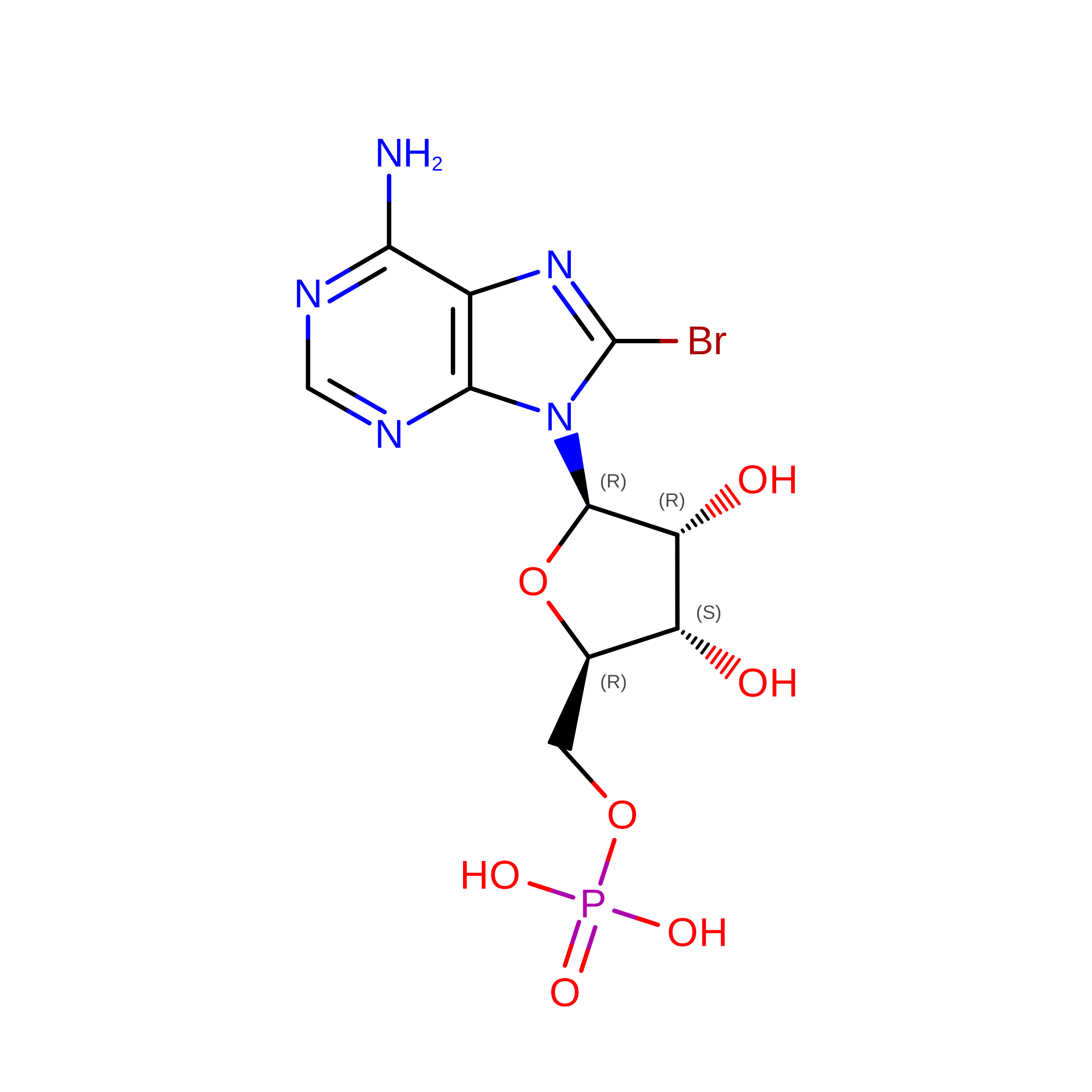
CRYSTAL STRUCTURES OF THE CATALYTIC DOMAIN OF PHOSPHODIESTERASE 4B2B COMPLEXED WITH 8-Br-AMP


Experimental Data Snapshot

  • Method: X-RAY DIFFRACTION
  • Resolution: 2.13 Å
  • R-Value Free: 
    0.234 (Depositor) 
  • R-Value Work: 
    0.210 (Depositor), 0.208 (DCC) 
  • R-Value Observed: 
    0.211 (Depositor) 

Starting Model: experimental
View more details

wwPDB Validation 3D Report Full Report

Validation slider image for 1RO9

Ligand Structure Quality Assessment 


This is version 1.5 of the entry. See complete history

Literature

Crystal structures of the catalytic domain of phosphodiesterase 4B complexed with AMP, 8-Br-AMP, and rolipram.

Xu, R.X.Rocque, W.J.Lambert, M.H.Vanderwall, D.E.Luther, M.A.Nolte, R.T.

(2004) J Mol Biology 337: 355-365

  • DOI: https://doi.org/10.1016/j.jmb.2004.01.040
  • Primary Citation Related Structures: 
    1RO6, 1RO9, 1ROR

  • PubMed Abstract: 

    Phosphodiesterase catalyzes the hydrolysis of the intracellular second messenger 3',5'-cyclic AMP (cAMP) into the corresponding 5'-nucleotide. Phosphodiesterase 4 (PDE4), the major cAMP-specific PDE in inflammatory and immune cells, is an attractive target for the treatment of asthma and COPD. We have determined crystal structures of the catalytic domain of PDE4B complexed with AMP (2.0 A), 8-Br-AMP (2.13 A) and the potent inhibitor rolipram (2.0 A). All the ligands bind in the same hydrophobic pocket and can interact directly with the active site metal ions. The identity of these metal ions was examined using X-ray anomalous difference data. The structure of the AMP complex confirms the location of the catalytic site and allowed us to speculate about the detailed mechanism of catalysis. The high-resolution structures provided the experimental insight into the nucleotide selectivity of phosphodiesterase. 8-Br-AMP binds in the syn conformation to the enzyme and demonstrates an alternative nucleotide-binding mode. Rolipram occupies much of the AMP-binding site and forms two hydrogen bonds with Gln443 similar to the nucleotides.


  • Organizational Affiliation
    • Department of Computational, Analytical and Structural Sciences, GlaxoSmithKline, 5 Moore Drive, V-180, Research Triangle Park, NC 27709, USA. robert.x.xu@gsk.com

Macromolecule Content 

  • Total Structure Weight: 88.02 kDa 
  • Atom Count: 5,758 
  • Modeled Residue Count: 675 
  • Deposited Residue Count: 756 
  • Unique protein chains: 1

Macromolecules

Find similar proteins by:|  3D Structure
Entity ID: 1
MoleculeChains  Sequence LengthOrganismDetailsImage
cAMP-specific 3',5'-cyclic phosphodiesterase 4B
A, B
378Homo sapiensMutation(s): 2 
Gene Names: PDE4B
EC: 3.1.4.17 (PDB Primary Data), 3.1.4.53 (UniProt)
UniProt & NIH Common Fund Data Resources
Find proteins for Q07343 (Homo sapiens)
Explore Q07343 
Go to UniProtKB:  Q07343
PHAROS:  Q07343
GTEx:  ENSG00000184588 
Entity Groups
Sequence Clusters30% Identity50% Identity70% Identity90% Identity95% Identity100% Identity
UniProt GroupQ07343
Sequence Annotations
Expand
Reference Sequence

Experimental Data & Validation

Experimental Data

  • Method: X-RAY DIFFRACTION
  • Resolution: 2.13 Å
  • R-Value Free:  0.234 (Depositor) 
  • R-Value Work:  0.210 (Depositor), 0.208 (DCC) 
  • R-Value Observed: 0.211 (Depositor) 
Space Group: C 2 2 21
Unit Cell:
Length ( Å )Angle ( ˚ )
a = 104.332α = 90
b = 159.211β = 90
c = 108.651γ = 90
Software Package:
Software NamePurpose
HKL-2000data collection
SCALEPACKdata scaling
AMoREphasing
CNSrefinement
HKL-2000data reduction

Structure Validation

View Full Validation Report


Ligand Structure Quality Assessment 


Entry History 

Deposition Data

Revision History  (Full details and data files)

  • Version 1.0: 2004-12-07
    Type: Initial release
  • Version 1.1: 2008-04-29
    Changes: Version format compliance
  • Version 1.2: 2011-07-13
    Changes: Version format compliance
  • Version 1.3: 2011-11-16
    Changes: Atomic model
  • Version 1.4: 2024-02-14
    Changes: Data collection, Database references, Derived calculations
  • Version 1.5: 2024-04-03
    Changes: Refinement description