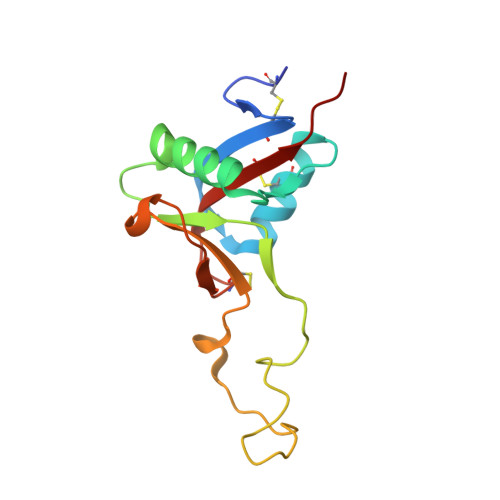
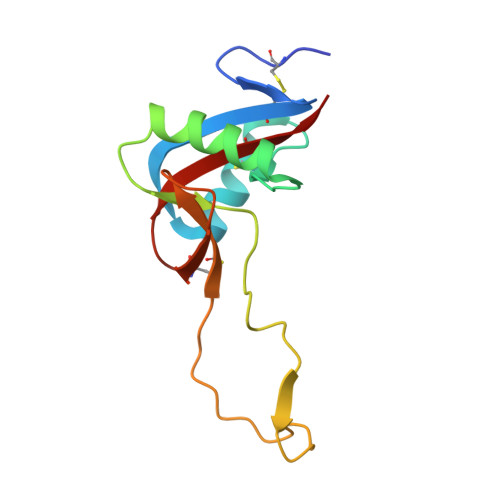
1UOS | pdb_00001uos

The Crystal Structure of the Snake Venom Toxin Convulxin


Experimental Data Snapshot

  • Method: X-RAY DIFFRACTION
  • Resolution: 2.70 Å
  • R-Value Free: 
    0.263 (Depositor), 0.244 (DCC) 
  • R-Value Work: 
    0.235 (Depositor), 0.205 (DCC) 
  • R-Value Observed: 
    0.235 (Depositor) 

Starting Model: experimental
View more details

wwPDB Validation 3D Report Full Report

Validation slider image for 1UOS

This is version 1.4 of the entry. See complete history

Literature

Structure of the Snake-Venom Toxin Convulxin

Batuwangala, T.Leduc, M.Gibbins, J.M.Bon, C.Jones, E.Y.

(2004) Acta Crystallogr D Biol Crystallogr 60: 46

  • DOI: https://doi.org/10.1107/s0907444903021620
  • Primary Citation Related Structures: 
    1UOS

  • PubMed Abstract: 

    Snake venoms contain a number of proteins that interact with components of the haemostatic system that promote or inhibit events leading to blood-clot formation. The snake-venom protein convulxin (Cvx) binds glycoprotein (GP) VI, the platelet receptor for collagen, and triggers signal transduction. Here, the 2.7 A resolution crystal structure of Cvx is presented. In common with other members of this snake-venom protein family, Cvx is an alphabeta-heterodimer and conforms to the C-type lectin-fold topology. Comparison with other family members allows a set of Cvx residues that form a concave surface to be putatively implicated in GPVI binding. Unlike other family members, with the exception of flavocetin-A (FL-A), Cvx forms an (alphabeta)(4) tetramer. This oligomeric structure is consistent with Cvx clustering GPVI molecules on the surface of platelets and as a result promoting signal transduction activity. The Cvx structure and the location of the putative binding sites suggest a model for this multimeric signalling assembly.


  • Organizational Affiliation
    • Cancer Research UK Receptor Structure Group, Division of Structural Biology, University of Oxford, The Henry Wellcome Building for Genomic Medicine, Roosevelt Drive, Headington, Oxford OX3 7BN, England.

Macromolecule Content 

  • Total Structure Weight: 61.56 kDa 
  • Atom Count: 4,608 
  • Modeled Residue Count: 514 
  • Deposited Residue Count: 522 
  • Unique protein chains: 2

Macromolecules

Find similar proteins by:|  3D Structure
Entity ID: 1
MoleculeChains  Sequence LengthOrganismDetailsImage
CONVULXIN ALPHA
A, C
135Crotalus durissus terrificusMutation(s): 0 
UniProt
Find proteins for O93426 (Crotalus durissus terrificus)
Explore O93426 
Go to UniProtKB:  O93426
Entity Groups
Sequence Clusters30% Identity50% Identity70% Identity90% Identity95% Identity100% Identity
UniProt GroupO93426
Sequence Annotations
Expand
Reference Sequence
Find similar proteins by:|  3D Structure
Entity ID: 2
MoleculeChains  Sequence LengthOrganismDetailsImage
CONVULXIN BETA
B, D
126Crotalus durissus terrificusMutation(s): 0 
UniProt
Find proteins for O93427 (Crotalus durissus terrificus)
Explore O93427 
Go to UniProtKB:  O93427
Entity Groups
Sequence Clusters30% Identity50% Identity70% Identity90% Identity95% Identity100% Identity
UniProt GroupO93427
Sequence Annotations
Expand
Reference Sequence

Experimental Data & Validation

Experimental Data

  • Method: X-RAY DIFFRACTION
  • Resolution: 2.70 Å
  • R-Value Free:  0.263 (Depositor), 0.244 (DCC) 
  • R-Value Work:  0.235 (Depositor), 0.205 (DCC) 
  • R-Value Observed: 0.235 (Depositor) 
Space Group: I 4
Unit Cell:
Length ( Å )Angle ( ˚ )
a = 132.458α = 90
b = 132.458β = 90
c = 112.959γ = 90
Software Package:
Software NamePurpose
CNSrefinement
DENZOdata reduction
SCALEPACKdata scaling
CNSphasing

Structure Validation

View Full Validation Report


Entry History 

Deposition Data

Revision History  (Full details and data files)

  • Version 1.0: 2003-10-14
    Type: Initial release
  • Version 1.1: 2011-05-08
    Changes: Version format compliance
  • Version 1.2: 2011-07-13
    Changes: Version format compliance
  • Version 1.3: 2023-12-13
    Changes: Data collection, Database references, Other, Refinement description
  • Version 1.4: 2024-11-20
    Changes: Structure summary