1VEA | pdb_00001vea

Crystal Structure of HutP, an RNA binding antitermination protein


Experimental Data Snapshot

  • Method: X-RAY DIFFRACTION
  • Resolution: 2.80 Å
  • R-Value Free: 
    0.281 (Depositor), 0.281 (DCC) 
  • R-Value Work: 
    0.230 (Depositor), 0.229 (DCC) 
  • R-Value Observed: 
    0.230 (Depositor) 

wwPDB Validation 3D Report Full Report

Validation slider image for 1VEA

Ligand Structure Quality Assessment 


This is version 1.5 of the entry. See complete history

Literature

Crystal Structure of Activated HutP; An RNA Binding Protein that Regulates Transcription of the hut Operon in Bacillus subtilis

Kumarevel, T.S.Fujimoto, Z.Karthe, P.Oda, M.Mizuno, H.Kumar, P.K.R.

(2004) Structure 12: 1269-1280

  • DOI: https://doi.org/10.1016/j.str.2004.05.005
  • Primary Citation Related Structures: 
    1VEA

  • PubMed Abstract: 

    HutP is an L-histidine-activated RNA binding protein that regulates the expression of the histidine utilization (hut) operon in Bacillus subtilis by binding to cis-acting regulatory sequences on the hut mRNA. The crystal structure of HutP complexed with an L-histidine analog showed a novel fold; there are four antiparallel beta strands in the central region of each monomer, with two alpha helices each on the front and back. Two HutP monomers form a dimer, and three dimers are arranged in crystallographic 3-fold symmetry to form a hexamer. A histidine analog was located in between the two monomers of HutP, with the imidazole group of L-histidine hydrogen bonded to Glu81. An activation mechanism is proposed based on the identification of key residues of HutP. The HutP binding region in hut mRNA was defined: it consists of three UAG trinucleotide motifs separated by four spacer nucleotides. Residues of HutP potentially important for RNA binding were identified.


  • Organizational Affiliation
    • Institute for Biological Resources and Functions, National Institute of Advanced Industrial Science and Technology (AIST), Tsukuba Central 6, Tsukuba, Ibaraki 305-8566, Japan.

Macromolecule Content 

  • Total Structure Weight: 32.75 kDa 
  • Atom Count: 2,247 
  • Modeled Residue Count: 287 
  • Deposited Residue Count: 296 
  • Unique protein chains: 1

Macromolecules

Find similar proteins by:|  3D Structure
Entity ID: 1
MoleculeChains  Sequence LengthOrganismDetailsImage
Hut operon positive regulatory protein
A, B
148Bacillus subtilisMutation(s): 1 
UniProt
Find proteins for P10943 (Bacillus subtilis (strain 168))
Explore P10943 
Go to UniProtKB:  P10943
Entity Groups
Sequence Clusters30% Identity50% Identity70% Identity90% Identity95% Identity100% Identity
UniProt GroupP10943
Sequence Annotations
Expand
Reference Sequence

Small Molecules

Ligands 1 Unique
IDChains Name / Formula / InChI Key2D Diagram3D Interactions
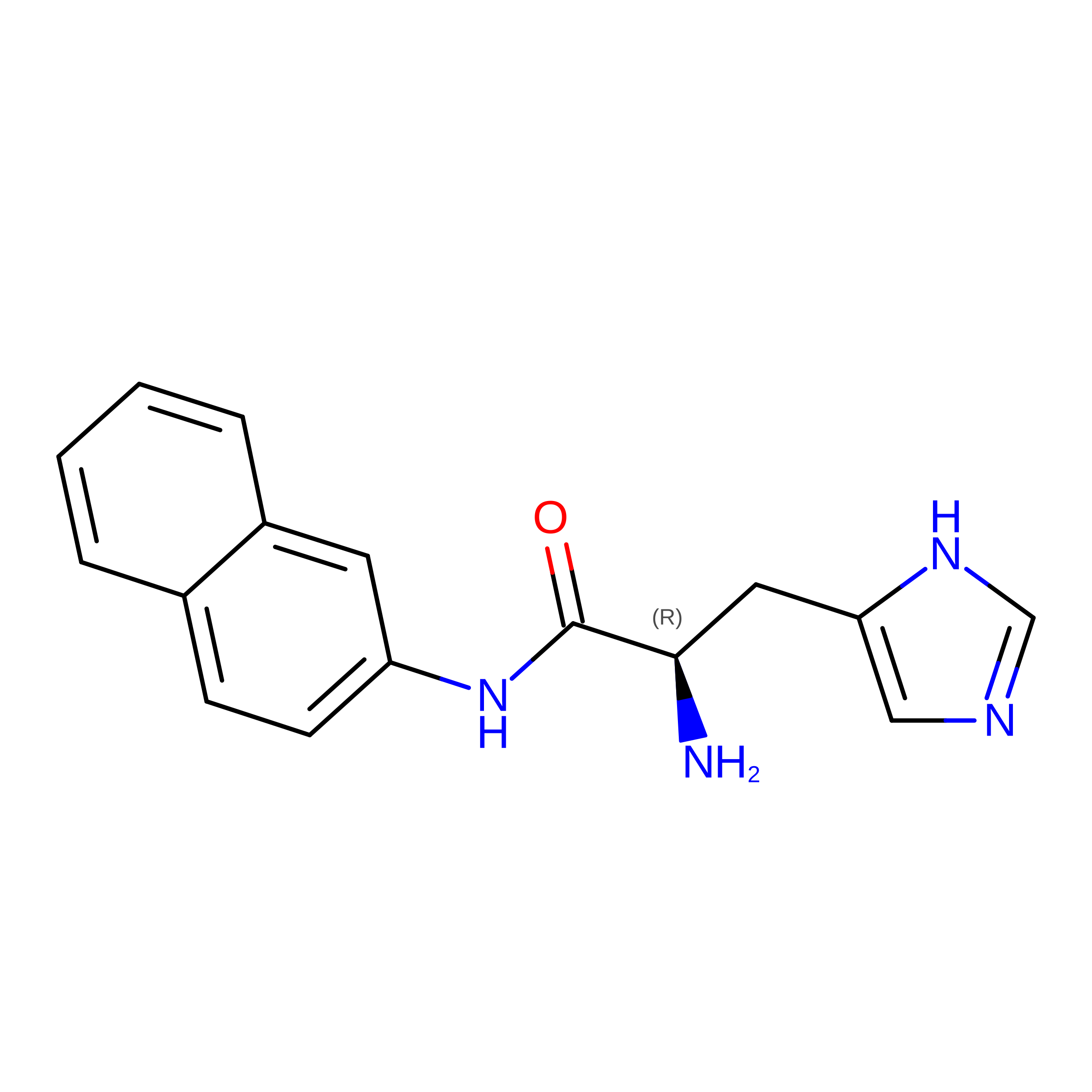
HBN

Query on HBN


Download:Ideal Coordinates CCD File
C [auth B]N-(2-NAPHTHYL)HISTIDINAMIDE
C16 H16 N4 O
DKDILZBBFKZMRO-OAHLLOKOSA-N

Experimental Data & Validation

Experimental Data

  • Method: X-RAY DIFFRACTION
  • Resolution: 2.80 Å
  • R-Value Free:  0.281 (Depositor), 0.281 (DCC) 
  • R-Value Work:  0.230 (Depositor), 0.229 (DCC) 
  • R-Value Observed: 0.230 (Depositor) 
Space Group: P 21 3
Unit Cell:
Length ( Å )Angle ( ˚ )
a = 95.41α = 90
b = 95.41β = 90
c = 95.41γ = 90
Software Package:
Software NamePurpose
CNSrefinement
MOSFLMdata reduction
CCP4data scaling
SOLVEphasing

Structure Validation

View Full Validation Report


Ligand Structure Quality Assessment 


Entry History 

Deposition Data

Revision History  (Full details and data files)

  • Version 1.0: 2004-07-20
    Type: Initial release
  • Version 1.1: 2008-04-27
    Changes: Version format compliance
  • Version 1.2: 2011-07-13
    Changes: Derived calculations, Version format compliance
  • Version 1.3: 2017-10-11
    Changes: Data collection
  • Version 1.4: 2021-11-10
    Changes: Database references, Derived calculations
  • Version 1.5: 2023-12-27
    Changes: Data collection