1WV0 | pdb_00001wv0

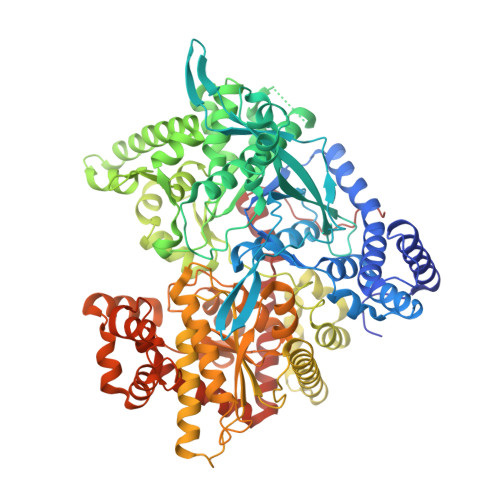
Crystallographic studies on acyl ureas, a new class of inhibitors of glycogen phosphorylase. Broad specificity of the allosteric site


Experimental Data Snapshot

  • Method: X-RAY DIFFRACTION
  • Resolution: 2.26 Å
  • R-Value Free: 
    0.240 (Depositor) 
  • R-Value Work: 
    0.197 (Depositor) 
  • R-Value Observed: 
    0.197 (Depositor) 

wwPDB Validation 3D Report Full Report

Validation slider image for 1WV0

This is version 1.3 of the entry. See complete history

Literature

Crystallographic studies on acyl ureas, a new class of glycogen phosphorylase inhibitors, as potential antidiabetic drugs

Oikonomakos, N.G.Kosmopoulou, M.N.Chrysina, E.D.Leonidas, D.D.Kostas, I.D.Wendt, K.U.Klabunde, T.Defossa, E.

(2005) Protein Sci 14: 1760-1771

  • DOI: https://doi.org/10.1110/ps.051432405
  • Primary Citation Related Structures: 
    1WUT, 1WUY, 1WV0, 1WV1

  • PubMed Abstract: 

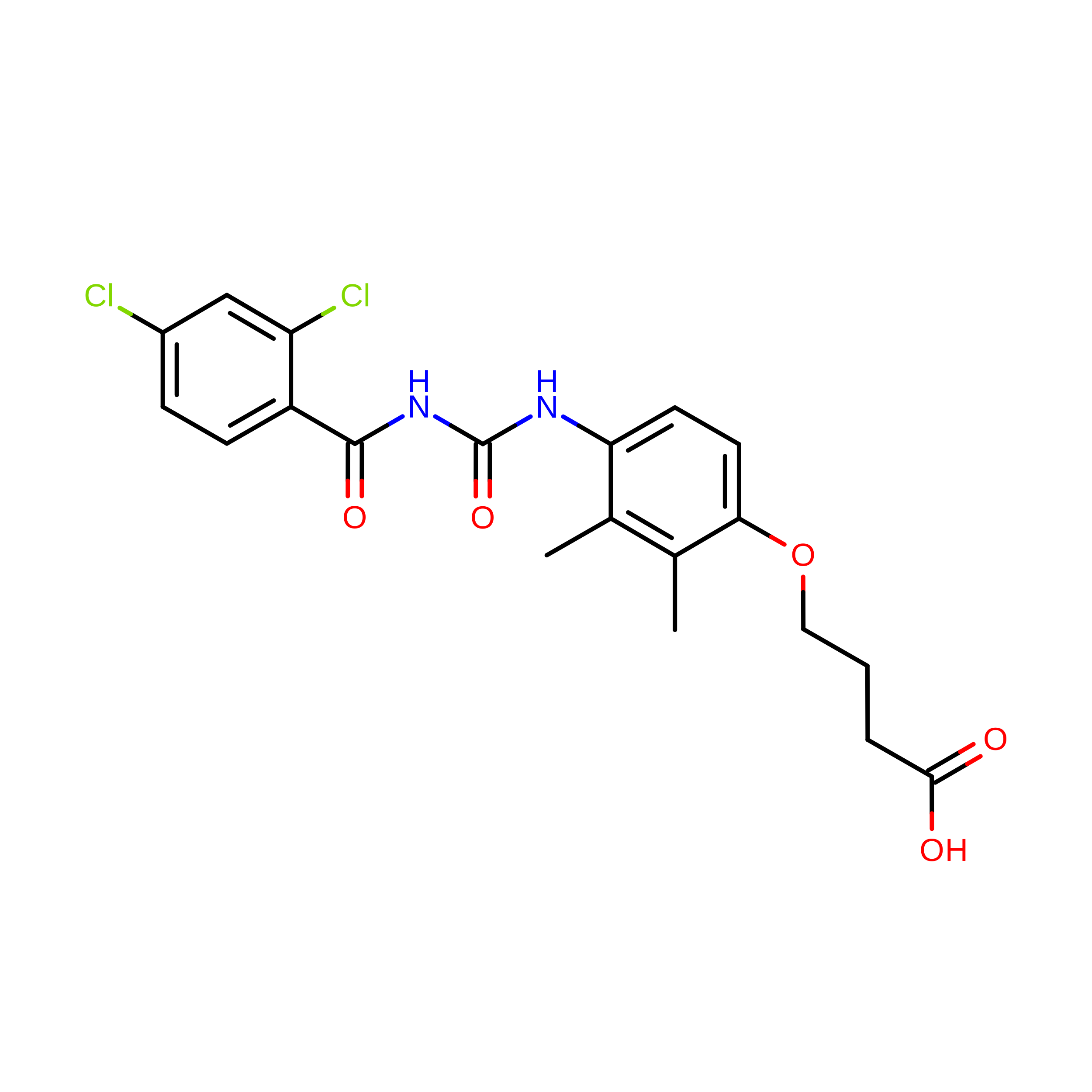
    Acyl ureas were discovered as a novel class of inhibitors for glycogen phosphorylase, a molecular target to control hyperglycemia in type 2 diabetics. This series is exemplified by 6-{2,6-Dichloro- 4-[3-(2-chloro-benzoyl)-ureido]-phenoxy}-hexanoic acid, which inhibits human liver glycogen phosphorylase a with an IC(50) of 2.0 microM. Here we analyze four crystal structures of acyl urea derivatives in complex with rabbit muscle glycogen phosphorylase b to elucidate the mechanism of inhibition of these inhibitors. The structures were determined and refined to 2.26 Angstroms resolution and demonstrate that the inhibitors bind at the allosteric activator site, where the physiological activator AMP binds. Acyl ureas induce conformational changes in the vicinity of the allosteric site. Our findings suggest that acyl ureas inhibit glycogen phosphorylase by direct inhibition of AMP binding and by indirect inhibition of substrate binding through stabilization of the T' state.


  • Organizational Affiliation
    • Institute of Organic and Pharmaceutical Chemistry, The National Hellenic Research Foundation, Athens, Greece. ngo@eie.gr

Macromolecule Content 

  • Total Structure Weight: 97.98 kDa 
  • Atom Count: 6,914 
  • Modeled Residue Count: 816 
  • Deposited Residue Count: 842 
  • Unique protein chains: 1

Macromolecules

Find similar proteins by:|  3D Structure
Entity ID: 1
MoleculeChains  Sequence LengthOrganismDetailsImage
Glycogen phosphorylase, muscle form842Oryctolagus cuniculusMutation(s): 0 
EC: 2.4.1.1
UniProt
Find proteins for P00489 (Oryctolagus cuniculus)
Explore P00489 
Go to UniProtKB:  P00489
Entity Groups
Sequence Clusters30% Identity50% Identity70% Identity90% Identity95% Identity100% Identity
UniProt GroupP00489
Sequence Annotations
Expand
Reference Sequence

Small Molecules

Ligands 2 Unique
IDChains Name / Formula / InChI Key2D Diagram3D Interactions
BN4

Query on BN4


Download:Ideal Coordinates CCD File
C [auth A]4-[4-({[(2,4-DICHLOROBENZOYL)AMINO]CARBONYL}AMINO)-2,3-DIMETHYLPHENOXY]BUTANOIC ACID
C20 H20 Cl2 N2 O5
FCEMCUPAYRPTLS-UHFFFAOYSA-N
PLP

Query on PLP


Download:Ideal Coordinates CCD File
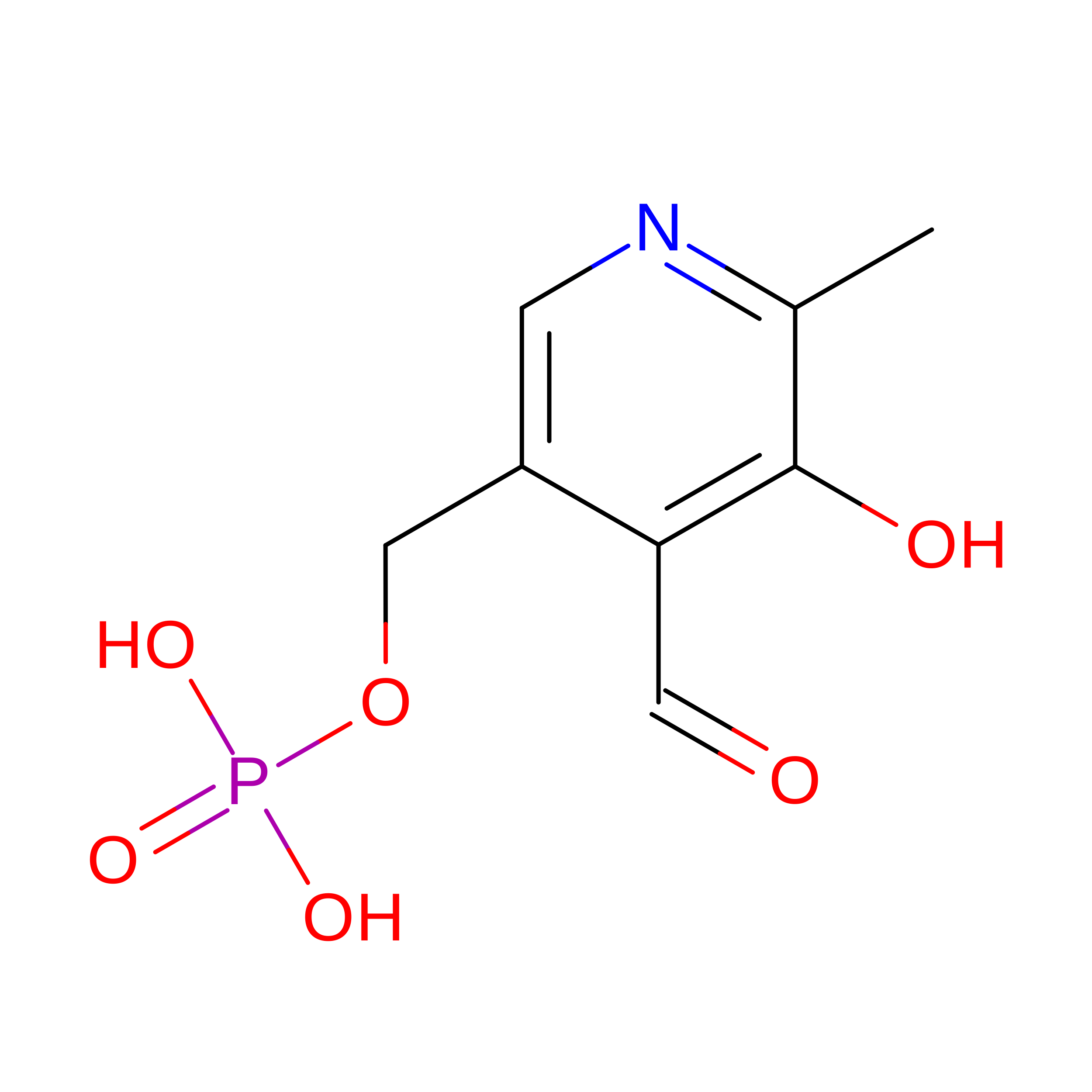
B [auth A]PYRIDOXAL-5'-PHOSPHATE
C8 H10 N O6 P
NGVDGCNFYWLIFO-UHFFFAOYSA-N

Experimental Data & Validation

Experimental Data

  • Method: X-RAY DIFFRACTION
  • Resolution: 2.26 Å
  • R-Value Free:  0.240 (Depositor) 
  • R-Value Work:  0.197 (Depositor) 
  • R-Value Observed: 0.197 (Depositor) 
Space Group: P 43 21 2
Unit Cell:
Length ( Å )Angle ( ˚ )
a = 128.65α = 90
b = 128.65β = 90
c = 116.065γ = 90
Software Package:
Software NamePurpose
X-PLORrefinement
HKL-2000data reduction
SCALEPACKdata scaling
X-PLORphasing

Structure Validation

View Full Validation Report


Entry History 

Deposition Data

Revision History  (Full details and data files)

  • Version 1.0: 2005-12-10
    Type: Initial release
  • Version 1.1: 2008-04-30
    Changes: Version format compliance
  • Version 1.2: 2011-07-13
    Changes: Derived calculations, Version format compliance
  • Version 1.3: 2025-03-26
    Changes: Data collection, Database references, Derived calculations, Structure summary