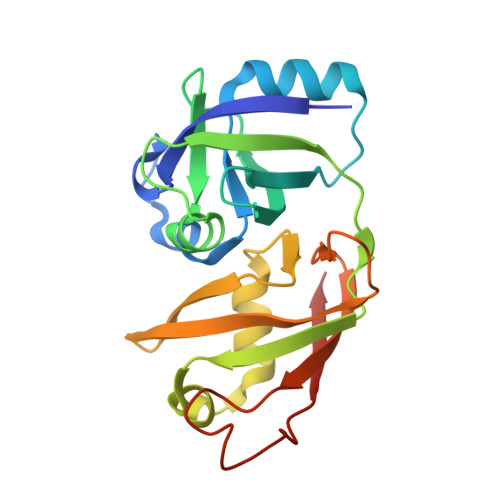
22ID | pdb_000022id

Structure of Chaetomium thermophilum Ufd1 UT3 domain fused with a ubiquitin C-terminal peptide


Experimental Data Snapshot

  • Method: X-RAY DIFFRACTION
  • Resolution: 2.14 Å
  • R-Value Free: 
    0.298 (Depositor), 0.298 (DCC) 
  • R-Value Work: 
    0.251 (Depositor), 0.251 (DCC) 
  • R-Value Observed: 
    0.255 (Depositor) 

Starting Model: in silico
View more details

wwPDB Validation 3D Report Full Report

Validation slider image for 22ID

This is version 1.0 of the entry. See complete history

Literature

ATP-independent unfolding of ubiquitin by Ufd1 initiates Cdc48/p97-mediated substrate processing.

Wang, Y.Zhang, Z.He, W.Wang, P.Du, J.Pan, J.Feng, S.Huang, J.Ji, Z.

(2026) Nat Struct Mol Biol 

  • DOI: https://doi.org/10.1038/s41594-026-01884-7
  • Primary Citation Related Structures: 
    22ID

  • PubMed Abstract: 

    The Cdc48 ATPase (p97 or VCP in mammals) cooperates with its cofactors Ufd1 and Npl4 to extract polyubiquitinated proteins from membranes or multisubunit complexes, promoting their proteasomal degradation. A ubiquitin molecule in the chain is unfolded in an ATP-independent manner and initiates substrate translocation through the central pore of the ATPase. How ubiquitin is unfolded remains unclear. Here we demonstrate that the UT3 domain of Ufd1 specifically interacts with two K48-linked ubiquitins and unfolds one of the ubiquitins by binding its C-terminal β-strand into a conserved hydrophobic cleft. Simultaneous binding of UT3 to two ubiquitin molecules is required to overcome the energy barrier of ubiquitin unfolding. Subsequently, the UT3-unfolded ubiquitin is captured by Npl4 and Cdc48/p97. Experiments in vitro and in cells show that unfolding-defective mutants of Ufd1 indeed compromise Cdc48/p97 function. Our results provide a reasonable explanation of how simple protein-protein interactions cause the unfolding of the remarkably stable ubiquitin.


  • Organizational Affiliation
    • Westlake Laboratory of Life Sciences and Biomedicine, Hangzhou, China.

Macromolecule Content 

  • Total Structure Weight: 46.06 kDa 
  • Atom Count: 3,292 
  • Modeled Residue Count: 389 
  • Deposited Residue Count: 406 
  • Unique protein chains: 1

Macromolecules

Find similar proteins by:|  3D Structure
Entity ID: 1
MoleculeChains  Sequence LengthOrganismDetailsImage
Putative ubiquitin fusion degradation protein
A, B
203Thermochaetoides thermophila DSM 1495Mutation(s): 0 
Gene Names: CTHT_0006190
UniProt
Find proteins for G0RYC4 (Thermochaetoides thermophila (strain DSM 1495 / CBS 144.50 / DAOM 24625 / IMI 039719))
Explore G0RYC4 
Go to UniProtKB:  G0RYC4
Entity Groups
Sequence Clusters30% Identity50% Identity70% Identity90% Identity95% Identity100% Identity
UniProt GroupG0RYC4
Sequence Annotations
Expand
Reference Sequence

Experimental Data & Validation

Experimental Data

  • Method: X-RAY DIFFRACTION
  • Resolution: 2.14 Å
  • R-Value Free:  0.298 (Depositor), 0.298 (DCC) 
  • R-Value Work:  0.251 (Depositor), 0.251 (DCC) 
  • R-Value Observed: 0.255 (Depositor) 
Space Group: C 2 2 21
Unit Cell:
Length ( Å )Angle ( ˚ )
a = 64.349α = 90
b = 67.465β = 90
c = 177.666γ = 90
Software Package:
Software NamePurpose
PHENIXrefinement
XDSdata reduction
Aimlessdata scaling
PHENIXphasing

Structure Validation

View Full Validation Report


Entry History 

& Funding Information

Deposition Data


Funding OrganizationLocationGrant Number
National Natural Science Foundation of China (NSFC)China--

Revision History  (Full details and data files)

  • Version 1.0: 2026-09-23
    Type: Initial release