Download Mendeley
Co-evolution-guided engineering of monensin biosynthetic monooxygenase MonCI reveals mechanistic basis for concurrent stability and catalytic enhancement.
Xiao, H., Li, J., Zhou, J., Liu, C., Deng, Y., Wang, S., Tong, Z., Liu, J., Zheng, Z., Zhong, J., Li, H., Chen, X.(2026) Int J Biol Macromol : 154119-154119
- PubMed: 42624264 Search on PubMed
- DOI: https://doi.org/10.1016/j.ijbiomac.2026.154119
- Primary Citation Related Structures:
23ZR, 23ZV, 24BG, 24CI - PubMed Abstract:
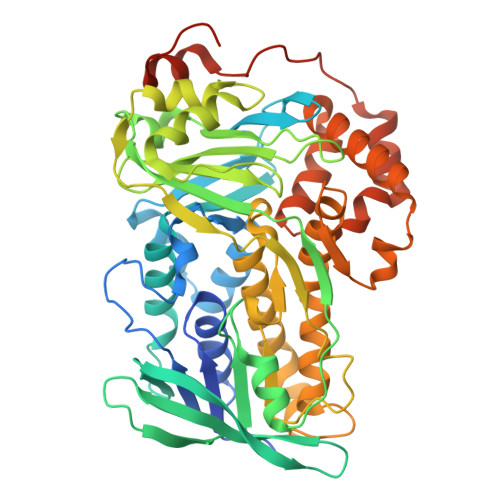
Improving enzyme stability without compromising catalytic activity remains a major challenge in protein engineering. Here, we present a co-evolution-guided strategy to enhance both thermostability and catalytic performance of the flavin-dependent monooxygenase MonCI, an enzyme involved in monensin biosynthesis. By combining sequence covariation analysis with structural filtering, a focused library of 15 single mutants yielded 4 variants with increased stability and activity. Combinatorial assembly generated triple, quadruple and quintuple mutants, with the best-performing quadruple variants exhibiting up to a 10 °C increase in melting temperature, a 2.3-fold increase in specific activity, and a 2.1-fold longer half-life, accompanied by enhanced turnover despite reduced substrate affinity. Crystal structures and molecular dynamics simulations reveal that stabilization arises from strengthened intramolecular networks of hydrogen bonds, salt bridges, and hydrophobic interactions, while epistatic effects limit additive improvements. This work provides mechanistic insight into how co-evolving residues modulate enzyme structure and function, presents a useful co-evolution-guided strategy for enzyme design, and advances MonCI as a promising biocatalyst for asymmetric epoxidation.
- Key Laboratory of Synthetic and Natural Functional Molecule of the Ministry of Education, College of Chemistry and Materials Science, Northwest University, Xi'an, 710127, China.
Organizational Affiliation: