Download Mendeley
Genetically Encoded Pentafluorophenylalanine Enables Quantitative Probing of Local Protein Malleability by 19F NMR.
Paul, N., Welegedara, A.P., Frkic, R.L., Macri, L., Thompson, T.R.C., Baber, J.L., Habel, E., Abdelkader, E.H., Qianzhu, H., Chilton, N.F., Jackson, C.J., Bax, A., Huber, T., Otting, G.(2026) J Am Chem Soc 148: 32644-32655
- PubMed: 42503665 Search on PubMedSearch on PubMed Central
- DOI: https://doi.org/10.1021/jacs.6c10121
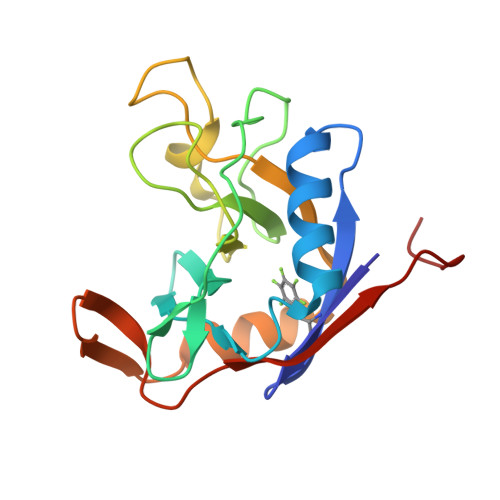
- Primary Citation Related Structures:
26AO, 26AP - PubMed Abstract:
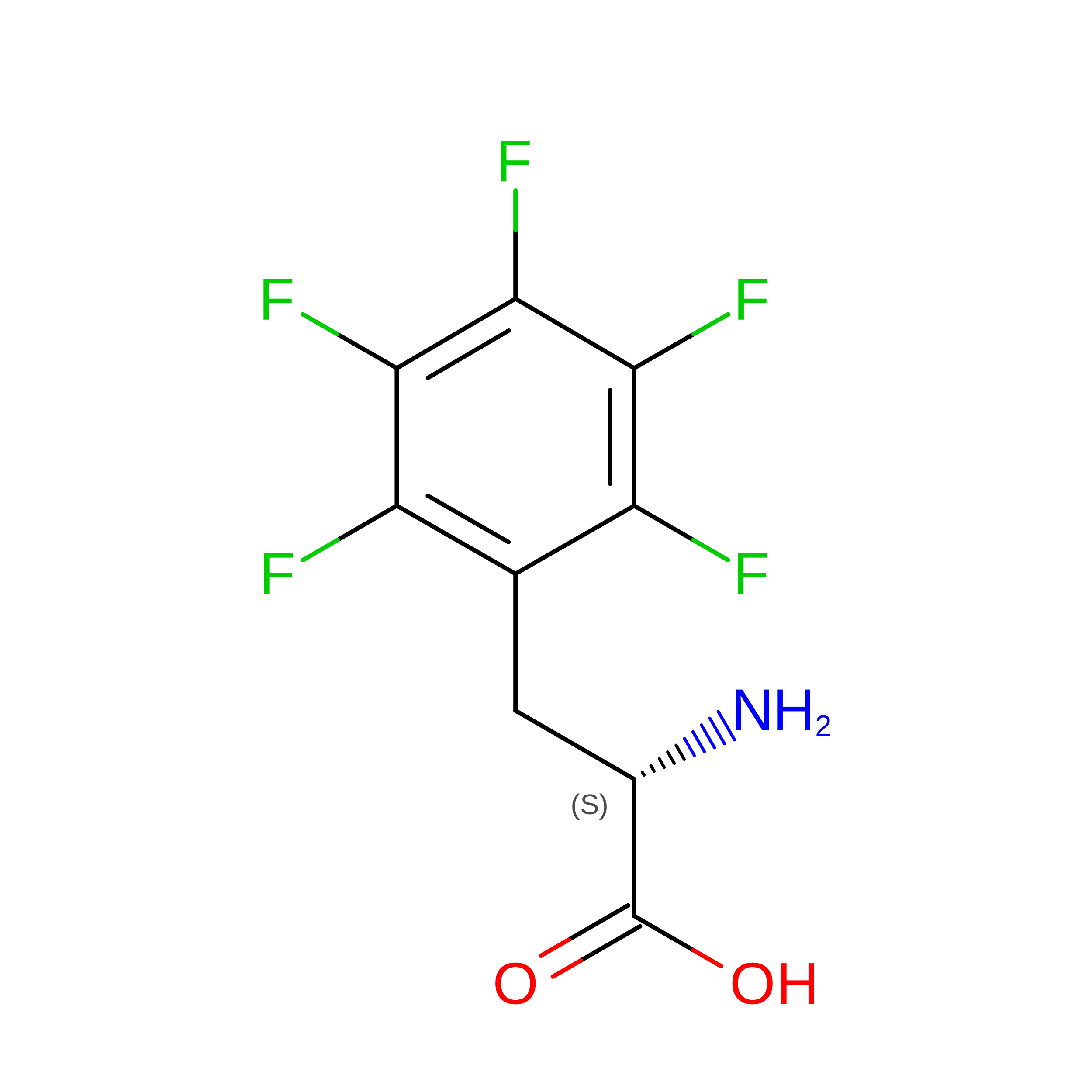
Aromatic ring flips in proteins provide a direct probe of local structural fluctuations, yet their rates are typically too fast for quantitative measurement by NMR spectroscopy. Here we show that site-specific incorporation of 2,3,4,5,6-pentafluoro-l-phenylalanine (F5Phe) reshapes the torsional energy landscape of aromatic side chains, slowing ring flips by over 2 orders of magnitude and shifting them into the slow-exchange regime accessible by 19F NMR. F5Phe can be genetically encoded with high fidelity and minimal structural perturbation, as confirmed by high-resolution X-ray crystallography across multiple proteins. The resulting 19F NMR spectra enable direct, quantitative measurements of ring-flip kinetics without the need for isotope labeling or complex multidimensional experiments. Application to a diverse set of proteins demonstrates that ring-flip rates vary widely even within the same hydrophobic cluster, revealing highly localized conformational fluctuations rather than global unfolding events. Pressure-dependent measurements yield small activation volumes, indicating that the structural rearrangements enabling ring flips are spatially confined. Ligand binding and protein-protein interactions modulate ring-flip rates in a site-specific manner, providing a sensitive readout of allosteric effects on local protein malleability. These results establish fluorinated aromatic amino acids as a general chemical strategy to engineer dynamic observables in proteins, transforming aromatic ring flips into a broadly applicable probe of local conformational dynamics and allostery.
- Research School of Chemistry, The Australian National University, Canberra, Australian Capital Territory2601, Australia.
Organizational Affiliation: