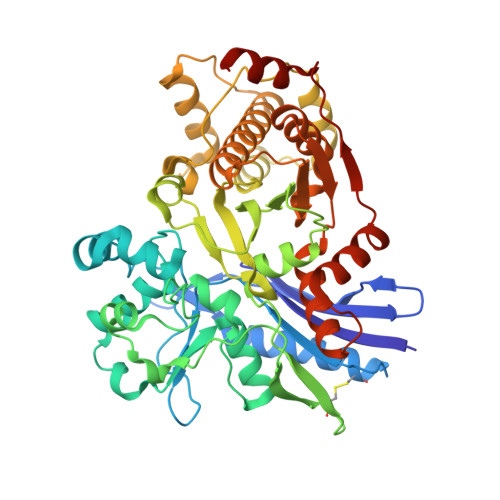
2CGK | pdb_00002cgk

Crystal Structure of L-rhamnulose kinase from Escherichia coli in an open uncomplexed conformation.


Experimental Data Snapshot

  • Method: X-RAY DIFFRACTION
  • Resolution: 2.46 Å
  • R-Value Free: 
    0.273 (Depositor), 0.264 (DCC) 
  • R-Value Work: 
    0.238 (Depositor), 0.232 (DCC) 
  • R-Value Observed: 
    0.238 (Depositor) 

Starting Model: experimental
View more details

wwPDB Validation 3D Report Full Report

Validation slider image for 2CGK

This is version 1.5 of the entry. See complete history

Literature

Structure and Reaction Mechanism of L-Rhamnulose Kinase from Escherichia Coli.

Grueninger, D.Schulz, G.E.

(2006) J Mol Biology 359: 787

  • DOI: https://doi.org/10.1016/j.jmb.2006.04.013
  • Primary Citation Related Structures: 
    2CGJ, 2CGK, 2CGL

  • PubMed Abstract: 

    Bacterial L-rhamnulose kinase participates in the degradation of L-rhamnose, which is ubiquitous and particularly abundant in some plants. The enzyme catalyzes the transfer of the gamma-phosphate group from ATP to the 1-hydroxyl group of L-rhamnulose. We determined the crystal structures of the substrate-free kinase and of a complex between the enzyme, ADP and L-fructose, which besides rhamnulose is also processed. According to its chainfold, the kinase belongs to the hexokinase-hsp70-actin superfamily. The closest structurally known homologue is glycerol kinase. The reported structures reveal a large conformational change on substrate binding as well as the key residues involved in catalysis. The substrates ADP and beta-L-fructose are in an ideal position to define a direct in-line phosphoryl transfer through a bipyramidal pentavalent intermediate. The enzyme contains one disulfide bridge at a position where two homologous glycerol kinases are regulated by phosphorylation and effector binding, respectively, and it has two more pairs of cysteine residues near the surface that are poised for bridging. However, identical catalytic rates were observed for the enzyme in reducing and oxidizing environments, suggesting that regulation by disulfide formation is unlikely.


  • Organizational Affiliation
    • Institut für Organische Chemie und Biochemie, Albert-Ludwigs-Universität, Albertstr. 21, 79104 Freiburg im Breisgau, Germany.

Macromolecule Content 

  • Total Structure Weight: 107.91 kDa 
  • Atom Count: 7,498 
  • Modeled Residue Count: 958 
  • Deposited Residue Count: 978 
  • Unique protein chains: 1

Macromolecules

Find similar proteins by:|  3D Structure
Entity ID: 1
MoleculeChains  Sequence LengthOrganismDetailsImage
L-RHAMNULOSE KINASE
A, B
489Escherichia coli BL21(DE3)Mutation(s): 3 
EC: 2.7.1.5
UniProt
Find proteins for P32171 (Escherichia coli (strain K12))
Explore P32171 
Go to UniProtKB:  P32171
Entity Groups
Sequence Clusters30% Identity50% Identity70% Identity90% Identity95% Identity100% Identity
UniProt GroupP32171
Sequence Annotations
Expand
Reference Sequence

Experimental Data & Validation

Experimental Data

  • Method: X-RAY DIFFRACTION
  • Resolution: 2.46 Å
  • R-Value Free:  0.273 (Depositor), 0.264 (DCC) 
  • R-Value Work:  0.238 (Depositor), 0.232 (DCC) 
  • R-Value Observed: 0.238 (Depositor) 
Space Group: P 1 21 1
Unit Cell:
Length ( Å )Angle ( ˚ )
a = 52.259α = 90
b = 164.933β = 93.45
c = 51.57γ = 90
Software Package:
Software NamePurpose
CNSrefinement
XDSdata reduction
XSCALEdata scaling
CCP4phasing
PHASERphasing
MOLREPphasing

Structure Validation

View Full Validation Report


Entry History 

Deposition Data

Revision History  (Full details and data files)

  • Version 1.0: 2006-05-31
    Type: Initial release
  • Version 1.1: 2011-05-08
    Changes: Version format compliance
  • Version 1.2: 2011-07-13
    Changes: Version format compliance
  • Version 1.3: 2018-10-24
    Changes: Data collection, Source and taxonomy
  • Version 1.4: 2023-12-13
    Changes: Data collection, Database references, Other, Refinement description
  • Version 1.5: 2024-10-16
    Changes: Structure summary