3G4Q | pdb_00003g4q

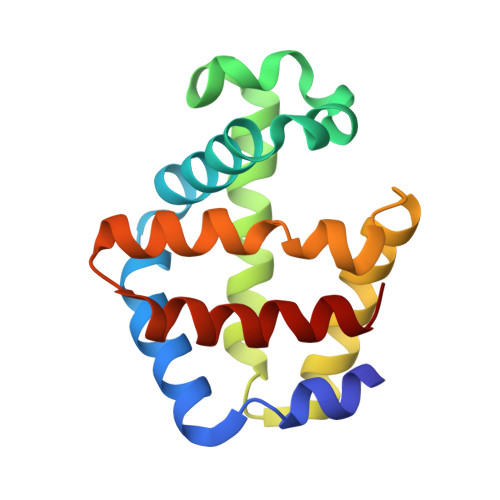
Ligand migration and cavities within scapharca dimeric hemoglobin: wild type with co bound to heme and chloroform bound to the XE4 cavity


Experimental Data Snapshot

  • Method: X-RAY DIFFRACTION
  • Resolution: 1.60 Å
  • R-Value Free: 
    0.219 (Depositor), 0.209 (DCC) 
  • R-Value Work: 
    0.201 (Depositor), 0.189 (DCC) 
  • R-Value Observed: 
    0.201 (Depositor) 

Starting Model: experimental
View more details

wwPDB Validation 3D Report Full Report

Validation slider image for 3G4Q

Ligand Structure Quality Assessment 


This is version 1.2 of the entry. See complete history

Literature

Ligand migration and cavities within Scapharca Dimeric HbI: studies by time-resolved crystallo-graphy, Xe binding, and computational analysis.

Knapp, J.E.Pahl, R.Cohen, J.Nichols, J.C.Schulten, K.Gibson, Q.H.Srajer, V.Royer, W.E.

(2009) Structure 17: 1494-1504

  • DOI: https://doi.org/10.1016/j.str.2009.09.004
  • Primary Citation Related Structures: 
    3G46, 3G4Q, 3G4R, 3G4U, 3G4V, 3G4W, 3G4Y, 3G52, 3G53

  • PubMed Abstract: 

    As in many other hemoglobins, no direct route for migration of ligands between solvent and active site is evident from crystal structures of Scapharca inaequivalvis dimeric HbI. Xenon (Xe) and organic halide binding experiments, along with computational analysis presented here, reveal protein cavities as potential ligand migration routes. Time-resolved crystallographic experiments show that photodissociated carbon monoxide (CO) docks within 5 ns at the distal pocket B site and at more remote Xe4 and Xe2 cavities. CO rebinding is not affected by the presence of dichloroethane within the major Xe4 protein cavity, demonstrating that this cavity is not on the major exit pathway. The crystal lattice has a substantial influence on ligand migration, suggesting that significant conformational rearrangements may be required for ligand exit. Taken together, these results are consistent with a distal histidine gate as one important ligand entry and exit route, despite its participation in the dimeric interface.


  • Organizational Affiliation
    • Department of Biochemistry and Molecular Pharmacology, The University of Massachusetts Medical School, Worcester, MA 01605, USA.

Macromolecule Content 

  • Total Structure Weight: 33.58 kDa 
  • Atom Count: 2,513 
  • Modeled Residue Count: 290 
  • Deposited Residue Count: 292 
  • Unique protein chains: 1

Macromolecules

Find similar proteins by:|  3D Structure
Entity ID: 1
MoleculeChains  Sequence LengthOrganismDetailsImage
Globin-1
A, B
146Anadara inaequivalvisMutation(s): 0 
Gene Names: HBI
UniProt
Find proteins for P02213 (Anadara inaequivalvis)
Explore P02213 
Go to UniProtKB:  P02213
Entity Groups
Sequence Clusters30% Identity50% Identity70% Identity90% Identity95% Identity100% Identity
UniProt GroupP02213
Sequence Annotations
Expand
Reference Sequence

Small Molecules

Ligands 3 Unique
IDChains Name / Formula / InChI Key2D Diagram3D Interactions
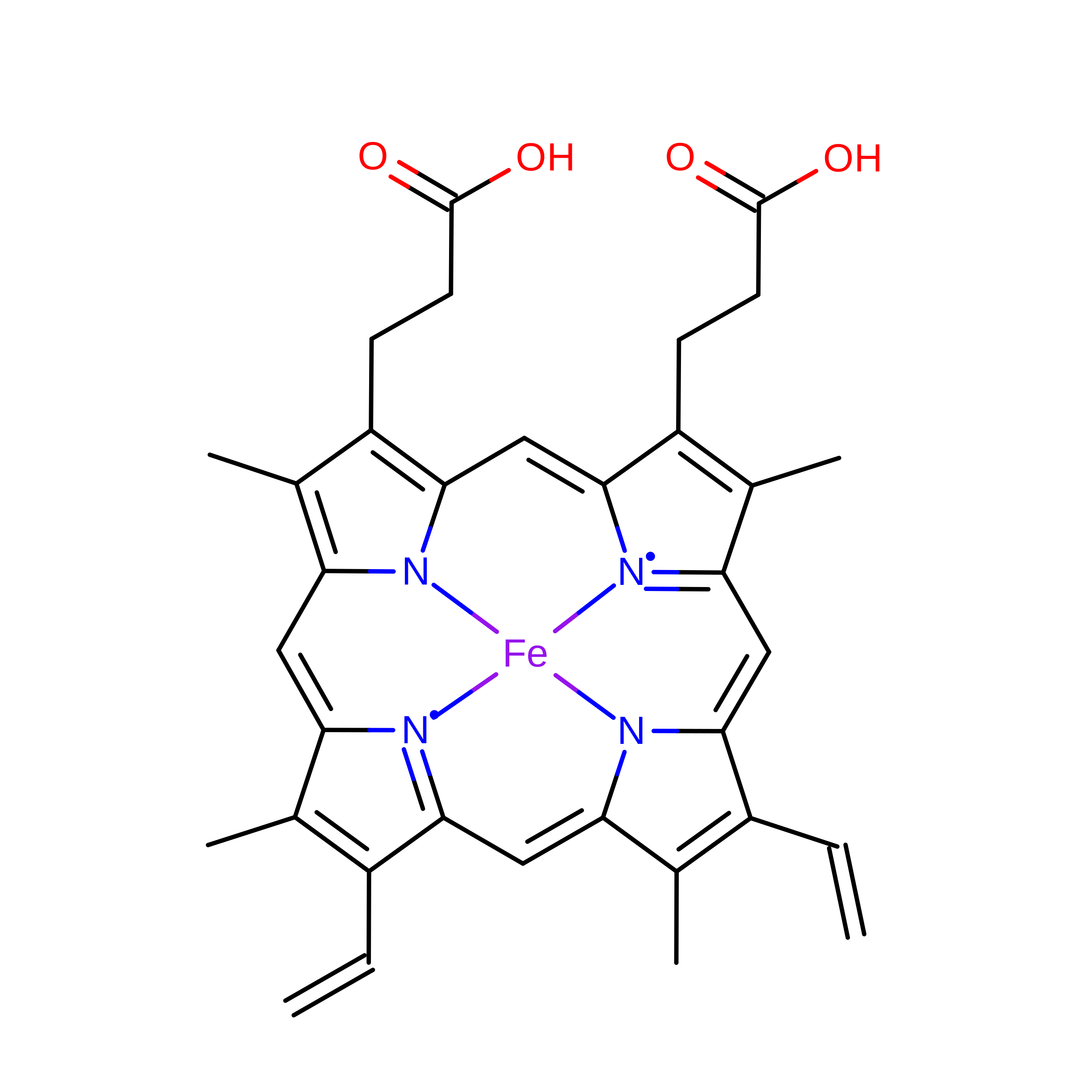
HEM

Query on HEM


Download:Ideal Coordinates CCD File
C [auth A],
F [auth B]
PROTOPORPHYRIN IX CONTAINING FE
C34 H32 Fe N4 O4
KABFMIBPWCXCRK-RGGAHWMASA-L
MCH

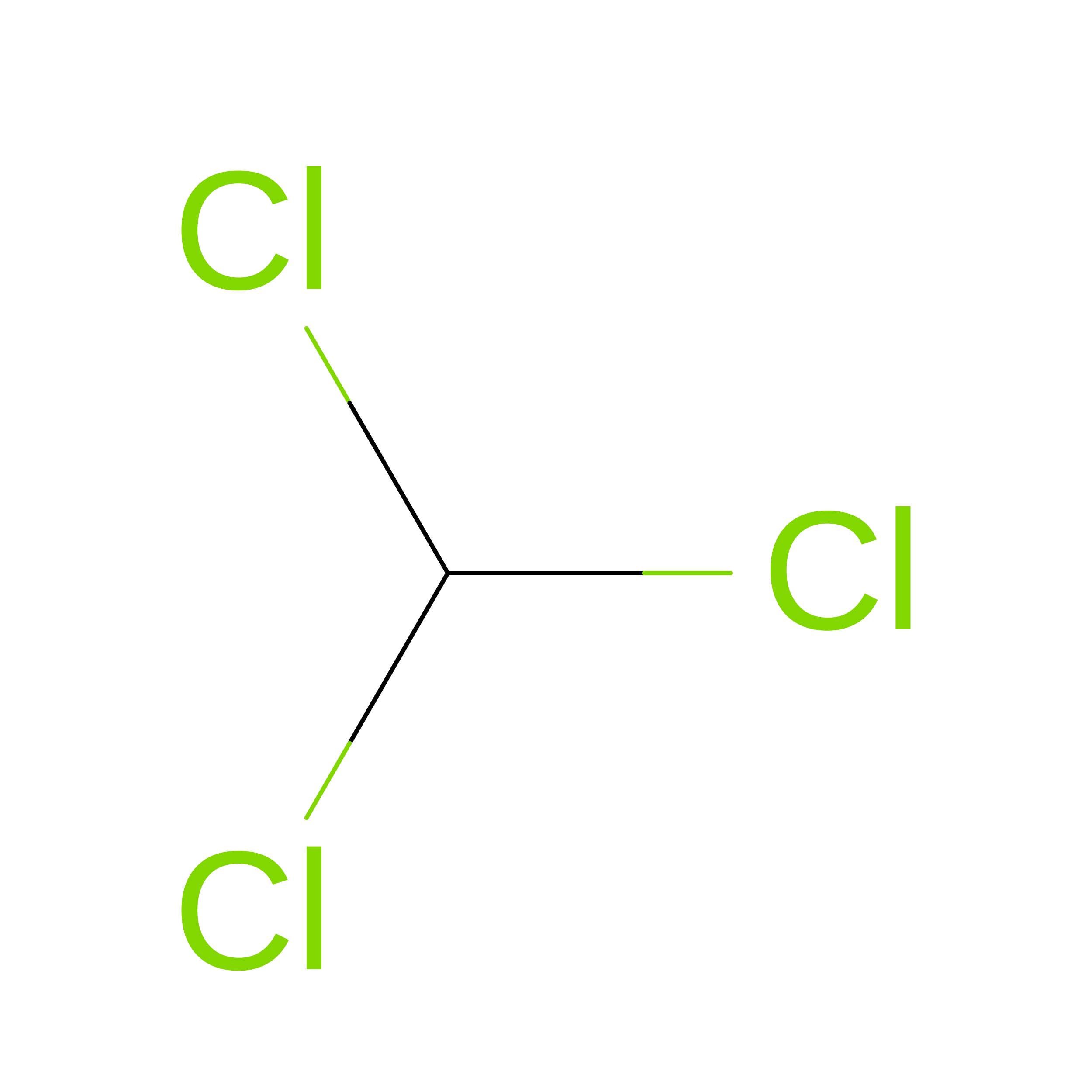
Query on MCH


Download:Ideal Coordinates CCD File
E [auth A],
H [auth B],
I [auth B]
trichloromethane
C H Cl3
HEDRZPFGACZZDS-UHFFFAOYSA-N
CMO

Query on CMO


Download:Ideal Coordinates CCD File
D [auth A],
G [auth B]
CARBON MONOXIDE
C O
UGFAIRIUMAVXCW-UHFFFAOYSA-N

Experimental Data & Validation

Experimental Data

  • Method: X-RAY DIFFRACTION
  • Resolution: 1.60 Å
  • R-Value Free:  0.219 (Depositor), 0.209 (DCC) 
  • R-Value Work:  0.201 (Depositor), 0.189 (DCC) 
  • R-Value Observed: 0.201 (Depositor) 
Space Group: C 1 2 1
Unit Cell:
Length ( Å )Angle ( ˚ )
a = 93.18α = 90
b = 43.89β = 121.93
c = 83.49γ = 90
Software Package:
Software NamePurpose
MAR345dtbdata collection
CNSrefinement
DENZOdata reduction
SCALEPACKdata scaling
CNSphasing

Structure Validation

View Full Validation Report


Ligand Structure Quality Assessment 


Entry History 

Deposition Data

Revision History  (Full details and data files)

  • Version 1.0: 2009-12-01
    Type: Initial release
  • Version 1.1: 2011-07-13
    Changes: Version format compliance
  • Version 1.2: 2023-09-06
    Changes: Data collection, Database references, Derived calculations, Refinement description