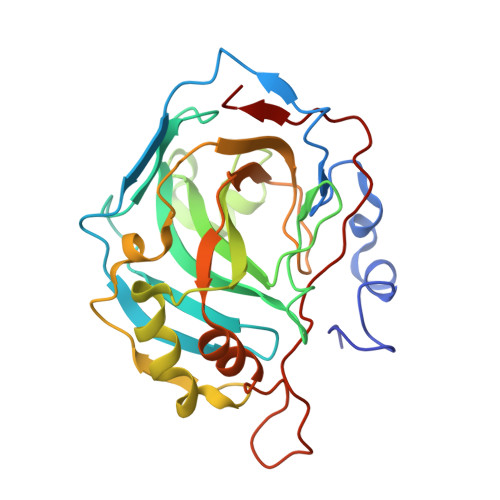
3GZ0 | pdb_00003gz0

Apo-human carbonic anhydrase II revisited: Implications of the loss of a metal in protein structure, stability and solvent network


Experimental Data Snapshot

  • Method: X-RAY DIFFRACTION
  • Resolution: 1.26 Å
  • R-Value Free: 
    0.187 (Depositor), 0.194 (DCC) 
  • R-Value Work: 
    0.140 (Depositor), 0.150 (DCC) 
  • R-Value Observed: 
    0.140 (Depositor) 

Starting Model: experimental
View more details

wwPDB Validation 3D Report Full Report

Validation slider image for 3GZ0

This is version 1.2 of the entry. See complete history

Literature

Apo-Human Carbonic Anhydrase II Revisited: Implications of the Loss of a Metal in Protein Structure, Stability, and Solvent Network .

Avvaru, B.S.Busby, S.A.Chalmers, M.J.Griffin, P.R.Venkatakrishnan, B.Agbandje-McKenna, M.Silverman, D.N.McKenna, R.

(2009) Biochemistry 48: 7365-7372

  • DOI: https://doi.org/10.1021/bi9007512
  • Primary Citation Related Structures: 
    3GZ0

  • PubMed Abstract: 

    Human carbonic anhydrase II (HCA II) is a monomeric zinc-containing metalloenzyme that catalyzes the hydration of CO(2) to form bicarbonate and a proton. The properties of the zinc have been extensively elucidated in catalysis but less well studied as a contributor to structure and stability. Apo-HCA II (without zinc) was prepared and compared to holo-HCA II: in crystallographic structural features, in backbone amide H/D exchange, and in thermal stability. The removal of zinc from the active site has no effect on either the topological fold of the enzyme or the ordered water network in the active site. However, the removal of the zinc alters the collective electrostatics of the apo-HCA II that result in the following differences from that of the holoenzyme: (1) the main thermal unfolding transition of the apo-HCA II is lowered by 8 degrees C, (2) the relative increase in thermal mobility of atoms of the apo-HCA II was not observed in the vicinity of the active site but manifested on the surface of the enzyme, and (3) the side chain of His 64, the proton shuttle residue that sits on the rim of the active site, is oriented outward and is associated with additional ordered "external" waters, as opposed to a near equal inward and outward orientation in the holo-HCA II.


  • Organizational Affiliation
    • Department of Biochemistry and Molecular Biology, University of Florida, Gainesville, Florida 32610, USA.

Macromolecule Content 

  • Total Structure Weight: 29.22 kDa 
  • Atom Count: 2,337 
  • Modeled Residue Count: 257 
  • Deposited Residue Count: 259 
  • Unique protein chains: 1

Macromolecules

Find similar proteins by:|  3D Structure
Entity ID: 1
MoleculeChains  Sequence LengthOrganismDetailsImage
Carbonic anhydrase 2259Homo sapiensMutation(s): 0 
Gene Names: CA2
EC: 4.2.1.1 (PDB Primary Data), 4.2.1.69 (UniProt)
UniProt & NIH Common Fund Data Resources
Find proteins for P00918 (Homo sapiens)
Explore P00918 
Go to UniProtKB:  P00918
PHAROS:  P00918
GTEx:  ENSG00000104267 
Entity Groups
Sequence Clusters30% Identity50% Identity70% Identity90% Identity95% Identity100% Identity
UniProt GroupP00918
Sequence Annotations
Expand
Reference Sequence

Small Molecules

Ligands 1 Unique
IDChains Name / Formula / InChI Key2D Diagram3D Interactions
ZN

Query on ZN


Download:Ideal Coordinates CCD File
B [auth A]ZINC ION
Zn
PTFCDOFLOPIGGS-UHFFFAOYSA-N

Experimental Data & Validation

Experimental Data

  • Method: X-RAY DIFFRACTION
  • Resolution: 1.26 Å
  • R-Value Free:  0.187 (Depositor), 0.194 (DCC) 
  • R-Value Work:  0.140 (Depositor), 0.150 (DCC) 
  • R-Value Observed: 0.140 (Depositor) 
Space Group: P 1 21 1
Unit Cell:
Length ( Å )Angle ( ˚ )
a = 42.737α = 90
b = 41.623β = 104.59
c = 72.821γ = 90
Software Package:
Software NamePurpose
HKL-2000data collection
SHELXL-97refinement
HKL-2000data reduction
HKL-2000data scaling

Structure Validation

View Full Validation Report


Entry History 

Deposition Data

Revision History  (Full details and data files)

  • Version 1.0: 2009-07-21
    Type: Initial release
  • Version 1.1: 2011-07-13
    Changes: Version format compliance
  • Version 1.2: 2023-09-06
    Changes: Data collection, Database references, Derived calculations, Refinement description