3JZK | pdb_00003jzk

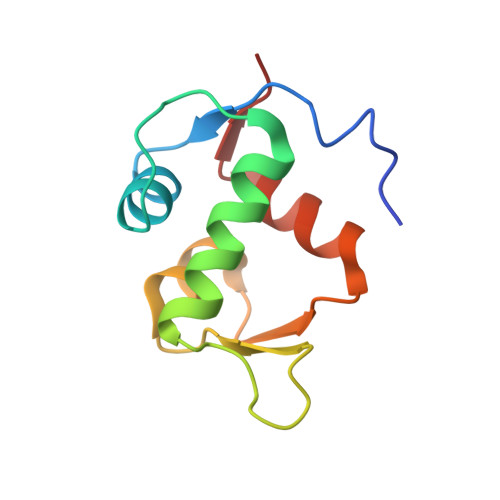
crystal structure of MDM2 with chromenotriazolopyrimidine 1


Experimental Data Snapshot

  • Method: X-RAY DIFFRACTION
  • Resolution: 2.10 Å
  • R-Value Free: 
    0.320 (Depositor), 0.315 (DCC) 
  • R-Value Work: 
    0.300 (Depositor), 0.296 (DCC) 

Starting Model: experimental
View more details

wwPDB Validation 3D Report Full Report

Validation slider image for 3JZK

Ligand Structure Quality Assessment 


This is version 1.2 of the entry. See complete history

Literature

Discovery and optimization of chromenotriazolopyrimidines as potent inhibitors of the mouse double minute 2-tumor protein 53 protein-protein interaction.

Allen, J.G.Bourbeau, M.P.Wohlhieter, G.E.Bartberger, M.D.Michelsen, K.Hungate, R.Gadwood, R.C.Gaston, R.D.Evans, B.Mann, L.W.Matison, M.E.Schneider, S.Huang, X.Yu, D.Andrews, P.S.Reichelt, A.Long, A.M.Yakowec, P.Yang, E.Y.Lee, T.A.Oliner, J.D.

(2009) J Med Chem 52: 7044-7053

  • DOI: https://doi.org/10.1021/jm900681h
  • Primary Citation Related Structures: 
    3JZK

  • PubMed Abstract: 

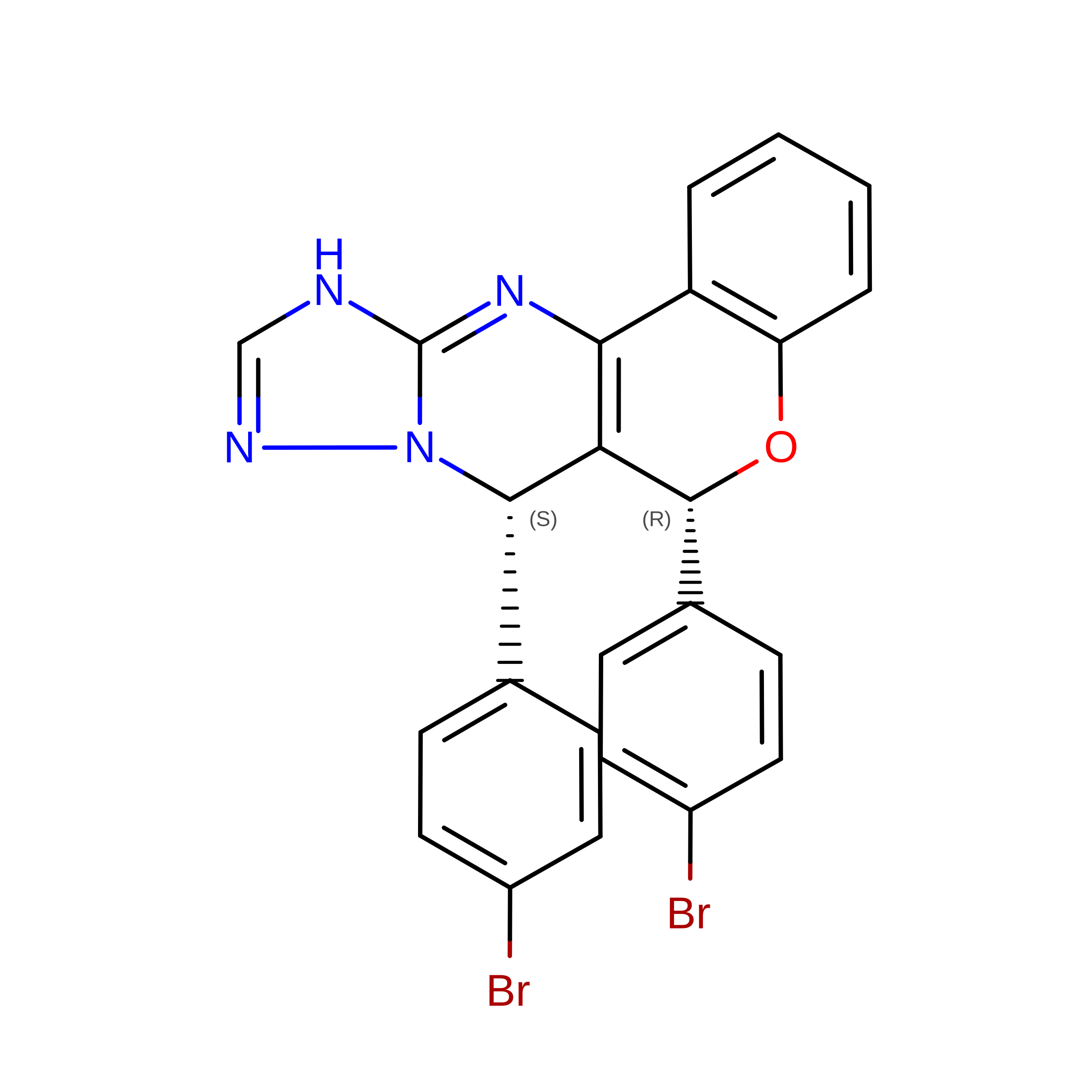
    Tumor protein 53 (p53) is a critical regulator of cell cycle and apoptosis that is frequently disabled in human tumors. In many tumor types, p53 is deleted or mutated, but in others p53 is inactivated by overexpression or amplification of its negative regulator mouse double minute 2 (MDM2). A high-throughput screening effort identified 6,7-bis(4-bromophenyl)-7,12-dihydro-6H-chromeno[4,3-d][1,2,4]triazolo[1,5-a]pyrimidine as a potent inhibitor of the MDM2-p53 protein-protein interaction. This screening hit was found to be chemically unstable and difficult to handle due to poor DMSO solubility. Co-crystallization with the target protein helped to direct further optimization and provided a tractable lead series of novel MDM2-p53 inhibitors. In cellular assays, these compounds were shown to upregulate p53 protein levels and p53 signaling and to cause p53-dependent inhibition of proliferation and apoptosis.


  • Organizational Affiliation
    • Chemistry Research and Discovery, Amgen Inc., One Amgen Center Drive, Thousand Oaks, California 91320, USA. johallen@amgen.com

Macromolecule Content 

  • Total Structure Weight: 11.69 kDa 
  • Atom Count: 829 
  • Modeled Residue Count: 93 
  • Deposited Residue Count: 96 
  • Unique protein chains: 1

Macromolecules

Find similar proteins by:|  3D Structure
Entity ID: 1
MoleculeChains  Sequence LengthOrganismDetailsImage
E3 ubiquitin-protein ligase Mdm296Homo sapiensMutation(s): 0 
Gene Names: MDM2
EC: 6.3.2 (PDB Primary Data), 2.3.2.27 (UniProt)
UniProt & NIH Common Fund Data Resources
Find proteins for Q00987 (Homo sapiens)
Explore Q00987 
Go to UniProtKB:  Q00987
PHAROS:  Q00987
GTEx:  ENSG00000135679 
Entity Groups
Sequence Clusters30% Identity50% Identity70% Identity90% Identity95% Identity100% Identity
UniProt GroupQ00987
Sequence Annotations
Expand
Reference Sequence

Small Molecules

Ligands 1 Unique
IDChains Name / Formula / InChI Key2D Diagram3D Interactions
YIN

Query on YIN


Download:Ideal Coordinates CCD File
B [auth A](6R,7S)-6,7-bis(4-bromophenyl)-7,11-dihydro-6H-chromeno[4,3-d][1,2,4]triazolo[1,5-a]pyrimidine
C24 H16 Br2 N4 O
HNNGTASVWGJHBY-XZOQPEGZSA-N

Experimental Data & Validation

Experimental Data

  • Method: X-RAY DIFFRACTION
  • Resolution: 2.10 Å
  • R-Value Free:  0.320 (Depositor), 0.315 (DCC) 
  • R-Value Work:  0.300 (Depositor), 0.296 (DCC) 
Space Group: P 41 21 2
Unit Cell:
Length ( Å )Angle ( ˚ )
a = 34.53α = 90
b = 34.53β = 90
c = 161.251γ = 90
Software Package:
Software NamePurpose
CrystalCleardata collection
AMoREphasing
CNSrefinement
DENZOdata reduction
SCALEPACKdata scaling

Structure Validation

View Full Validation Report


Ligand Structure Quality Assessment 


Entry History 

Deposition Data

  • Released Date: 2009-11-17 
  • Deposition Author(s): Huang, X.

Revision History  (Full details and data files)

  • Version 1.0: 2009-11-17
    Type: Initial release
  • Version 1.1: 2011-07-13
    Changes: Version format compliance
  • Version 1.2: 2023-09-06
    Changes: Data collection, Database references, Derived calculations, Refinement description