3UVQ | pdb_00003uvq

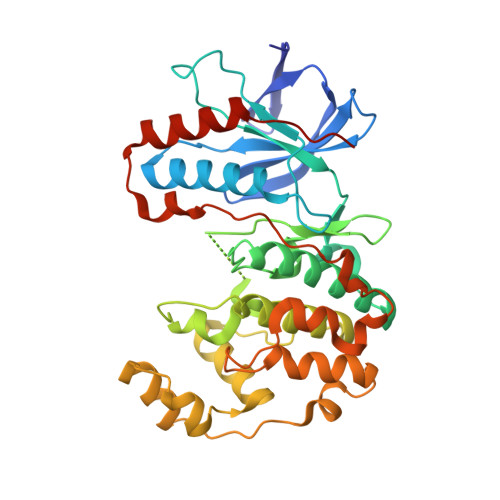
Human p38 MAP Kinase in Complex with a Dibenzosuberone Derivative


Experimental Data Snapshot

  • Method: X-RAY DIFFRACTION
  • Resolution: 2.20 Å
  • R-Value Free: 
    0.318 (Depositor), 0.314 (DCC) 
  • R-Value Work: 
    0.236 (Depositor), 0.233 (DCC) 
  • R-Value Observed: 
    0.240 (Depositor) 

Starting Model: experimental
View more details

wwPDB Validation 3D Report Full Report

Validation slider image for 3UVQ

Ligand Structure Quality Assessment 


This is version 1.4 of the entry. See complete history

Literature

Dibenzosuberones as p38 mitogen-activated protein kinase inhibitors with low ATP competitiveness and outstanding whole blood activity.

Fischer, S.Wentsch, H.K.Mayer-Wrangowski, S.C.Zimmermann, M.Bauer, S.M.Storch, K.Niess, R.Koeberle, S.C.Grutter, C.Boeckler, F.M.Rauh, D.Laufer, S.A.

(2013) J Med Chem 56: 241-253

  • DOI: https://doi.org/10.1021/jm301539x
  • Primary Citation Related Structures: 
    3UVQ

  • PubMed Abstract: 

    p38α mitogen-activated protein (MAP) kinase is a main target in drug research concerning inflammatory diseases. Nevertheless, no inhibitor of p38α MAP kinase has been introduced to the market. This might be attributed to the fact that there is no inhibitor which combines outstanding activity in biological systems and selectivity. Herein an approach to the development of such inhibitors on the basis of the highly selective molecular probe Skepinone-L is described. Introduction of a "deep pocket" moiety addressing the DFG motif led to an increased activity of the compounds. Hydrophilic moieties, addressing the solvent-exposed area adjacent to hydrophilic region II, conserved a high activity of the compounds in a whole blood assay. Combined with their outstanding selectivity and low ATP competitiveness, these inhibitors are very interesting candidates for use in biological systems and in therapy.


  • Organizational Affiliation
    • Institute of Pharmacy, University of Tübingen , Auf der Morgenstelle 8, D-72076 Tübingen, Germany.

Macromolecule Content 

  • Total Structure Weight: 42.09 kDa 
  • Atom Count: 2,834 
  • Modeled Residue Count: 333 
  • Deposited Residue Count: 360 
  • Unique protein chains: 1

Macromolecules

Find similar proteins by:|  3D Structure
Entity ID: 1
MoleculeChains  Sequence LengthOrganismDetailsImage
Mitogen-activated protein kinase 14360Homo sapiensMutation(s): 0 
Gene Names: MAPK14CSBPCSBP1CSBP2CSPB1MXI2
EC: 2.7.11.24
UniProt & NIH Common Fund Data Resources
Find proteins for Q16539 (Homo sapiens)
Explore Q16539 
Go to UniProtKB:  Q16539
PHAROS:  Q16539
GTEx:  ENSG00000112062 
Entity Groups
Sequence Clusters30% Identity50% Identity70% Identity90% Identity95% Identity100% Identity
UniProt GroupQ16539
Sequence Annotations
Expand
Reference Sequence

Small Molecules

Ligands 2 Unique
IDChains Name / Formula / InChI Key2D Diagram3D Interactions
FS8

Query on FS8


Download:Ideal Coordinates CCD File
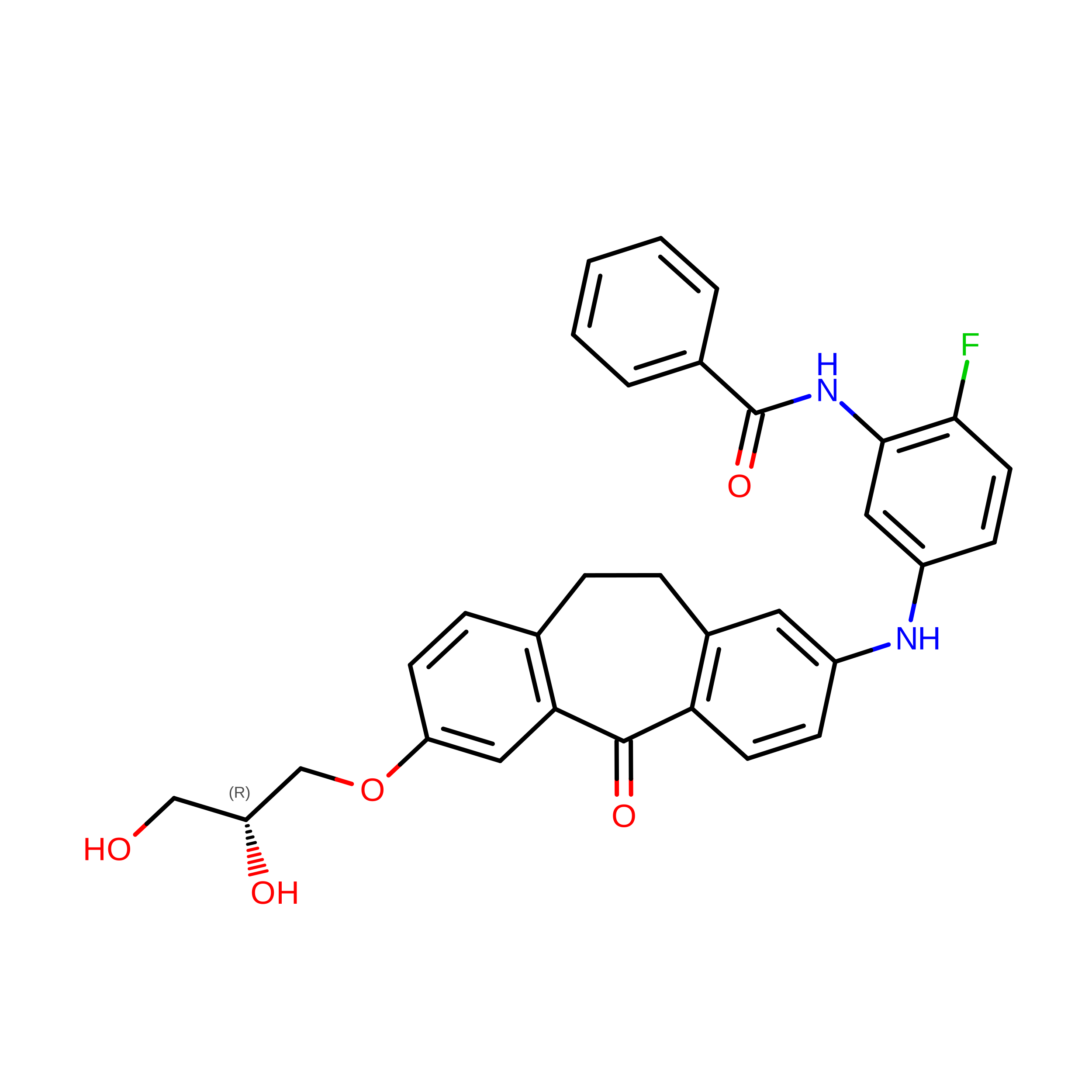
B [auth A]N-{5-[(7-{[(2R)-2,3-dihydroxypropyl]oxy}-5-oxo-10,11-dihydro-5H-dibenzo[a,d][7]annulen-2-yl)amino]-2-fluorophenyl}benzamide
C31 H27 F N2 O5
ZPBRNNLSMHDHFY-XMMPIXPASA-N
BOG

Query on BOG


Download:Ideal Coordinates CCD File
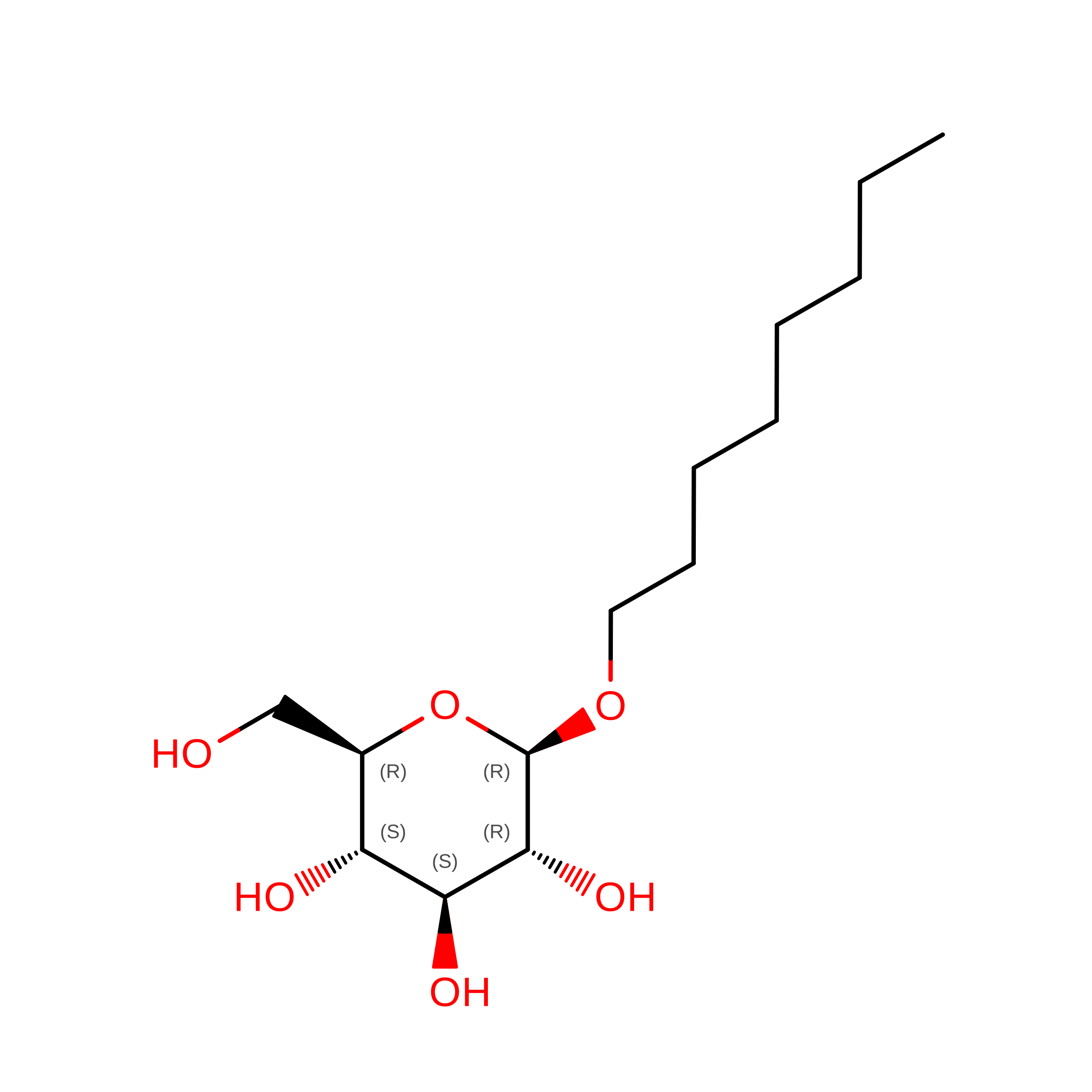
C [auth A]octyl beta-D-glucopyranoside
C14 H28 O6
HEGSGKPQLMEBJL-RKQHYHRCSA-N
Binding Affinity Annotations 
IDSourceBinding Affinity
FS8 BindingDB:  3UVQ IC50: 1 (nM) from 1 assay(s)

Experimental Data & Validation

Experimental Data

  • Method: X-RAY DIFFRACTION
  • Resolution: 2.20 Å
  • R-Value Free:  0.318 (Depositor), 0.314 (DCC) 
  • R-Value Work:  0.236 (Depositor), 0.233 (DCC) 
  • R-Value Observed: 0.240 (Depositor) 
Space Group: P 21 21 21
Unit Cell:
Length ( Å )Angle ( ˚ )
a = 66.099α = 90
b = 74.289β = 90
c = 77.727γ = 90
Software Package:
Software NamePurpose
XSCALEdata scaling
PHASERphasing
REFMACrefinement
PDB_EXTRACTdata extraction
XDSdata scaling

Structure Validation

View Full Validation Report


Ligand Structure Quality Assessment 


Entry History 

Deposition Data

Revision History  (Full details and data files)

  • Version 1.0: 2012-12-05
    Type: Initial release
  • Version 1.1: 2013-01-16
    Changes: Database references, Structure summary
  • Version 1.2: 2013-07-17
    Changes: Database references
  • Version 1.3: 2020-07-29
    Type: Remediation
    Reason: Carbohydrate remediation
    Changes: Data collection, Database references, Derived calculations, Structure summary
  • Version 1.4: 2023-11-08
    Changes: Data collection, Database references, Refinement description, Structure summary