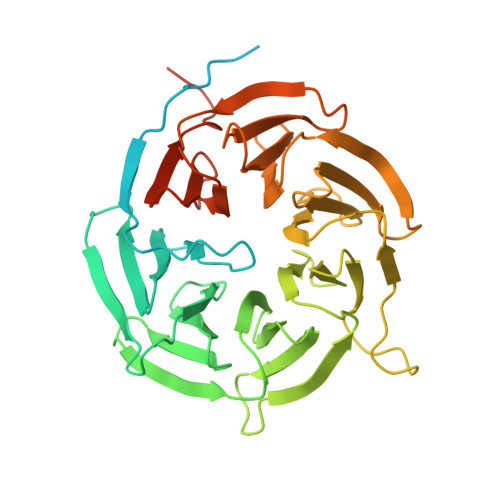
4GGA | pdb_00004gga

Structural Analysis of Human Cdc20 Supports Multi-site Degron Recognition by APC/C


Experimental Data Snapshot

  • Method: X-RAY DIFFRACTION
  • Resolution: 2.04 Å
  • R-Value Free: 
    0.203 (Depositor), 0.208 (DCC) 
  • R-Value Work: 
    0.151 (Depositor), 0.156 (DCC) 
  • R-Value Observed: 
    0.154 (Depositor) 

wwPDB Validation 3D Report Full Report

Validation slider image for 4GGA

This is version 1.4 of the entry. See complete history

Literature

Structural analysis of human Cdc20 supports multisite degron recognition by APC/C.

Tian, W.Li, B.Warrington, R.Tomchick, D.R.Yu, H.Luo, X.

(2012) Proc Natl Acad Sci U S A 109: 18419-18424

  • DOI: https://doi.org/10.1073/pnas.1213438109
  • Primary Citation Related Structures: 
    4GGA, 4GGC, 4GGD

  • PubMed Abstract: 

    The anaphase-promoting complex/cyclosome (APC/C) promotes anaphase onset and mitotic exit through ubiquitinating securin and cyclin B1. The mitotic APC/C activator, the cell division cycle 20 (Cdc20) protein, directly interacts with APC/C degrons--the destruction (D) and KEN boxes. APC/C(Cdc20) is the target of the spindle checkpoint. Checkpoint inhibition of APC/C(Cdc20) requires the binding of a BubR1 KEN box to Cdc20. How APC/C recognizes substrates is not understood. We report the crystal structures of human Cdc20 alone or bound to a BubR1 KEN box. Cdc20 has a disordered N-terminal region and a C-terminal WD40 β propeller with a preformed KEN-box-binding site at its top face. We identify a second conserved surface at the side of the Cdc20 β propeller as a D-box-binding site. The D box of securin, but not its KEN box, is critical for securin ubiquitination by APC/C(Cdc20). Although both motifs contribute to securin ubiquitination by APC/C(Cdh1), securin mutants lacking either motif are efficiently ubiquitinated. Furthermore, D-box peptides diminish the ubiquitination of KEN-box substrates by APC/C(Cdh1), suggesting possible competition between the two motifs. Our results indicate the lack of strong positive cooperativity between the two degrons of securin. We propose that low-cooperativity, multisite target recognition enables APC/C to robustly ubiquitinate diverse substrates and helps to drive cell cycle oscillations.


  • Organizational Affiliation
    • Department of Pharmacology, University of Texas Southwestern Medical Center, Dallas, TX 75390, USA.

Macromolecule Content 

  • Total Structure Weight: 46.35 kDa 
  • Atom Count: 2,687 
  • Modeled Residue Count: 314 
  • Deposited Residue Count: 420 
  • Unique protein chains: 1

Macromolecules

Find similar proteins by:|  3D Structure
Entity ID: 1
MoleculeChains  Sequence LengthOrganismDetailsImage
Cell division cycle protein 20 homolog420Homo sapiensMutation(s): 0 
Gene Names: CDC20
UniProt & NIH Common Fund Data Resources
Find proteins for Q12834 (Homo sapiens)
Explore Q12834 
Go to UniProtKB:  Q12834
PHAROS:  Q12834
GTEx:  ENSG00000117399 
Entity Groups
Sequence Clusters30% Identity50% Identity70% Identity90% Identity95% Identity100% Identity
UniProt GroupQ12834
Sequence Annotations
Expand
Reference Sequence

Experimental Data & Validation

Experimental Data

  • Method: X-RAY DIFFRACTION
  • Resolution: 2.04 Å
  • R-Value Free:  0.203 (Depositor), 0.208 (DCC) 
  • R-Value Work:  0.151 (Depositor), 0.156 (DCC) 
  • R-Value Observed: 0.154 (Depositor) 
Space Group: P 21 21 21
Unit Cell:
Length ( Å )Angle ( ˚ )
a = 40.865α = 90
b = 87.258β = 90
c = 110.954γ = 90
Software Package:
Software NamePurpose
DENZOdata reduction
SCALEPACKdata scaling
PHASERphasing
PHENIXrefinement
PDB_EXTRACTdata extraction
HKL-3000data collection
HKL-3000data reduction
HKL-3000data scaling

Structure Validation

View Full Validation Report


Entry History 

Deposition Data

Revision History  (Full details and data files)

  • Version 1.0: 2012-11-07
    Type: Initial release
  • Version 1.1: 2012-12-26
    Changes: Database references
  • Version 1.2: 2017-11-15
    Changes: Refinement description
  • Version 1.3: 2018-02-21
    Changes: Experimental preparation
  • Version 1.4: 2024-02-28
    Changes: Data collection, Database references