Download Mendeley
Bin2 Is a Membrane Sculpting N-BAR Protein That Influences Leucocyte Podosomes, Motility and Phagocytosis
Sanchez-Barrena, M.J., Vallis, Y., Clatworthy, M.R., Doherty, G.J., Veprintsev, D.B., Evans, P.R., McMahon, H.T.(2012) PLoS One 7: e52401-e52401
- PubMed: 23285027 Search on PubMedSearch on PubMed Central
- DOI: https://doi.org/10.1371/journal.pone.0052401
- Primary Citation Related Structures:
4I1Q - PubMed Abstract:
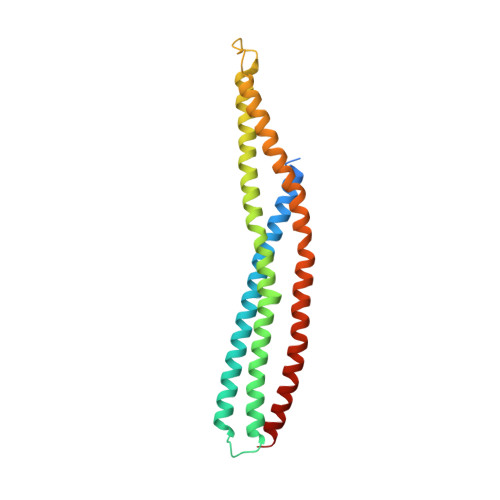
Cell motility, adhesion and phagocytosis are controlled by actin and membrane remodelling processes. Bridging integrator-2 (Bin2) also called Breast cancer-associated protein 1 (BRAP1) is a predicted N-BAR domain containing protein with unknown function that is highly expressed in leucocytic cells. In the present study we solved the structure of Bin2 BAR domain and studied its membrane binding and bending properties in vitro and in vivo. Live-cell imaging experiments showed that Bin2 is associated with actin rich structures on the plasma membrane, where it was targeted through its N-BAR domain. Pull-down experiments and immunoprecipitations showed that Bin2 C-terminus bound SH3 domain containing proteins such as Endophilin A2 and α-PIX. siRNA of endogenous protein led to decreased cell migration, increased phagocytosis and reduced podosome density and dynamics. In contrast, overexpression of Bin2 led to decreased phagocytosis and increased podosome density and dynamics. We conclude that Bin2 is a membrane-sculpting protein that influences podosome formation, motility and phagocytosis in leucocytes. Further understanding of this protein may be key to understand the behaviour of leucocytes under physiological and pathological conditions.
- MRC Laboratory of Molecular Biology, Cambridge, United Kingdom. xmjose@iqfr.csic.es
Organizational Affiliation: