4IO8 | pdb_00004io8

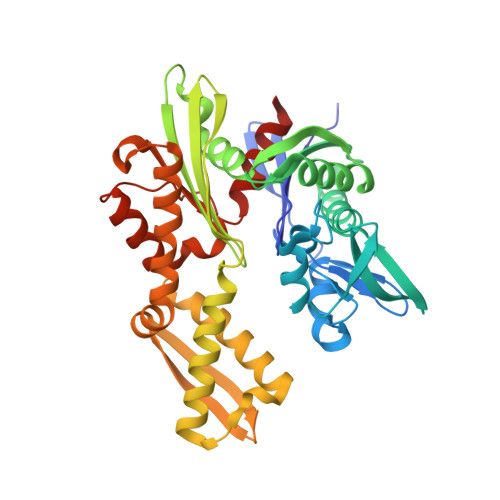
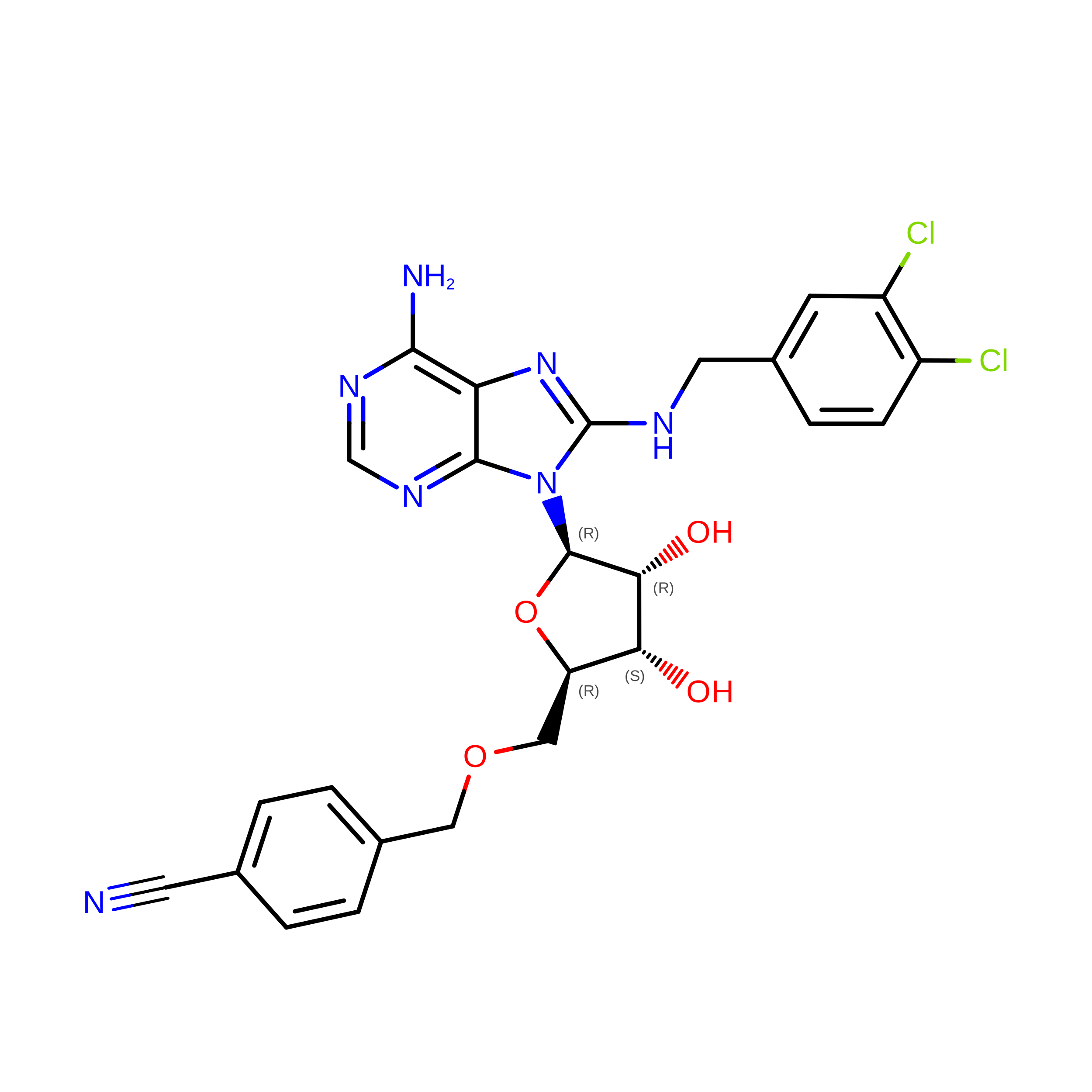
Crystal structure of human HSP70 complexed with 4-{(2R,3S,4R)-5-[(R)-6-Amino-8-(3,4-dichloro-benzylamino)-purin-9-yl]-3,4-dihydroxy-tetrahydro-furan-2-ylmethoxymethyl}-benzonitrile


Experimental Data Snapshot

  • Method: X-RAY DIFFRACTION
  • Resolution: 2.58 Å
  • R-Value Free: 
    0.222 (Depositor), 0.218 (DCC) 
  • R-Value Work: 
    0.169 (Depositor), 0.172 (DCC) 
  • R-Value Observed: 
    0.172 (Depositor) 

Starting Model: experimental
View more details

wwPDB Validation 3D Report Full Report

Validation slider image for 4IO8

Ligand Structure Quality Assessment 


This is version 1.1 of the entry. See complete history

Literature

Functional analysis of hsp70 inhibitors.

Schlecht, R.Scholz, S.R.Dahmen, H.Wegener, A.Sirrenberg, C.Musil, D.Bomke, J.Eggenweiler, H.M.Mayer, M.P.Bukau, B.

(2013) PLoS One 8: e78443-e78443

  • DOI: https://doi.org/10.1371/journal.pone.0078443
  • Primary Citation Related Structures: 
    4IO8

  • PubMed Abstract: 

    The molecular chaperones of the Hsp70 family have been recognized as targets for anti-cancer therapy. Since several paralogs of Hsp70 proteins exist in cytosol, endoplasmic reticulum and mitochondria, we investigated which isoform needs to be down-regulated for reducing viability of cancer cells. For two recently identified small molecule inhibitors, VER-155008 and 2-phenylethynesulfonamide (PES), which are proposed to target different sites in Hsp70s, we analyzed the molecular mode of action in vitro. We found that for significant reduction of viability of cancer cells simultaneous knockdown of heat-inducible Hsp70 (HSPA1) and constitutive Hsc70 (HSPA8) is necessary. The compound VER-155008, which binds to the nucleotide binding site of Hsp70, arrests the nucleotide binding domain (NBD) in a half-open conformation and thereby acts as ATP-competitive inhibitor that prevents allosteric control between NBD and substrate binding domain (SBD). Compound PES interacts with the SBD of Hsp70 in an unspecific, detergent-like fashion, under the conditions tested. None of the two inhibitors investigated was isoform-specific.


  • Organizational Affiliation
    • Zentrum für Molekulare Biologie der Universität Heidelberg (ZMBH), DKFZ-ZMBH-Alliance, Heidelberg, Germany.

Macromolecule Content 

  • Total Structure Weight: 42.63 kDa 
  • Atom Count: 3,085 
  • Modeled Residue Count: 377 
  • Deposited Residue Count: 382 
  • Unique protein chains: 1

Macromolecules

Find similar proteins by:|  3D Structure
Entity ID: 1
MoleculeChains  Sequence LengthOrganismDetailsImage
Heat shock 70kDa protein 1A variant382Homo sapiensMutation(s): 0 
UniProt & NIH Common Fund Data Resources
Find proteins for P0DMV8 (Homo sapiens)
Explore P0DMV8 
Go to UniProtKB:  P0DMV8
PHAROS:  P0DMV8
GTEx:  ENSG00000204389 
Entity Groups
Sequence Clusters30% Identity50% Identity70% Identity90% Identity95% Identity100% Identity
UniProt GroupP0DMV8
Sequence Annotations
Expand
Reference Sequence

Small Molecules

Ligands 1 Unique
IDChains Name / Formula / InChI Key2D Diagram3D Interactions
3FD

Query on 3FD


Download:Ideal Coordinates CCD File
B [auth A]4-[[(2R,3S,4R,5R)-5-[6-amino-8-[(3,4-dichlorophenyl)methylamino]purin-9-yl]-3,4-dihydroxy-oxolan-2-yl]methoxymethyl]benzonitrile
C25 H23 Cl2 N7 O4
ZXGGCBQORXDVTE-UMCMBGNQSA-N

Experimental Data & Validation

Experimental Data

  • Method: X-RAY DIFFRACTION
  • Resolution: 2.58 Å
  • R-Value Free:  0.222 (Depositor), 0.218 (DCC) 
  • R-Value Work:  0.169 (Depositor), 0.172 (DCC) 
  • R-Value Observed: 0.172 (Depositor) 
Space Group: P 1 21 1
Unit Cell:
Length ( Å )Angle ( ˚ )
a = 58.68α = 90
b = 53.973β = 101.07
c = 70.796γ = 90
Software Package:
Software NamePurpose
MOLREPphasing
BUSTERrefinement
XDSdata reduction
XSCALEdata scaling

Structure Validation

View Full Validation Report


Ligand Structure Quality Assessment 


Entry History 

Deposition Data

Revision History  (Full details and data files)

  • Version 1.0: 2013-12-18
    Type: Initial release
  • Version 1.1: 2023-09-20
    Changes: Data collection, Database references, Derived calculations, Refinement description