Download Mendeley
Divergent Sequence Tunes Ligand Sensitivity in Phospholipid-regulated Hormone Receptors.
Musille, P.M., Pathak, M., Lauer, J.L., Griffin, P.R., Ortlund, E.A.(2013) J Biol Chem 288: 20702-20712
- PubMed: 23737522 Search on PubMedSearch on PubMed Central
- DOI: https://doi.org/10.1074/jbc.M113.472837
- Primary Citation Related Structures:
4IS8 - PubMed Abstract:
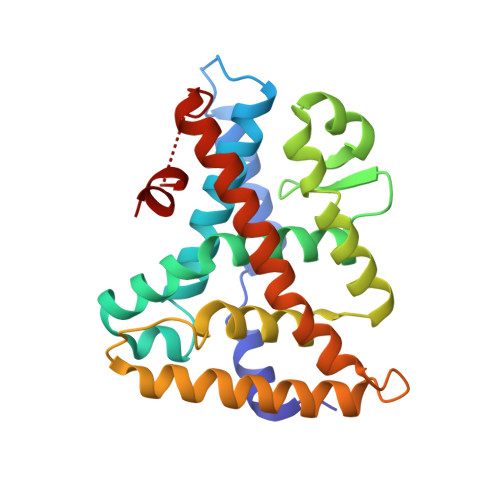
The members of the NR5A subfamily of nuclear receptors (NRs) are important regulators of pluripotency, lipid and glucose homeostasis, and steroidogenesis. Liver receptor homologue 1 (LRH-1; NR5A2) and steroidogenic factor 1 (SF-1; NR5A1) have therapeutic potential for the treatment of metabolic and neoplastic disease; however, a poor understanding of their ligand regulation has hampered the pursuit of these proteins as pharmaceutical targets. In this study, we dissect how sequence variation among LRH-1 orthologs affects phospholipid (PL) binding and regulation. Both human LRH-1 (hLRH-1) and mouse LRH-1 (mLRH-1) respond to newly discovered medium chain PL agonists to modulate lipid and glucose homeostasis. These PLs activate hLRH-1 by altering receptor dynamics in a newly identified alternate activation function region. Mouse and Drosophila orthologs contain divergent sequences in this region potentially altering PL-driven activation. Structural evidence suggests that these sequence differences in mLRH-1 and Drosophila FTZ-f1 (dmFTZ-f1) confer at least partial ligand independence, making them poor models for hLRH-1 studies; however, the mechanisms of ligand independence remain untested. We show using structural and biochemical methods that the recent evolutionary divergence of the mLRH-1 stabilizes the active conformation in the absence of ligand, yet does not abrogate PL-dependent activation. We also show by mass spectrometry and biochemical assays that FTZ-f1 is incapable of PL binding. This work provides a structural mechanism for the differential tuning of PL sensitivity in NR5A orthologs and supports the use of mice as viable therapeutic models for LRH-1-dependent diseases.
- Department of Biochemistry, Emory University School of Medicine, Atlanta, Georgia 30322, USA.
Organizational Affiliation: