4L5R | pdb_00004l5r

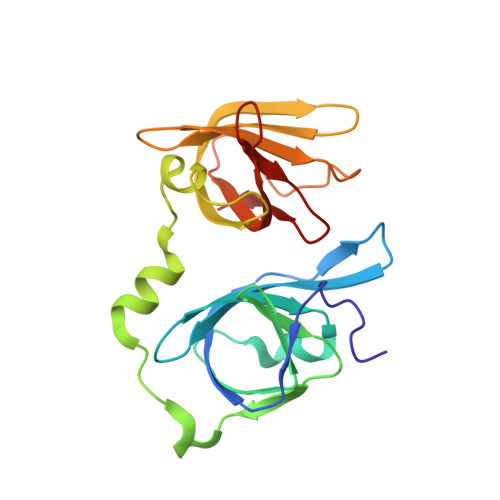
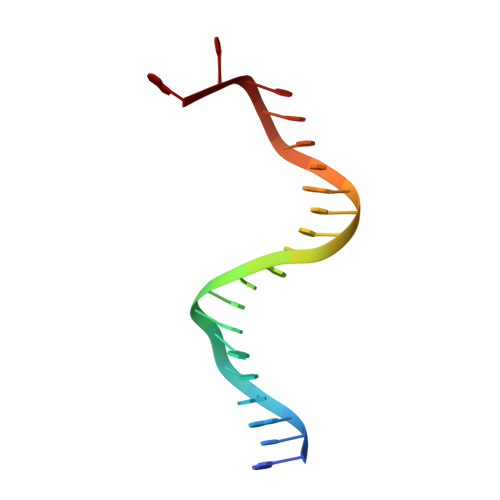
Crystal structure of p202 HIN1 in complex with 20-mer dsDNA


Experimental Data Snapshot

  • Method: X-RAY DIFFRACTION
  • Resolution: 1.87 Å
  • R-Value Free: 
    0.228 (Depositor), 0.219 (DCC) 
  • R-Value Work: 
    0.191 (Depositor), 0.184 (DCC) 
  • R-Value Observed: 
    0.193 (Depositor) 

wwPDB Validation 3D Report Full Report

Validation slider image for 4L5R

This is version 1.2 of the entry. See complete history

Literature

Molecular Mechanism for p202-Mediated Specific Inhibition of AIM2 Inflammasome Activation.

Yin, Q.Sester, D.P.Tian, Y.Hsiao, Y.S.Lu, A.Cridland, J.A.Sagulenko, V.Thygesen, S.J.Choubey, D.Hornung, V.Walz, T.Stacey, K.J.Wu, H.

(2013) Cell Rep 4: 327-339

  • DOI: https://doi.org/10.1016/j.celrep.2013.06.024
  • Primary Citation Related Structures: 
    4L5Q, 4L5R, 4L5S, 4L5T

  • PubMed Abstract: 

    Mouse p202 containing two hemopoietic expression, interferon inducibility, nuclear localization (HIN) domains antagonizes AIM2 inflammasome signaling and potentially modifies lupus susceptibility. We found that only HIN1 of p202 binds double-stranded DNA (dsDNA), while HIN2 forms a homotetramer. Crystal structures of HIN1 revealed that dsDNA is bound on face opposite the site used in AIM2 and IFI16. The structure of HIN2 revealed a dimer of dimers, the face analogous to the HIN1 dsDNA binding site being a dimerization interface. Electron microscopy imaging showed that HIN1 is flexibly linked to HIN2 in p202, and tetramerization provided enhanced avidity for dsDNA. Surprisingly, HIN2 of p202 interacts with the AIM HIN domain. We propose that this results in a spatial separation of the AIM2 pyrin domains, and indeed p202 prevented the dsDNA-dependent clustering of apoptosis-associated speck-like protein containing caspase recruitment domain (ASC) and AIM2 inflammasome activation. We hypothesize that while p202 was evolutionarily selected to limit AIM2-mediated inflammation in some mouse strains, the same mechanism contributes to increased interferon production and lupus susceptibility.


  • Organizational Affiliation
    • Program in Cellular and Molecular Medicine, Boston Children's Hospital, and Department of Biological Chemistry and Molecular Pharmacology, Harvard Medical School, Boston, MA 02115, USA.

Macromolecule Content 

  • Total Structure Weight: 35.03 kDa 
  • Atom Count: 2,585 
  • Modeled Residue Count: 238 
  • Deposited Residue Count: 238 
  • Unique protein chains: 1
  • Unique nucleic acid chains: 1

Macromolecules


Find similar proteins by:|  3D Structure
Entity ID: 1
MoleculeChains  Sequence LengthOrganismDetailsImage
Interferon-activable protein 202A [auth C]198Mus musculusMutation(s): 5 
Gene Names: Ifi202Ifi202aIfi202b
UniProt
Find proteins for Q9R002 (Mus musculus)
Explore Q9R002 
Go to UniProtKB:  Q9R002
Entity Groups
Sequence Clusters30% Identity50% Identity70% Identity90% Identity95% Identity100% Identity
UniProt GroupQ9R002
Sequence Annotations
Expand
Reference Sequence
Find similar nucleic acids by:  Sequence
Entity ID: 2
MoleculeChains LengthOrganismImage
20-mer DNAB [auth A],
C [auth B]
20N/A
Sequence Annotations
Expand
Reference Sequence

Small Molecules

Ligands 1 Unique
IDChains Name / Formula / InChI Key2D Diagram3D Interactions
NA

Query on NA


Download:Ideal Coordinates CCD File
D [auth C]SODIUM ION
Na
FKNQFGJONOIPTF-UHFFFAOYSA-N

Experimental Data & Validation

Experimental Data

  • Method: X-RAY DIFFRACTION
  • Resolution: 1.87 Å
  • R-Value Free:  0.228 (Depositor), 0.219 (DCC) 
  • R-Value Work:  0.191 (Depositor), 0.184 (DCC) 
  • R-Value Observed: 0.193 (Depositor) 
Space Group: P 1 21 1
Unit Cell:
Length ( Å )Angle ( ˚ )
a = 46.347α = 90
b = 86.424β = 113.34
c = 51.412γ = 90
Software Package:
Software NamePurpose
ADSCdata collection
PHASESphasing
PHENIXrefinement
HKL-2000data reduction
HKL-2000data scaling

Structure Validation

View Full Validation Report


Entry History 

Deposition Data

Revision History  (Full details and data files)

  • Version 1.0: 2013-07-31
    Type: Initial release
  • Version 1.1: 2013-08-21
    Changes: Database references
  • Version 1.2: 2024-02-28
    Changes: Data collection, Database references, Derived calculations