4LGH | pdb_00004lgh

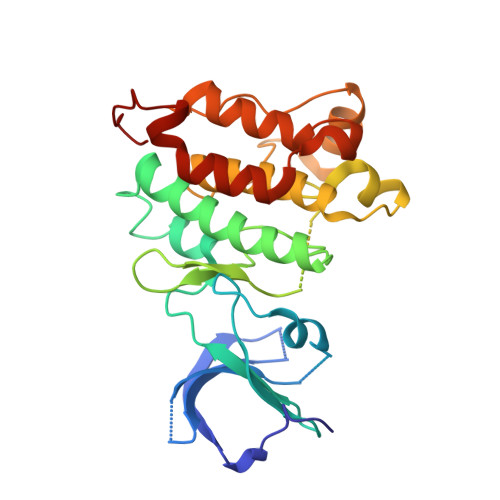
Crystal structure of 1NM-PP1 bound to analog-sensitive Src kinase


Experimental Data Snapshot

  • Method: X-RAY DIFFRACTION
  • Resolution: 2.84 Å
  • R-Value Free: 
    0.272 (Depositor), 0.270 (DCC) 
  • R-Value Work: 
    0.213 (Depositor), 0.213 (DCC) 
  • R-Value Observed: 
    0.216 (Depositor) 

Starting Model: experimental
View more details

wwPDB Validation 3D Report Full Report

Validation slider image for 4LGH

Ligand Structure Quality Assessment 


This is version 1.3 of the entry. See complete history

Literature

Structure-guided inhibitor design expands the scope of analog-sensitive kinase technology.

Zhang, C.Lopez, M.S.Dar, A.C.Ladow, E.Finkbeiner, S.Yun, C.H.Eck, M.J.Shokat, K.M.

(2013) ACS Chem Biol 8: 1931-1938

  • DOI: https://doi.org/10.1021/cb400376p
  • Primary Citation Related Structures: 
    4LGG, 4LGH

  • PubMed Abstract: 

    Engineered analog-sensitive (AS) protein kinases have emerged as powerful tools for dissecting phospho-signaling pathways, for elucidating the cellular function of individual kinases, and for deciphering unanticipated effects of clinical therapeutics. A crucial and necessary feature of this technology is a bioorthogonal small molecule that is innocuous toward native cellular systems but potently inhibits the engineered kinase. In order to generalize this method, we sought a molecule capable of targeting divergent AS-kinases. Here we employ X-ray crystallography and medicinal chemistry to unravel the mechanism of current inhibitors and use these insights to design the most potent, selective, and general AS-kinase inhibitors reported to date. We use large-scale kinase inhibitor profiling to characterize the selectivity of these molecules as well as examine the consequences of potential off-target effects in chemical genetic experiments. The molecules reported here will serve as powerful tools in efforts to extend AS-kinase technology to the entire kinome and the principles discovered may help in the design of other engineered enzyme/ligand pairs.


  • Organizational Affiliation
    • Howard Hughes Medical Institute and Department of Cellular & Molecular Pharmacology, University of California, San Francisco , San Francisco, California 94158, United States.

Macromolecule Content 

  • Total Structure Weight: 64.18 kDa 
  • Atom Count: 3,962 
  • Modeled Residue Count: 490 
  • Deposited Residue Count: 554 
  • Unique protein chains: 1

Macromolecules

Find similar proteins by:|  3D Structure
Entity ID: 1
MoleculeChains  Sequence LengthOrganismDetailsImage
Proto-oncogene tyrosine-protein kinase Src
A, B
277Gallus gallusMutation(s): 1 
Gene Names: SRC
EC: 2.7.10.2
UniProt
Find proteins for P00523 (Gallus gallus)
Explore P00523 
Go to UniProtKB:  P00523
Entity Groups
Sequence Clusters30% Identity50% Identity70% Identity90% Identity95% Identity100% Identity
UniProt GroupP00523
Sequence Annotations
Expand
Reference Sequence

Small Molecules

Ligands 1 Unique
IDChains Name / Formula / InChI Key2D Diagram3D Interactions
0JN

Query on 0JN


Download:Ideal Coordinates CCD File
C [auth A],
D [auth B]
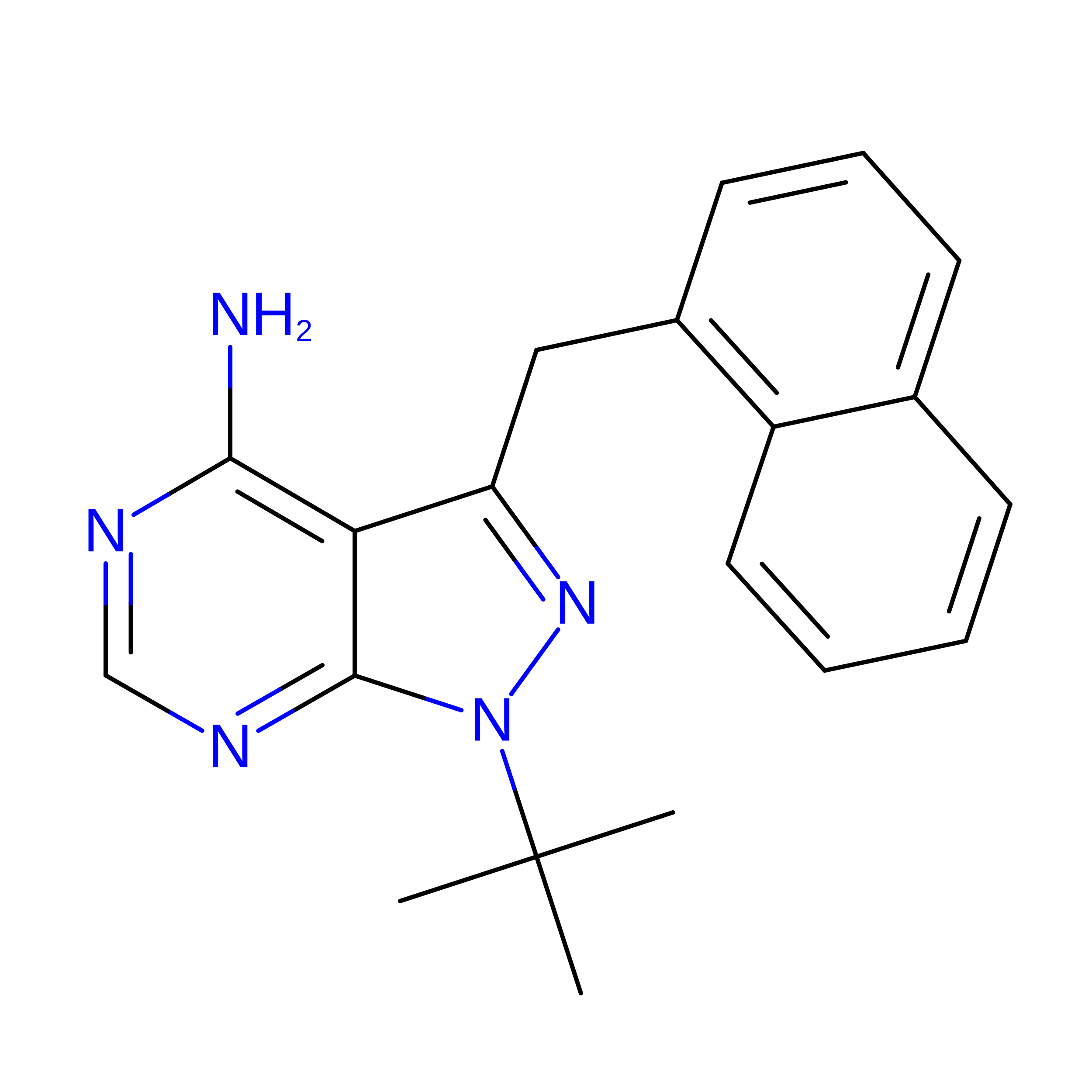
1-tert-butyl-3-(naphthalen-1-ylmethyl)-1H-pyrazolo[3,4-d]pyrimidin-4-amine
C20 H21 N5
GDQXJQSQYMMKRA-UHFFFAOYSA-N
Binding Affinity Annotations 
IDSourceBinding Affinity
0JN BindingDB:  4LGH IC50: min: 620, max: 2200 (nM) from 2 assay(s)

Experimental Data & Validation

Experimental Data

  • Method: X-RAY DIFFRACTION
  • Resolution: 2.84 Å
  • R-Value Free:  0.272 (Depositor), 0.270 (DCC) 
  • R-Value Work:  0.213 (Depositor), 0.213 (DCC) 
  • R-Value Observed: 0.216 (Depositor) 
Space Group: P 1
Unit Cell:
Length ( Å )Angle ( ˚ )
a = 42.264α = 100.38
b = 62.654β = 91.01
c = 74.325γ = 90.07
Software Package:
Software NamePurpose
DENZOdata reduction
SCALEPACKdata scaling
PHASERphasing
PHENIXrefinement
PDB_EXTRACTdata extraction
HKL-2000data collection

Structure Validation

View Full Validation Report


Ligand Structure Quality Assessment 


Entry History 

Deposition Data

Revision History  (Full details and data files)

  • Version 1.0: 2013-08-07
    Type: Initial release
  • Version 1.1: 2013-10-09
    Changes: Database references
  • Version 1.2: 2017-11-15
    Changes: Refinement description
  • Version 1.3: 2023-09-20
    Changes: Data collection, Database references, Derived calculations, Refinement description